


C-SPACE (cleavage-specific amplification of cDNA ends): a novel method of ribozyme-mediated gene identification
- PMID: 11574696
- PMCID: PMC60254
- DOI: 10.1093/nar/29.19.e94
C-SPACE (cleavage-specific amplification of cDNA ends): a novel method of ribozyme-mediated gene identification
Abstract
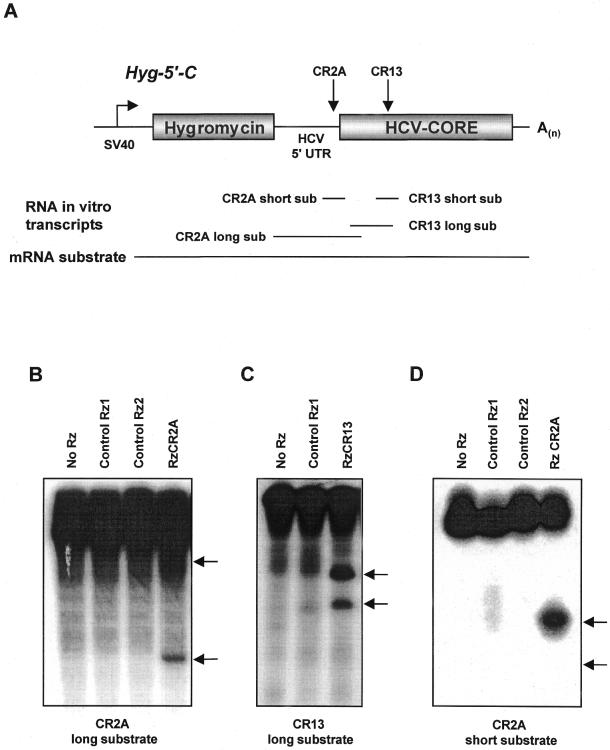
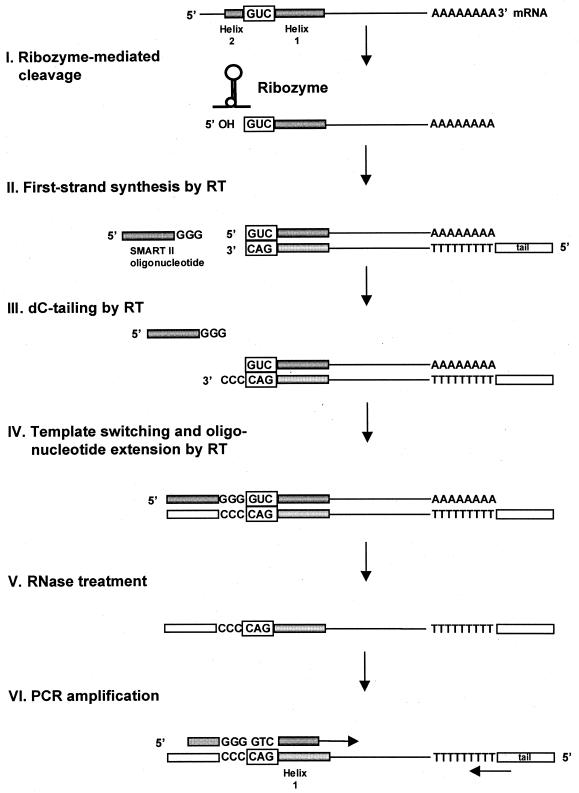
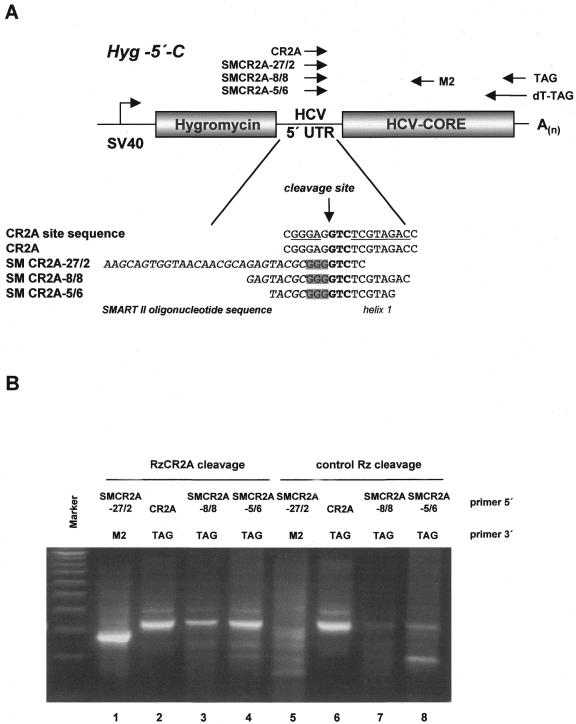
A hairpin ribozyme, RzCR2A, directed against position 323 of the hepatitis C virus 5'-untranslated region (HCV 5'-UTR) was used to establish and validate a novel method for the detection of cellular target molecules for hairpin ribozymes, termed C-SPACE (cleavage-specific amplification of cDNA ends). For C-SPACE, HeLa mRNA containing the transcript of interest was subjected to in vitro cleavage by RzCR2A in parallel with a control ribozyme, followed by reverse transcription using a modified SMART cDNA amplification method and cleavage-specific PCR analysis. C-SPACE allowed identification of the RzCR2A target transcript from a mixture containing the entire cellular mRNA while only requiring knowledge of the ribozyme binding sequence for amplification. In a similar approach, C-SPACE was used successfully to identify human 20S proteasome alpha-subunit PSMA7 mRNA as the cellular target RNA of Rz3'X, a ribozyme originally designed to cleave the negative strand HCV 3'-UTR. Rz3'X was found to substantially inhibit HCV internal ribosome entry site (IRES) activity and PSMA7 was subsequently confirmed to be involved in HCV IRES-mediated translation. Thereby, C-SPACE was validated as a powerful tool to rapidly identify unknown target RNAs recognized and cleaved by hairpin ribozymes.
Figures
References
-
- Muotri A.R., da Veiga Pereira,L., dos Reis Vasques,L. and Menck,C.F. (1999) Ribozymes and the anti-gene therapy: how a catalytic RNA can be used to inhibit gene function. Gene, 237, 303–310. - PubMed
-
- Beger C., Krüger,M. and Wong-Staal,F. (1998) Ribozymes in cancer gene therapy. In Lattime,E.C. and Gerson,S.L. (eds), Gene Therapy of Cancer. Academic Press, San Diego, CA, pp. 139–152.
-
- James H.A. (1999) The potential application of ribozymes for the treatment of hematological disorders. J. Leukoc. Biol., 66, 361–368. - PubMed
-
- Welch P.J., Barber,J.R. and Wong-Staal,F. (1998) Expression of ribozymes in gene transfer systems to modulate target RNA levels. Curr. Opin. Biotechnol., 9, 486–496. - PubMed
-
- Folini M., Colella,G., Villa,R., Lualdi,S., Daidone,M.G. and Zaffaroni,N. (2000) Inhibition of telomerase activity by a hammerhead ribozyme targeting the RNA component of telomerase in human melanoma cells. J. Invest. Dermatol., 114, 259–267. - PubMed
Publication types
MeSH terms
Substances
LinkOut - more resources
Full Text Sources
Molecular Biology Databases
Miscellaneous
