


Protective effects of lactic acid on force production in rat skeletal muscle
- PMID: 11579166
- PMCID: PMC2278832
- DOI: 10.1111/j.1469-7793.2001.t01-1-00161.x
Protective effects of lactic acid on force production in rat skeletal muscle
Abstract
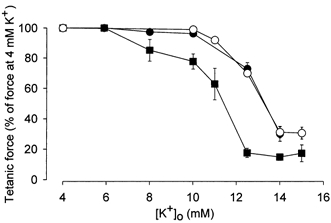
1. During strenuous exercise lactic acid accumulates producing a reduction in muscle pH. In addition, exercise causes a loss of muscle K(+) leading to an increased concentration of extracellular K(+) ([K(+)](o)). Individually, reduced pH and increased [K(+)](o) have both been suggested to contribute to muscle fatigue. 2. To study the combined effect of these changes on muscle function, isolated rat soleus muscles were incubated at a [K(+)](o) of 11 mM, which reduced tetanic force by 75 %. Subsequent addition of 20 mM lactic acid led, however, to an almost complete force recovery. A similar recovery was observed if pH was reduced by adding propionic acid or increasing the CO(2) tension. 3. The recovery of force was associated with a recovery of muscle excitability as assessed from compound action potentials. In contrast, acidification had no effect on the membrane potential or the Ca(2+) handling of the muscles. 4. It is concluded that acidification counteracts the depressing effects of elevated [K(+)](o) on muscle excitability and force. Since intense exercise is associated with increased [K(+)](o), this indicates that, in contrast to the often suggested role for acidosis as a cause of muscle fatigue, acidosis may protect against fatigue. Moreover, it suggests that elevated [K(+)](o) is of less importance for fatigue than indicated by previous studies on isolated muscles.
Figures
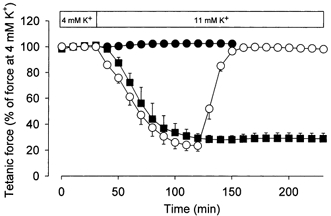
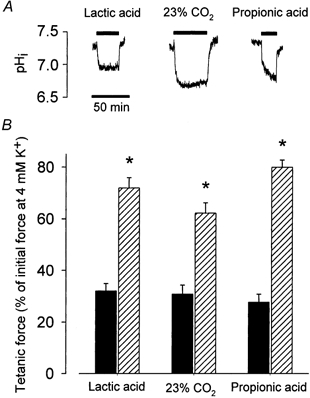
 ). Muscles were stimulated tetanically every 10 min using 30 Hz pulse trains of 2 s duration and a pulse duration of 1 ms. Data show means and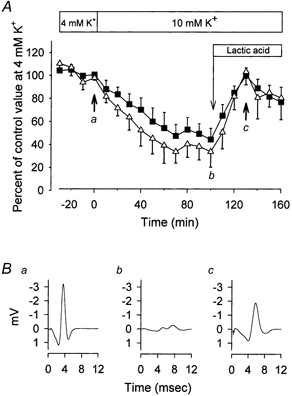
References
-
- Andersen SL, Clausen T. Calcitonin gene-related peptide stimulates active Na+-K+ transport in rat soleus muscle. American Journal of Physiology. 1993;264:C419–429. - PubMed
-
- Bouclin R, Charbonneau E, Renaud JM. Na+ and K+ effect on contractility of frog sartorius muscle: implication for the mechanism of fatigue. American Journal of Physiology. 1995;268:C1528–1536. - PubMed
-
- Bruton JD, Lannergren J, Westerblad H. Effects of CO2-induced acidification on the fatigue resistance of single mouse muscle fibers at 28 degrees C. Journal of Applied Physiology. 1998;85:478–483. - PubMed
-
- Cairns SP, Flatman JA, Clausen T. Relation between extracellular [K+], membrane potential and contraction in rat soleus muscle: modulation by the Na+-K+ pump. Pflügers Archiv. 1995;430:909–915. - PubMed
-
- Cairns SP, Hing WA, Slack JR, Mills RG, Loiselle DS. Different effects of raised [K+]o on membrane potential and contraction in mouse fast- and slow-twitch muscle. American Journal of Physiology. 1997;273:C598–611. - PubMed
Publication types
MeSH terms
Substances
LinkOut - more resources
Full Text Sources
Miscellaneous
