. 2001 Oct;108(7):1051-9.
doi: 10.1172/JCI12467.

Mechanical stimulation activates Galphaq signaling pathways and 5-hydroxytryptamine release from human carcinoid BON cells

Affiliations

Mechanical stimulation activates Galphaq signaling pathways and 5-hydroxytryptamine release from human carcinoid BON cells

M Kim et al. J Clin Invest. 2001 Oct.

Abstract

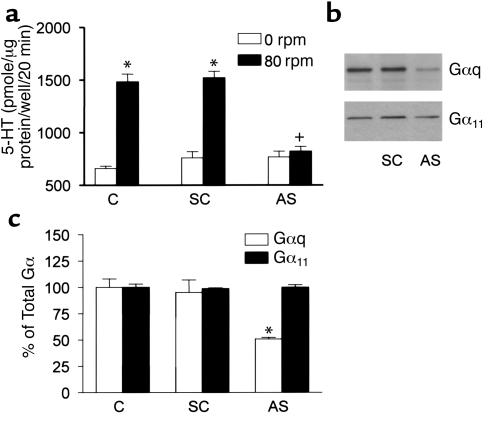
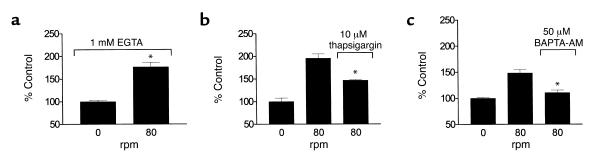
5-Hydroxytryptamine (5-HT) released from enterochromaffin cells activates secretory and peristaltic reflexes necessary for lubrication and propulsion of intestinal luminal contents. The aim of this study was to identify mechanosensitive intracellular signaling pathways that regulate 5-HT release. Human carcinoid BON cells displayed 5-HT immunoreactivity associated with granules dispersed throughout the cells or at the borders. Mechanical stimulation by rotational shaking released 5-HT from BON cells or from guinea pig jejunum during neural blockade with tetrodotoxin. In streptolysin O-permeabilized cells, guanosine 5'-O- (2-thiodiphosphate) (GDP-beta-S) and a synthetic peptide derived from the COOH terminus of Galphaq abolished mechanically evoked 5-HT release, while the NH(2)-terminal peptide did not. An antisense phosphorothioated oligonucleotide targeted to a unique sequence of Galphaq abolished mechanically evoked 5-HT release and reduced Galphaq protein levels without affecting the expression of Galpha(11). Depletion and chelation of extracellular calcium did not alter mechanically evoked 5-HT release, whereas depletion of intracellular calcium stores by thapsigargin and chelation of intracellular calcium by 1,2-bis (o-Aminophenoxy) ethane-N,N,N',N'-tetraacetic acid tetra (acetoxymethyl) ester (BAPTA-AM) reduced 5-HT release. Mechanically evoked 5-HT release was inhibited by somatostatin-14 in a concentration-dependent manner. The results suggest that mechanical stimulation of enterochromaffin-derived BON cells directly or indirectly stimulates a G protein-coupled receptor that activates Galphaq, mobilizes intracellular calcium, and causes 5-HT release.


Figures
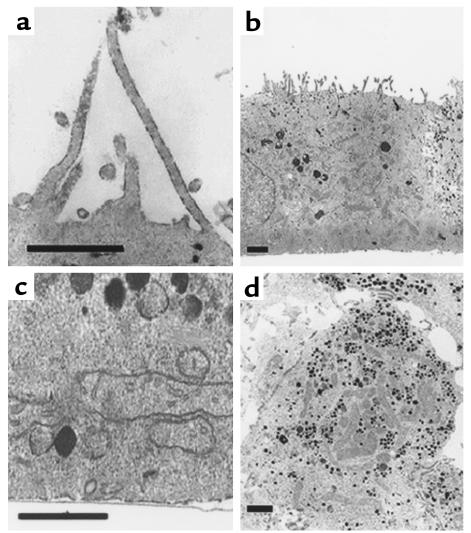
Figure 1
Figure 1
Transmission electron micrographs of BON cells. Sections (80 nm) were examined with a Philips CM 12 transmission electron microscope at 60 kV. (a and b) Electron micrographs showing microvilli with varying shapes and sizes on the plasma membrane of BON cells. Note abundance of granules adjacent to microvilli (b). (c) Bottom surface has no microvilli-like protrusions. (d) The cytoplasm is rich in secretory granules. Scale bar, 1 μm. ×7,500 (b); ×12,500 (d); ×70,000 (a and c).
Figure 2
Figure 2
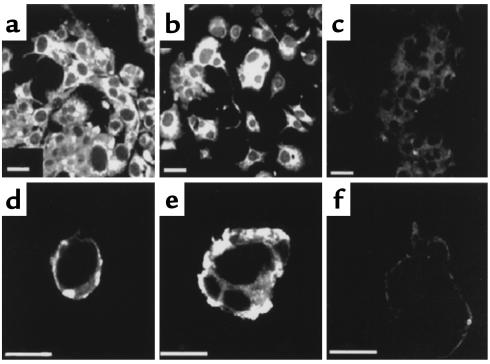
5-HT immunoreactivity in BON cells. (a, b, d, and e) 5-HT immunoreactivity, indicated by white, was detected in most BON cells. (c and f) Preadsorption with 0.5 mM 5-HT abolished any positive reaction. Optical slices were 0.5–1.5 μm thick. (ac) Bars, 40 μm; (df) bars, 20 μm.
Figure 3
Figure 3
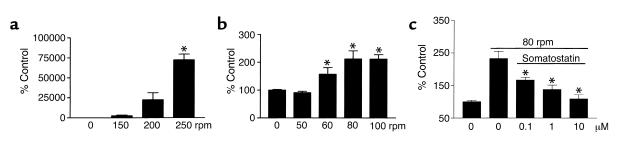
Effect of mechanical stimulation on 5-HT release from guinea pig small intestine (a) and human BON cells without (b) and with somatostatin-14 (c). Tissues and cells were maintained in a static condition (0 rpm; control) or exposed to mechanical stimulation ranging from 50 to 100 or 150 to 250 rpm for 20 minutes at 37°C. Values represent 5-HT release relative to controls in picomoles per well per 20 minutes. (b) Cells 0.8 ± 0.08. (c) Cells 1.3 ± 0.1. (a) Tissue 9.8 ± 4. Increasing rpm resulted in rpm-dependent increase in 5-HT release (n = 32, 0 rpm; n = 4, 50 rpm; n = 10, 60 rpm; n = 6, 80 rpm; n = 16, 100 rpm). *P < 0.05 versus 0 rpm.
Figure 4
Figure 4
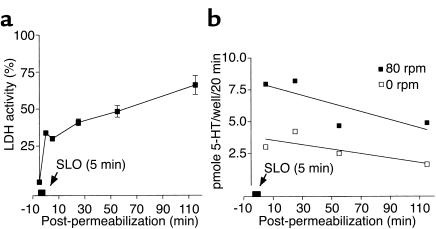
Effects of SLO on LDH activity and 5-HT release. BON cells were permeabilized by 20 U/ml SLO for 5 minutes at 37°C in permeabilizing buffer. After permeabilization, SLO was washed out, and BON cells were incubated at 37°C for different time periods from 5 minutes to 115 minutes. (a) Buffers were collected after each time period and the amount of LDH activity was measured. Values represent percentage of total LDH activity (n = 3). (b) After incubations, BON cells were stimulated with/without rotational shaking (80 rpm) and 5-HT release was measured after the stimulation (20 minutes). Values represent concentrations of 5-HT in wells. Linear regression analysis of 5-HT release showed that the slopes were not significantly different (–0.018 ± 0.0050 and –0.032 ± 0.0098; P = 0.21) under static or stimulated conditions (80 rpm; n = 3).
Figure 5
Figure 5
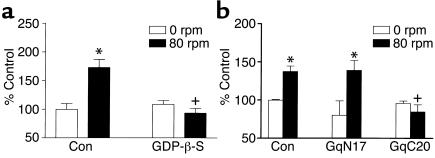
(a) SLO-permeabilized BON cells. Cells were permeabilized by 20 U/ml SLO for 5 minutes in permeabilizing buffer and preincubated with 200 μM of GDP-β-S for 5 minutes before stimulation (shaking at 80 rpm): 0 rpm, 2.9 ± 0.4 pmol/well/20 min; 0 rpm + GDP-β-S, 3.1 ± 0.3 pmol/well/20 min. *P < 0.05 versus permeabilized static control, +P < 0.05 versus shaking at 80 rpm of permeabilized cells (n = 9). (b) BON cells were permeabilized by 20 U/ml SLO for 5 minutes in permeabilizing buffer and preincubated with 25 μg/ml of NH2-terminal peptide (GqN17) or COOH-terminal peptide (GqC20) for 5 minutes before mechanical stimulation at 80 rpm. Experiments were performed in the presence of 1× protease inhibitor cocktail. 5-HT release in pmol/well/20 min was 0 rpm, control: 2.2 ± 0.02; GqN17: 1.8 ± 0.4; GqC20: 2.1 ± 0.07. *P < 0.05 versus permeabilized static control, +P < 0.05 versus shaking at 80 rpm of permeabilized cells (n = 3).
Figure 6
Figure 6
Selective suppression of Gαq protein with antisense oligonucleotide. (a) BON cells were untreated (C) or treated with 1 μM of antisense (AS) or scrambled (SC) phosphorothioated oligonucleotide for 6 days. 5-HT release was measured after stimulation (filled bar; shaking at 80 rpm for 20 minutes) or from static controls (open bar). 5-HT release in pmol/μg protein/well/20 min at 0 rpm: C, 0.7 ± 0.02; SC, 0.8 ± 0.06; AS, 0.8 ± 0.06. *P < 0.0001 versus 0 rpm, +P > 0.05 versus 0 rpm: n = 4, 0 rpm, C, SC, and AS; n = 6, 80 rpm, AS; n = 7, 80 rpm, SC; n = 10, 80 rpm, C. (b) Membrane extracts (29 μg of protein) from each group were separated by 10% SDS gel electrophoresis and then analyzed for the expression levels of Gαq protein using specific polyclonal Ab’s against Gαq. After exposure of the immunoblot to film, the membrane was stripped of the anti-Gαq primary-secondary Ab complexes with 0.2 M NaOH for 5 minutes and reprobed with specific polyclonal Ab’s against Gα11. The first lane is control; the second and third lanes are SC and AS, respectively. (c) The density of visualized bands was analyzed and expressed as percentage of untreated control. *P < 0.05 versus control (n = 3).
Figure 7
Figure 7
Effects of chelating or depleting extracellular and intracellular Ca2+ on mechanically evoked 5-HT release. (a) For extracellular Ca2+ free conditions, experiments were performed in Ca2-free EBBS containing 1 mM EGTA. Mechanical stimulation was shaking at 80 rpm. *P < 0.05 versus static controls (0 rpm; n = 6). (b) Pretreated with 10 μM thapsigargin for 30 minutes. *P < 0.05 versus shaking of untreated cells at 80 rpm (n = 3). (c) Pretreated with 50 μM BAPTA-AM for 1 hour. *P < 0.05 versus shaking of untreated cells at 80 rpm (n = 6). Controls at 0 rpm are (a) 0.9 ± 0.1 pmol/well/20 min; (b) 1.2 ± 0.09 pmol/well/20 min; (c) 0.9 ± 0.3 pmol/well/20 min.

References

    1. Kellow JE, Phillips SF. Altered small bowel motility in irritable bowel syndrome is correlated with symptoms. Gastroenterology. 1987;92:1885–1893. - PubMed
    1. Mayer EA. Emerging disease model for functional gastrointestinal disorders. Am J Med. 1999;107:12S–19S. - PubMed
    1. Tobe T, Kimura C, Fujiwara M. Role of 5-hydroxytryptamine in the dumping syndrome after gastrectomy: histochemical study. Ann Surg. 1967;165:382–387. - PMC - PubMed
    1. Halford S, Waxman J. The management of carcinoid tumours. QJM. 1998;91:795–798. - PubMed
    1. Platt AJ, Heddle RM, Rake MO, Smedley H. Ondansetron in carcinoid syndrome. Lancet. 1992;339:1416. - PubMed

Publication types