. 2001 Oct;159(4):1383-95.
doi: 10.1016/S0002-9440(10)62525-4.

Direct thrombin inhibition reduces lung collagen, accumulation, and connective tissue growth factor mRNA levels in bleomycin-induced pulmonary fibrosis

Affiliations

Direct thrombin inhibition reduces lung collagen, accumulation, and connective tissue growth factor mRNA levels in bleomycin-induced pulmonary fibrosis

D C Howell et al. Am J Pathol. 2001 Oct.

Abstract

Dramatic activation of the coagulation cascade has been extensively documented for pulmonary fibrosis associated with acute and chronic lung injury. In addition to its role in hemostasis, thrombin exerts profibrotic effects via activation of the major thrombin receptor, protease-activated receptor-1. In this study, we examined the effect of the direct thrombin inhibitor, UK-156406 on fibroblast responses in vitro and on bleomycin-induced pulmonary fibrosis in rats. UK-156406 significantly inhibited thrombin-induced fibroblast proliferation, procollagen production, and connective tissue growth factor (CTGF) mRNA levels when used at equimolar concentration to the protease. Thrombin levels in bronchoalveolar lavage fluid and expression of thrombin and protease-activated receptor-1 in lung tissue were increased after intratracheal instillation of bleomycin. The characteristic doubling in lung collagen in bleomycin-treated animals (38.4 +/- 2.0 mg versus 17.1 +/- 1.4 mg, P < 0.01) was preceded by significant elevations in alpha1(I) procollagen and CTGF mRNA levels (3.0 +/- 0.4-fold and 6.3 +/- 0.4-fold respectively, (P < 0.01), and total inflammatory cell number. UK-156406, administered at an anticoagulant dose, attenuated lung collagen accumulation in response to bleomycin by 35 +/- 12% (P < 0.05), inhibited alpha1(I) procollagen and CTGF mRNA levels by 50% and 35%, respectively (P < 0.05), but had no effect on inflammatory cell recruitment. This is the first report showing that direct thrombin inhibition abrogates lung collagen accumulation in bleomycin-induced pulmonary fibrosis.


Figures
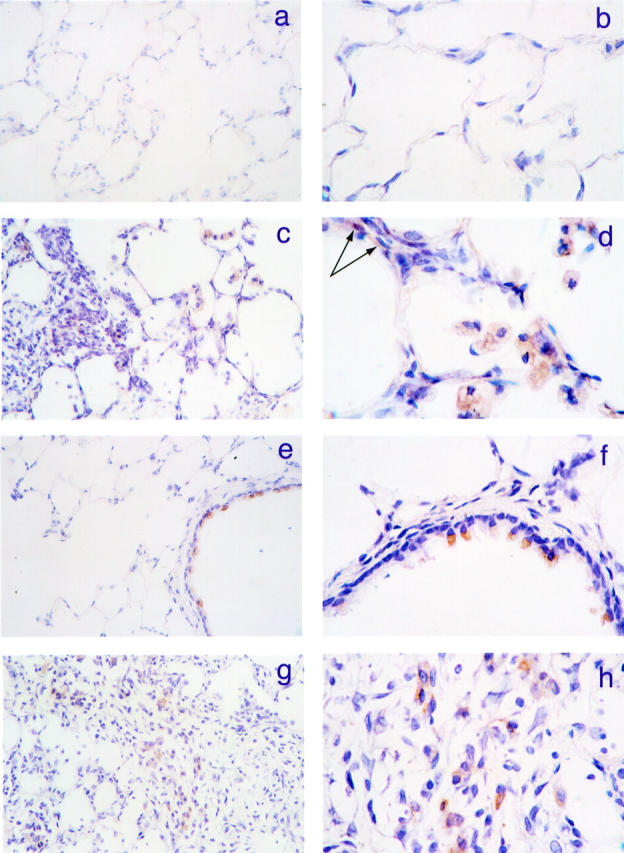
Figure 1.
Figure 1.
Thrombin and PAR-1 expression is increased in bleomycin-induced pulmonary fibrosis. a and b: A section of rat lung, 6 days after intratracheal instillation of saline. There is only weak staining for active thrombin on resident macrophages. c and d: A corresponding lung section, after intratracheal instillation of bleomycin. There is extensive staining for active thrombin, which is predominantly associated with macrophages in inflammatory and fibroproliferative foci, but is also localized to fibroblast-like interstitial cells (arrows in d). e and f: The immunohistochemical localization of PAR-1, 6 days after intratracheal saline instillation. PAR-1 was consistently expressed on the bronchial epithelium but the lung parenchyma was negative. g and h: A corresponding lung section from a bleomycin-treated animal at the same time point. The expression of PAR-1 was dramatically increased in the lung parenchyma of these animals and was again predominantly associated with macrophages in inflammatory and fibroproliferative foci. Original magnifications: panels a, c, e, and g ×400, panels b, d, f, and h ×1000; counterstained with Mayers hematoxylin.
Figure 2.
Figure 2.
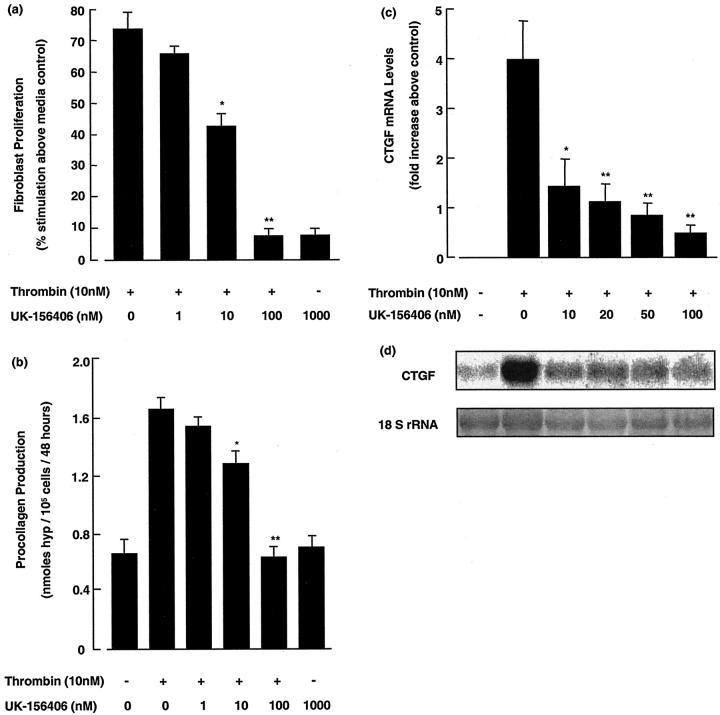
UK-156406 blocks thrombin-induced fibroblast proliferation, procollagen production, and CTGF mRNA levels in vitro. a and b: The effect of UK-156406 on thrombin-induced fibroblast proliferation and procollagen production at the end of a 48-hour incubation period. For fibroproliferation and procollagen assays, data are expressed as mean ± SEM of six replicates from a representative experiment (n = 3). For comparison, optimal serum (10% NCS) stimulated fibroblast proliferation by 344 ± 2%. Procollagen production is based on hydroxyproline measured in the media and cell layer and values are corrected for hydroxyproline associated with the cell layer at the onset of the experiment and expressed as nmol hydroxyproline/10 cells/48 hours. c: A graph of the mean fold increases in CTGF mRNA levels at 90 minutes, normalized for RNA loading based on densitometric quantitation of rRNA, greater than control levels for four replicate cultures. d: A phosphorimage of a representative Northern blot of the 2.4-kb CTGF transcript and a laser scan of the corresponding ethidium bromide-stained 18 S rRNA bands. The P values denote the statistical significance of the indicated data compared to cells treated with thrombin alone (10 nmol/L): *, P < 0.05; **, P < 0.01. The data shown is representative of three separate experiments performed.
Figure 3.
Figure 3.
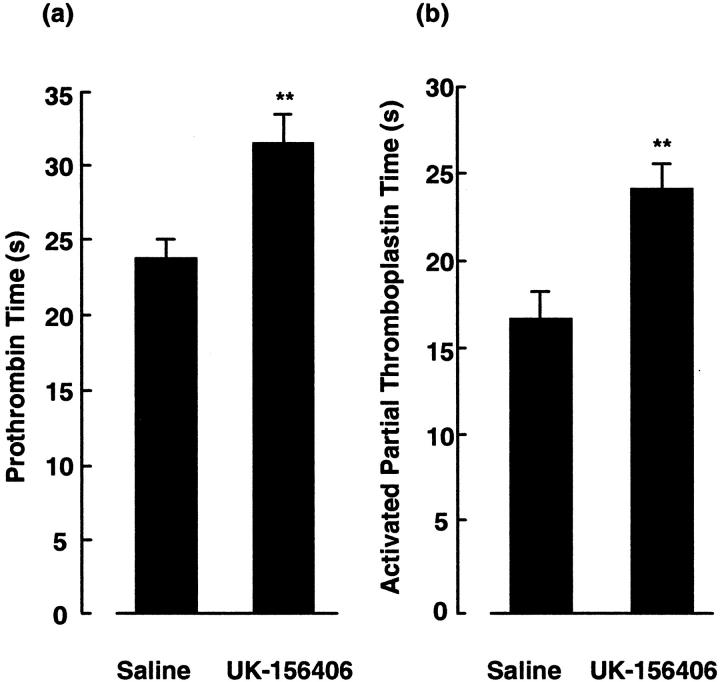
UK-156406 prolongs rat blood coagulation parameters. Figure ▶ shows the effect of a continuous subcutaneous infusion of UK-156406 on the mean plasma PT and APTT (a and b), respectively. The P values denote the significance of the indicated data compared to animals treated with a continuous infusion of saline: **, P < 0.01; n = 6.
Figure 4.
Figure 4.
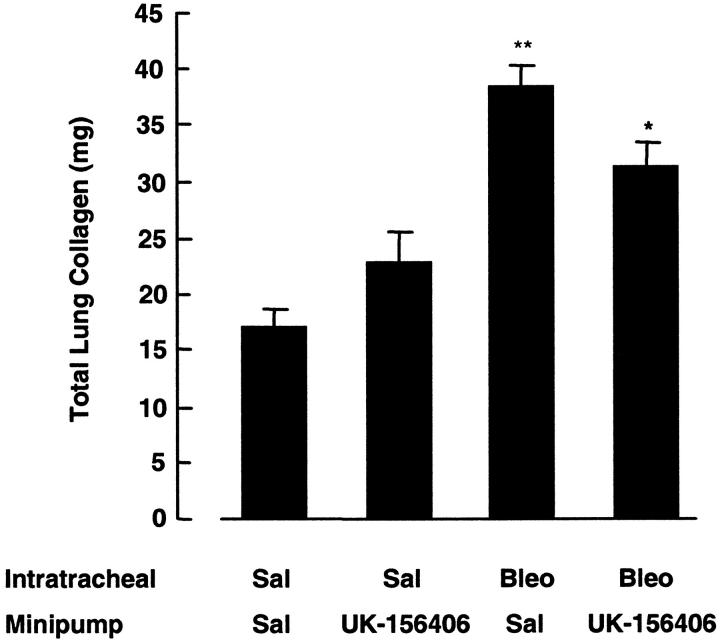
UK-156406 attenuates lung collagen accumulation in bleomycin-induced pulmonary fibrosis. ▶ shows the effect of a continuous subcutaneous infusion of UK-156406 on lung collagen accumulation at 14 days, after a single intratracheal instillation of bleomycin (1.5 mg/kg). **, P < 0.01, denotes the statistical increase in total lung collagen between bleomycin-treated animals and saline-treated controls. *, P < 0.05, indicates the reduction in lung collagen accumulation in bleomycin-treated animals given UK-156406, n = 6. The results obtained are representative of three separate experiments.
Figure 5.
Figure 5.
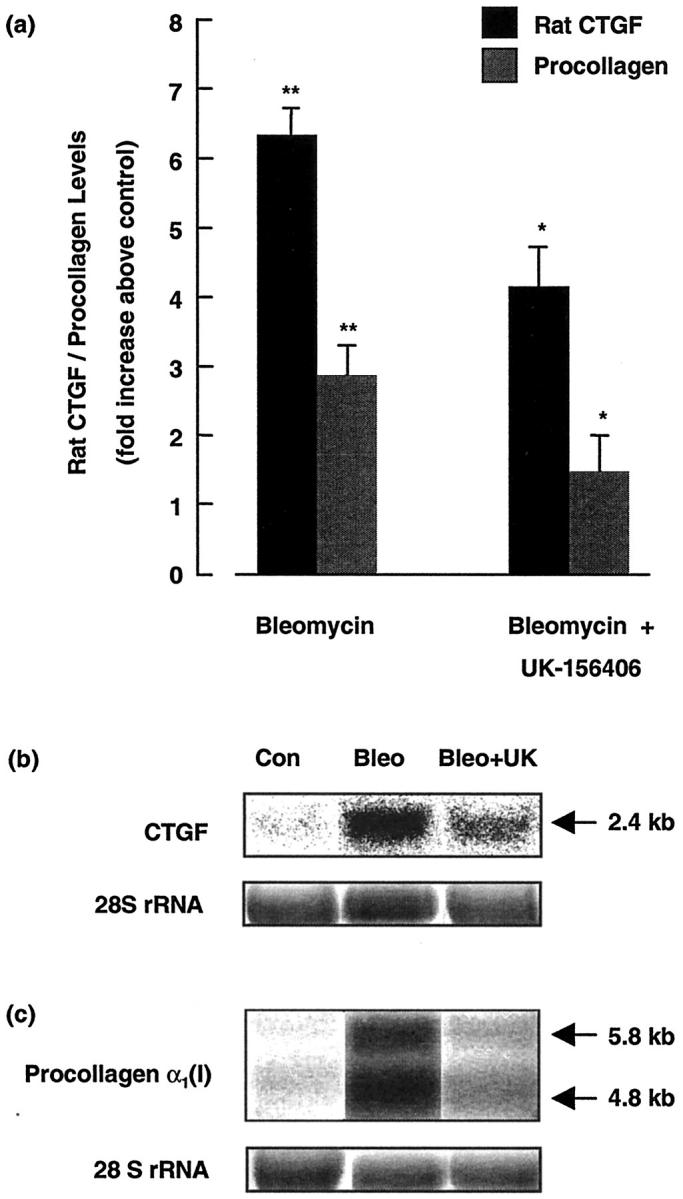
UK-156406 attenuates CTGF and α1(I) procollagen mRNA levels in bleomycin-induced pulmonary fibrosis. a: Data for bleomycin-treated animals expressed as fold increases in lung CTGF and α1(I) procollagen mRNA levels above saline control animals, normalized for RNA loading based on densitometric quantitation of rRNA (mean ± SEM, n = 6). **, P < 0.01, denotes the statistical increase in CTGF and α1(I) procollagen mRNA levels in bleomycin-treated animals compared to control animals. *, P < 0.05, indicates the reduction in these levels in bleomycin-treated animals given UK-156406, n = 6. b and c: Phosphorimages of representative Northern blots for the 2.4-kb CTGF mRNA transcript and the 5.8-kb and 4.8-kb α1(I) procollagen transcripts. The corresponding ethidium bromide-stained 28 rRNA S bands are also shown.

References

    1. McAnulty RJ, Laurent GJ: Pathogenesis of lung fibrosis and potential new therapeutic strategies. Exp Nephrol 1995, 3:96-107 - PubMed
    1. Chapman HA, Allen CL, Stone OL: Abnormalities in pathways of alveolar fibrin turnover among patients with interstitial lung disease. Am Rev Respir Dis 1986, 133:437-443 - PubMed
    1. Ikeda T, Hirose N, Koto H, Hirano H, Shigematsu N: Fibrin deposition and fibrinolysis in the pathogenesis of pulmonary fibrosis. Nippon Kyobu Shikkan Gakkai Zasshi 1989, 27:448-451 - PubMed
    1. Kotani I, Sato A, Hayakawa H, Urano T, Takada Y, Takada A: Increased procoagulant and antifibrinolytic activities in the lungs with idiopathic pulmonary fibrosis. Thromb Res 1995, 77:493-504 - PubMed
    1. Bachofen M, Weibel ER: Structural alterations of lung parenchyma in the adult respiratory distress syndrome. Clin Chest Med 1982, 3:35-56 - PubMed

Publication types

MeSH terms