. 2001:1:7.
doi: 10.1186/1472-6750-1-7. Epub 2001 Sep 26.

Mutant loxP vectors for selectable marker recycle and conditional knock-outs

Affiliations

Mutant loxP vectors for selectable marker recycle and conditional knock-outs

H Arakawa et al. BMC Biotechnol. 2001.

Abstract

Background: Gene disruption by targeted integration of transfected constructs becomes increasingly popular for studies of gene function. The chicken B cell line DT40 has been widely used as a model for gene knock-outs due to its high targeted integration activity. Disruption of multiple genes and complementation of the phenotypes is, however, restricted by the number of available selectable marker genes. It is therefore highly desirable to recycle the selectable markers using a site-specific recombination system like Cre/loxP.

Results: We constructed three plasmid vectors (neoR, puroR and bsr), which carry selectable marker genes flanked by two different mutant loxP sites. After stable transfection, the marker genes can be excised from the genome by transient induction of Cre recombinase expression. This excision converts the two mutant loxP sites to an inactive double-mutant loxP. Furthermore we constructed a versatile expression vector to clone cDNA expression cassettes between mutant loxP sites. This vector can also be used to design knock-out constructs in which the floxed marker gene is combined with a cDNA expression cassette. This construct enables gene knock-out and complementation in a single step. Gene expression can subsequently be terminated by the Cre mediated deletion of the cDNA expression cassette. This strategy is powerful for analyzing essential genes, whose disruption brings lethality to the mutant cell.

Conclusions: Mutant loxP vectors have been developed for the recycle of selectable markers and conditional gene knock-out approaches. As the marker and the cDNA expression cassettes are driven by the universally active and evolutionary conserved beta-actin promoter, they can be used for the selection of stable transfectants in a wide range of cell lines.


Figures
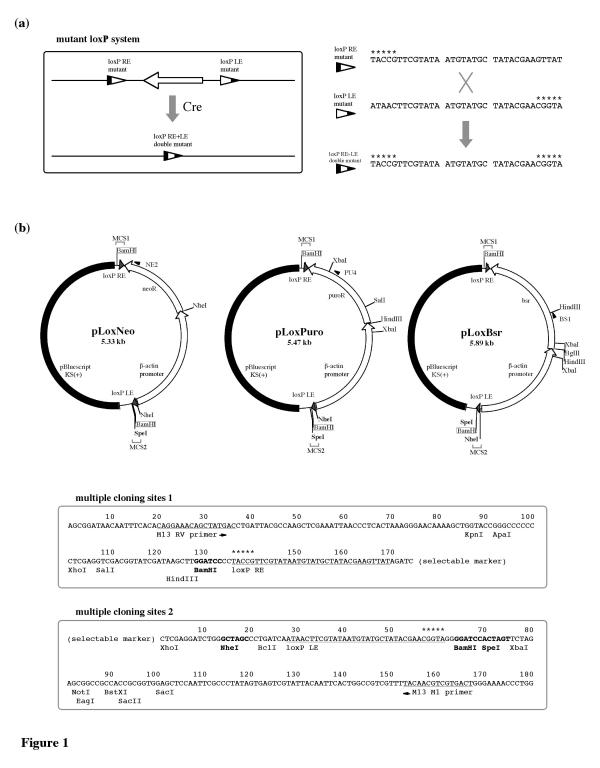
Figure 1
Figure 1
Mutant loxP sites and mutant loxP vectors. (a) The scheme of mutant loxP system is shown with sites for the rearrangement of mutant loxP sites. Nucleotide changes in mutant loxP sequences are stressed by stars. (b) Maps and positions of multiple cloning sites in the mutant loxP vectors, pLoxNeo, pLoxPuro and pLoxBsr. Each of the mutant loxP-flanked selectable marker genes can be utilized as a BamHI cassette. pLoxNeo, pLoxPuro and pLoxBsr have unique SpeI sites outside of mutant loxP-flanked region. pLoxPuro and pLoxBsr have unique NheI sites inside of mutant loxP-flanked region. These SpeI and NheI sites are important for the combination of the mutant loxP vectors with pExpress (Figure 3). Location of the PCR primers specific for the selectable marker genes (NE2, PU4, BS1) are shown by triangles.
Figure 2
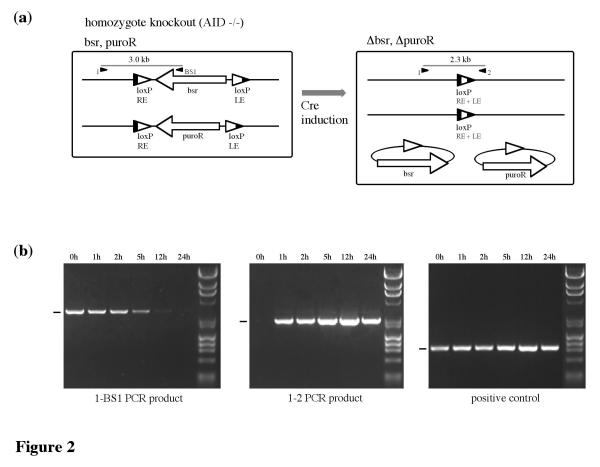
Figure 2
Quantitation of mutant loxP recombination following the induction of Cre recombinase. (a) Configuration of the AID locus in an AID -/- DT40 mutant before and after Cre recombinase induction. The cell clone stably expresses a transfected MerCreMer construct. PCR primers for detecting mutant-loxP recombination are shown together with the sizes of the resulting PCR products. (b) Time course of mutant loxP recombination. The cells were cultured for the indicated time in the presence of 0.05 mM 4-hydroxy tamoxifen for inducible-Cre activation. Crude extract of 500 cells were utilized for PCR reaction. The region downstream of loxP_LE, which is not affected by recombination, was amplified as a positive control.
Figure 3
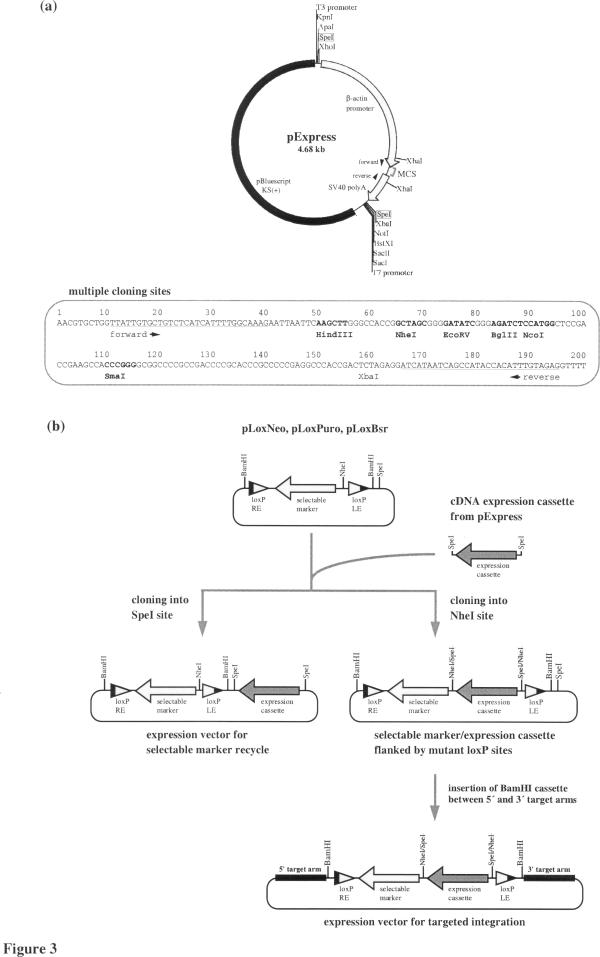
Figure 3
Design of the cDNA expression vector and the conditional expression vectors. (a) Map and multiple cloning sites of expression vector pExpress. After cloning of the cDNA coding sequence into pExpress, the expression cassette can be excised as a SpeI cassette. Location of forward and reverse primers are shown by triangles. (b) Insertion of the cDNA expression cassette into the mutant loxP vectors. Cloning of the expression cassette (SpeI cassette) into the SpeI site of mutant loxP vectors (pLoxNeo, pLoxPuro and pLoxBsr) produces an expression vector whose selectable marker can be recycled. Cloning of the expression cassette (SpeI cassette) into the NheI site of mutant loxP vectors (pLoxPuro and pLoxBsr) produces a vector in which a selectable marker and an expression cassette is flanked by mutant loxP sites.

References

    1. Buerstedde J-M, Takeda S. Increased ratio of targeted to random integration after transfection of chicken B cell lines. Cell. 1991;67:179–188. - PubMed
    1. Winding P, Berchtold MW. The chicken B cell line DT40: a novel tool for gene disruption experiments. J Immunol Methods. 2001;249:1–16. doi: 10.1016/S0022-1759(00)00333-1. - DOI - PubMed
    1. Sauer B, Henderson N. Site-specific DNA recombination in mammalian cells by the Cre recombinase of bacteriophage P1. Proc Natl Acad Sci U S A. 1988;85:5166–5170. - PMC - PubMed
    1. Albert H, Dale EC, Lee E, Ow DW. Site-specific integration of DNA into wild-type and mutant lox sites placed in the plant genome. Plant J. 1995;7:649–659. doi: 10.1046/j.1365-313X.1995.7040649.x. - DOI - PubMed
    1. Araki K, Araki M, Yamamura K. Targeted integration of DNA using mutant lox sites in embryonic stem cells. Nucleic Acids Res. 1997;25:868–872. doi: 10.1093/nar/25.4.868. - DOI - PMC - PubMed

Publication types

MeSH terms

LinkOut - more resources