. 2001 Oct;11(10):1699-705.
doi: 10.1101/gr.182501.

Partial deletion of the bovine ED1 gene causes anhidrotic ectodermal dysplasia in cattle

Affiliations

Partial deletion of the bovine ED1 gene causes anhidrotic ectodermal dysplasia in cattle

C Drögemüller et al. Genome Res. 2001 Oct.

Abstract

Anhidrotic ectodermal dysplasia (ED1) is characterized by hypotrichosis, reduced number of sweat glands, and incisior anodontia in human, mouse, and cattle. In affected humans and mice, mutations in the ED1 gene coding for ectodysplasin 1 are found. Ectodysplasin 1 is a novel trimeric transmembrane protein with an extracellular TNF-like signaling domain that is believed to be involved in the formation of hair follicles and tooth buds during fetal development. We report the construction of a 480-kb BAC contig harboring the complete bovine ED1 gene on BTA Xq22-Xq24. Physical mapping and sequence analysis of the coding parts of the ED1 gene revealed that a large genomic region including exon 3 of the ED1 gene is deleted in cattle with anhidrotic ectodermal dysplasia in a family of German Holstein cattle with three affected maternal half sibs.


Figures
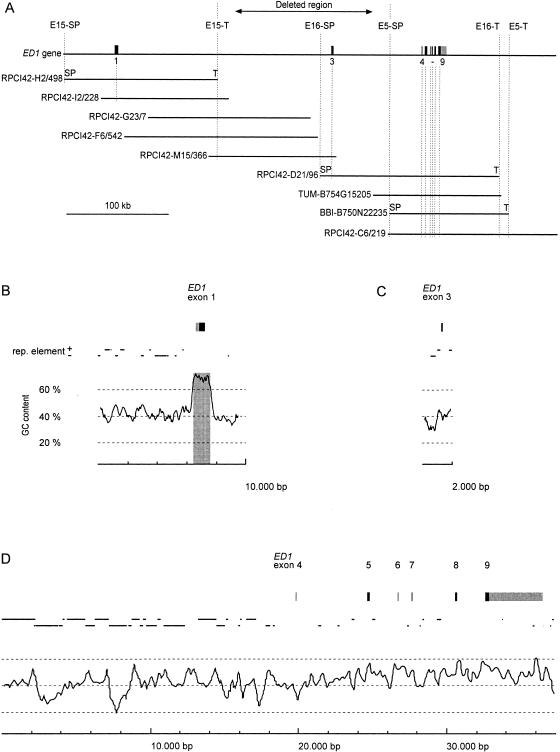
Figure 1
Figure 1
(A) Genomic structure of the bovine ED1 gene. Exons are numbered according to the nomenclature of Bayés et al. (1998). The positions of the isolated BAC clones are represented by horizontal bars in the lower part. The deleted genomic region in ED1-affected cattle is marked by an arrow. Vertical broken lines indicate STS loci used for physical mapping of the BAC contig. (B,C,D) Exons of the ED1 gene are shown as boxes. Untranslated regions are shown in gray, whereas protein-coding parts are shown in black. The positions and orientations of repetitive elements (SINE, LINE, LTR) are indicated by solid lines. In the lower part of the figure, the GC content is shown. A 300-bp window size was used for the calculation of the GC content. The shaded box highlights a CpG island in the region of the promotor and exon 1 of the bovine ED1 gene.
Figure 2
Figure 2
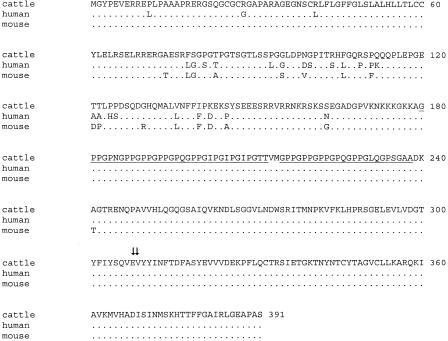
Alignment of the ectodysplasin 1 (ED1-A1) amino acid sequences of cattle, human, and mouse. The interrupted (Gly-X-Y)19 repeat is underlined. Arrows mark the amino acids 308E and 309V that are absent from the ED1-A2 isoform. Note the extremely high-sequence conservation of the proteins in the C-terminal region that harbors the TNF-like signaling domain.
Figure 3
Figure 3
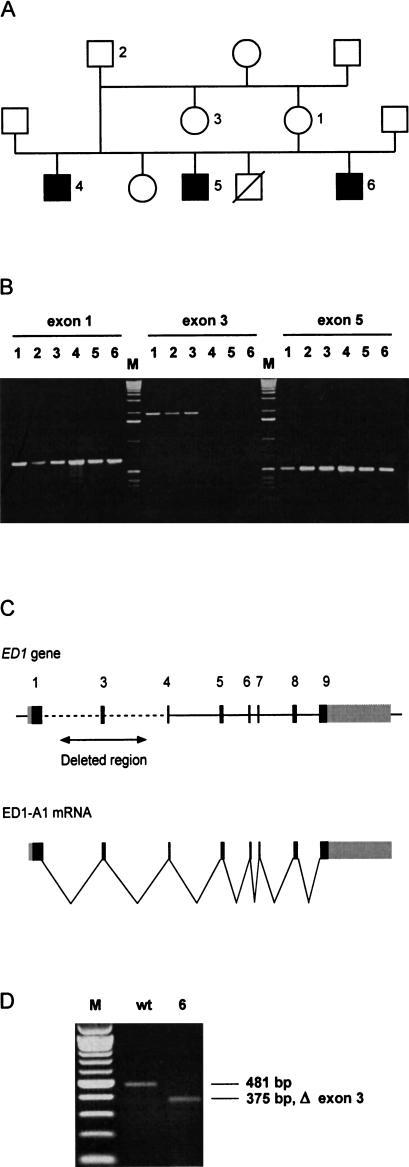
(A) ED1 cattle family used in this study. In this pedigree, a subset of the animals from a previous study is shown (Drögemüller et al. 2000a). (B) Identification of deletions within the ED1 gene in affected animals. ED1 exons were PCR amplified from animals 1–6 (Fig. 3A). PCR primers flanking exon 3 did not generate PCR products on the DNA of affected animals 4–6, indicating a deletion of this genomic region. (M) 1-kb ladder; (exon 1) 661-bp product, (exon 3) 2006-bp product, (exon 5) 535-bp product with M13-tagged PCR primers). (C) Genomic organization of the mammalian ED1 gene. ED1-A1 and ED1-A2 differ by the presence or absence of 6 nucleotides encoded by exon 8b. (D) RT–PCR amplification of ED1 mRNA. Skin RNA from one affected and one control animal was reverse transcribed and amplified by use of a forward primer located in exon 1 and a reverse primer located in exon 5. The RT–PCR product of the affected animal corresponds to an ED1 cDNA lacking the 106-bp exon 3. The identity of the RT–PCR products and the borders of the deletion were verified by DNA sequencing (M) 100-bp-ladder; (wt) wild type; (6) affected animal No. 6 from Fig. 3A).

References

    1. Ausubel FM, Brent R, Kingston RE, Moore DD, Seidman JG, Smith JA, Struhl K. Current protocols in molecular biology. New York, NY: Wiley; 1995.
    1. Band MR, Larson JH, Rebeiz M, Green CA, Heyen DW, Donovan J, Windish R, Steining C, Mahyuddin P, Womack JE, et al. An ordered comparative map of the cattle and human genomes. Genome Res. 2000;10:1359–1368. - PMC - PubMed
    1. Bayés M, Hartung AJ, Ezer S, Pispa J, Thesleff I, Srivastava AK, Kere J. The anhidrotic ectodermal dysplasia gene (EDA) undergoes alternative splicing and encodes ectodysplasin-A with deletion mutations in collagenous repeats. Hum Mol Genet. 1998;7:1661–1669. - PubMed
    1. Drögemüller C, Neander S, Klippert H, Kuiper H, Kutschke L, Guionaud S, Ueberschär S, Scholz H, Distl O. Genetic analysis of congenital hypotrichosis with anodontia in cattle. Arch Anim Breed. 2000a;43:213–222.
    1. Drögemüller C, Distl O, Leeb T. Identification of a highly polymorphic microsatellite within the bovine ectodysplasin A (ED1) gene on BTA Xq22–24. Anim Genet. 2000b;31:416. - PubMed

Publication types

Associated data

LinkOut - more resources