


Suppressor of cytokine signaling 3 (SOCS-3) protects beta -cells against interleukin-1beta - and interferon-gamma -mediated toxicity
- PMID: 11593036
- PMCID: PMC59790
- DOI: 10.1073/pnas.211445998
Suppressor of cytokine signaling 3 (SOCS-3) protects beta -cells against interleukin-1beta - and interferon-gamma -mediated toxicity
Abstract
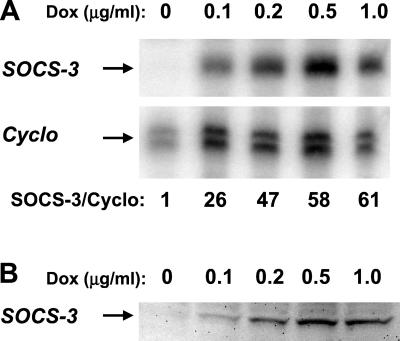
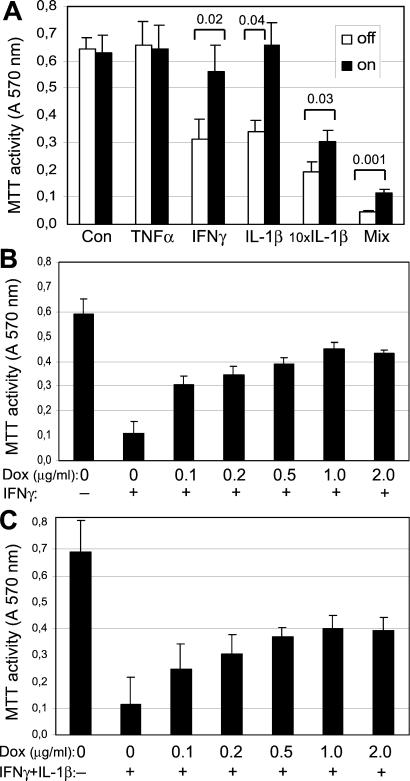
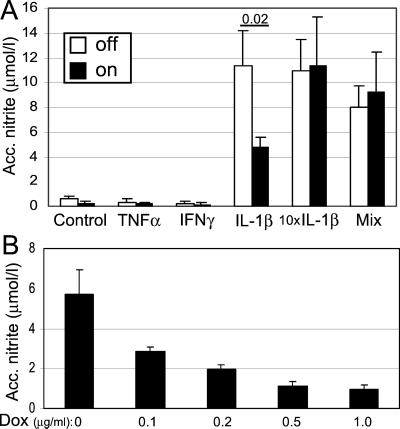
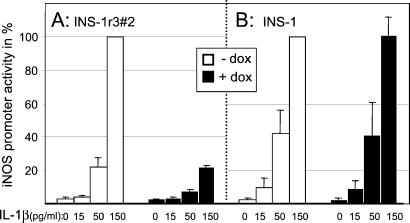
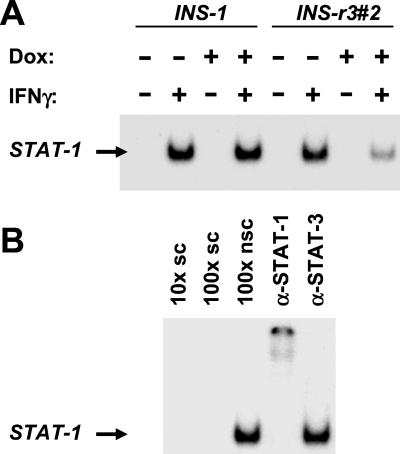
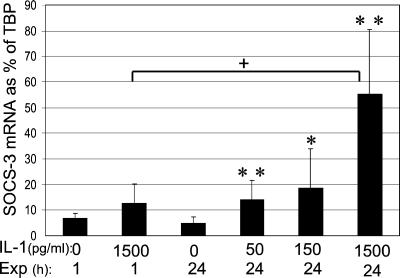
Suppressor of cytokine signaling 3 (SOCS-3) is a negative feedback regulator of IFN-gamma signaling, shown up-regulated in mouse bone marrow cells by the proinflammatory cytokines interleukin-1beta (IL-1beta), tumor necrosis factor-alpha (TNF-alpha), and IFN-gamma. IL-1beta and IFN-gamma alone, or potentiated by TNF-alpha, are cytotoxic to the insulin producing pancreatic beta-cells and beta-cell lines in vitro and suggested to contribute to the specific beta-cell destruction in Type-1 diabetes mellitus (T1DM). Using a doxycycline-inducible SOCS-3 expression system in the rat beta-cell line INS-1, we demonstrate that the toxic effect of both IL-1beta or IFN-gamma at concentrations that reduced the viability by 50% over 3 days, was fully preventable when SOCS-3 expression was turned on in the cells. At cytokine concentrations or combinations more toxic to the cells, SOCS-3 overexpression yielded a partial protection. Whereas SOCS-3-mediated inhibition of IFN-gamma signaling is described in other cell systems, SOCS-3 mediated inhibition of IL-1beta signaling has not previously been described. In addition we show that SOCS-3 prevention of IL-1beta-induced toxicity is accompanied by inhibited transcription of the inducible nitric oxide synthase (iNOS) by 80%, resulting in 60% decreased formation of the toxic nitric oxide (NO). Analysis of isolated native rat islets exposed to IL-1beta revealed a naturally occurring but delayed up-regulated SOCS-3 transcription. Influencing SOCS-3 expression thus represents an approach for affecting cytokine-induced signal transduction at a proximal step in the signal cascade, potentially useful in future therapies aimed at reducing the destructive potential of beta-cell cytotoxic cytokines in T1DM, as well as other cytokine-dependent diseases.
Figures
References
-
- Mandrup-Poulsen T, Bendtzen K, Nerup J, Dinarello C A, Svenson M, Nielsen J H. Diabetologia. 1986;29:63–67. - PubMed
-
- Bendtzen K, Mandrup-Poulsen T, Nerup J, Nielsen J H, Dinarello C A, Svenson M. Science. 1986;232:1545–1547. - PubMed
-
- Mandrup-Poulsen T, Egebjerg J, Nerup J, Bendtzen K, Nielsen J, Dinarello C. Acta Pathol Microbiol Immunol Scand Sect C. 1987;95:55–63. - PubMed
-
- Nerup J, Mandrup-Poulsen T, Helqvist S, Andersen H U, Pociot F, Reimers J I, Cuartero B G, Karlsen A E, Bjerre U, Lorenzen T. In: New Horizons in Diabetes Mellitus and Cardiovascular Disease. Schwartz C J, Born G V R, editors. London: Science Press; 1995. pp. 57–63.
-
- Eizirik D L, Flodström M, Karlsen A E, Welsh N. Diabetologia. 1996;39:875–890. - PubMed
Publication types
MeSH terms
Substances
LinkOut - more resources
Full Text Sources
Research Materials
Miscellaneous
