


Dynamic copy choice: steady state between murine leukemia virus polymerase and polymerase-dependent RNase H activity determines frequency of in vivo template switching
- PMID: 11593039
- PMCID: PMC59793
- DOI: 10.1073/pnas.221289898
Dynamic copy choice: steady state between murine leukemia virus polymerase and polymerase-dependent RNase H activity determines frequency of in vivo template switching
Abstract
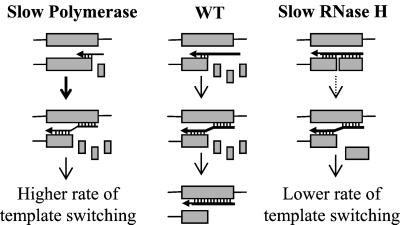
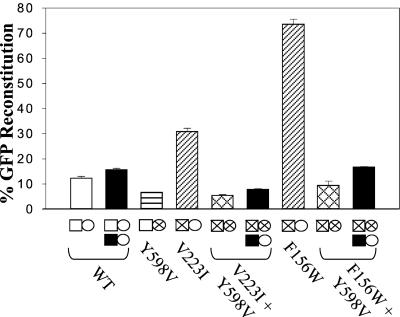
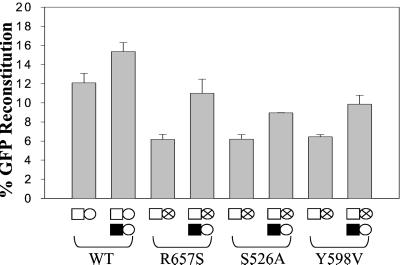
We recently proposed a dynamic copy-choice model for retroviral recombination in which a steady state between the rates of polymerization and RNA degradation determines the frequency of reverse transcriptase (RT) template switching. The relative contributions of polymerase-dependent and polymerase-independent RNase H activities during reverse transcription and template switching in vivo have not been determined. We developed an in vivo trans-complementation assay in which direct repeat deletion through template switching reconstitutes a functional green fluorescent protein gene in a retroviral vector. Complementation in trans between murine leukemia virus Gag-Pol proteins lacking polymerase and RNase H activities restored viral replication. Because only polymerase-independent RNase H activity is present in this cell line, the relative roles of polymerase-dependent and -independent RNase H activities in template switching could be determined. We also analyzed double mutants possessing polymerase and RNase H mutations that increased and decreased template switching, respectively. The double mutants exhibited low template switching frequency, indicating that the RNase H mutations were dominant. Trans-complementation of the double mutants with polymerase-independent RNase H did not restore the high template switching frequency, indicating that polymerase-dependent RNase H activity was essential for the increased frequency of template switching. Additionally, trans-complementation of RNase H mutants in the presence and absence of hydroxyurea, which slows the rate of reverse transcription, showed that hydroxyurea increased template switching only when polymerase-dependent RNase H activity was present. This is, to our knowledge, the first demonstration of polymerase-dependent RNase H activity in vivo. These results provide strong evidence for a dynamic association between the rates of DNA polymerization and polymerase-dependent RNase H activity, which determines the frequency of in vivo template switching.
Figures




References
-
- Schinazi R F, Larder B A, Mellors J W. Int Antiviral News. 2000;8:65–91.
-
- McKeating J A, Gow J, Goudsmit J, Pearl L H, Mulder C, Weiss R A. AIDS. 1989;3:777–784. - PubMed
-
- Phillips R E, Rowland-Jones S, Nixon D F, Gotch F M, Edwards J P, Ogunlesi A O, Elvin J G, Rothbard J A, Bangham C R, Rizza C R, et al. Nature (London) 1991;354:453–459. - PubMed
-
- Reitz M S, Wilson C, Naugle C, Gallo R C, Robert-Guroff M. Cell. 1988;54:57–63. - PubMed
-
- Pathak V K, Hu W S. Semin Virol. 1997;8:141–150.
Publication types
MeSH terms
Substances
LinkOut - more resources
Full Text Sources
Other Literature Sources
