. 2001 Nov;45(11):3001-8.
doi: 10.1128/AAC.45.11.3001-3008.2001.

Effects of azithromycin and rifampin on Chlamydia trachomatis infection in vitro

Affiliations

Effects of azithromycin and rifampin on Chlamydia trachomatis infection in vitro

U Dreses-Werringloer et al. Antimicrob Agents Chemother. 2001 Nov.

Abstract

An in vitro cell culture model was used to investigate the long-term effects of azithromycin, rifampin, and the combination of azithromycin and rifampin on Chlamydia trachomatis infection. Although standard in vitro susceptibility testing indicated efficient inhibition by azithromycin, prolonged treatment did not reveal a clear elimination of chlamydia from host cells. Chlamydia were temporarily arrested in a persistent state, characterized by culture-negative, but viable, metabolically active chlamydia, as demonstrated by the presence of short-lived rRNA transcripts. Additionally, azithromycin induced generation of aberrant inclusions and an altered steady-state level of chlamydial antigens, with the predominance of Hsp60 protein compared to the level of the major outer membrane protein. Treatment with azithromycin finally resulted in suppression of rRNA synthesis. Chlamydial lipopolysaccharide and processed, functional rRNA were detectable throughout the entire incubation period. These in vitro data show a good correlation to those from some recent clinical investigations that have reported on the persistence of chlamydia, despite appropriate antibiotic treatment with azithromycin. Rifampin was highly active by in vitro susceptibility testing, but prolonged exposure to rifampin alone for up to 20 days resulted in the emergence of resistance. No development of resistance to rifampin was observed when chlamydia-infected cells were incubated with a combination of azithromycin and rifampin. This combination was shown to be more efficient than azithromycin alone, in that suppression of rRNA synthesis occurred earlier. Thus, such a combination may prove more useful than azithromycin alone.


Figures
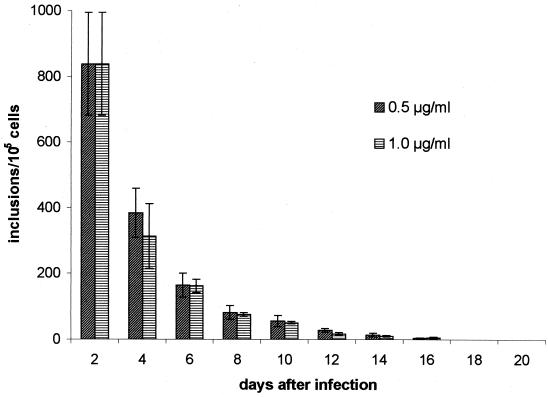
FIG. 1
FIG. 1
Effect of 0.5 and 1.0 μg of azithromycin per ml on chlamydial inclusions in HEp-2 cells. HEp-2 cells were inoculated at an MOI of 0.05. Incubation with azithromycin was started 2 days after infection. Cultures without azithromycin were run in parallel as a control, with complete destruction of the cell monolayer in 6 days. The figure does not include the numbers of atypical inclusions. Data presented are the means ± standard deviations (error bars) of six and four experiments with concentrations of 0.5 and 1.0 μg/ml, respectively.
FIG. 2
FIG. 2
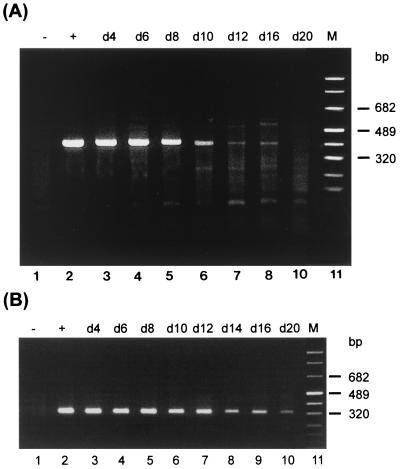
RT-PCR analysis of HEp-2 cells treated with azithromycin. Cells were infected at an MOI of 0.05 and were treated with 0.5 μg of azithromycin per ml starting 2 days after infection. Detection of unprocessed 16S rRNA transcripts (A) and processed, functional rRNA (B) was performed as described in Materials and Methods. Lanes: 1, uninfected cells; 2, control cells at 2 days postinfection; 3 to 10, chlamydia-infected cells treated with azithromycin; 11, marker (M).
FIG. 3
FIG. 3
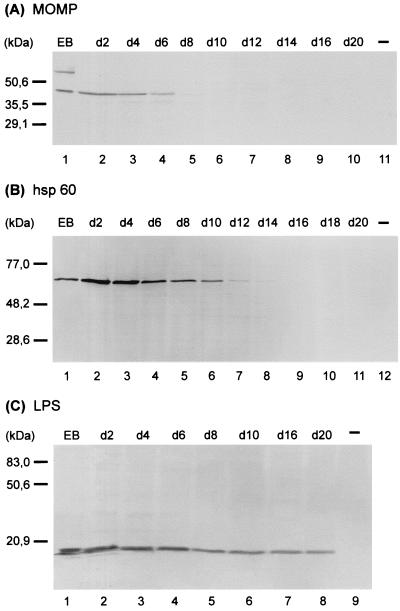
Immunoblot analysis of azithromycin-treated HEp-2 cells with anti-MOMP (A), anti-hsp60 (B), and anti-LPS (C) antibodies. HEp-2 cells were infected at an MOI of 0.05 and were treated with 0.5 μg of azithromycin per ml starting 2 days after infection. Lanes: 1, C. trachomatis serovar K EBs; 11 (A), 12 (B) and 9 (C), uninfected (−) cells; 2 to 10 (A), 11 (B), and 8 (C), chlamydia-infected cells treated with 0.5 μg of azithromycin per ml on the indicated day (d).
FIG. 4
FIG. 4
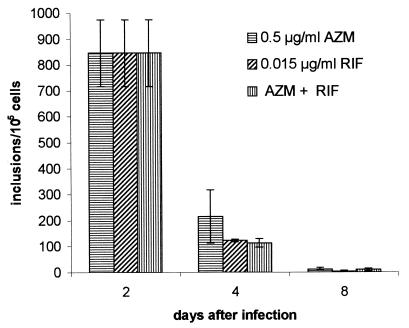
Effects of azithromycin (AEM), rifampin (RIF), and azithromycin plus rifampin on chlamydial inclusions. Untreated control cells were completely destroyed in 6 days. Antibiotic incubation was started 2 days postinfection. Host cells were found to be free of typical inclusions at day 14 for all three treatment regimens. Data are presented as the means ± standard deviations of four (azithromycin) and six (rifampin and azithromycin plus rifampin) experiments.
FIG. 5
FIG. 5
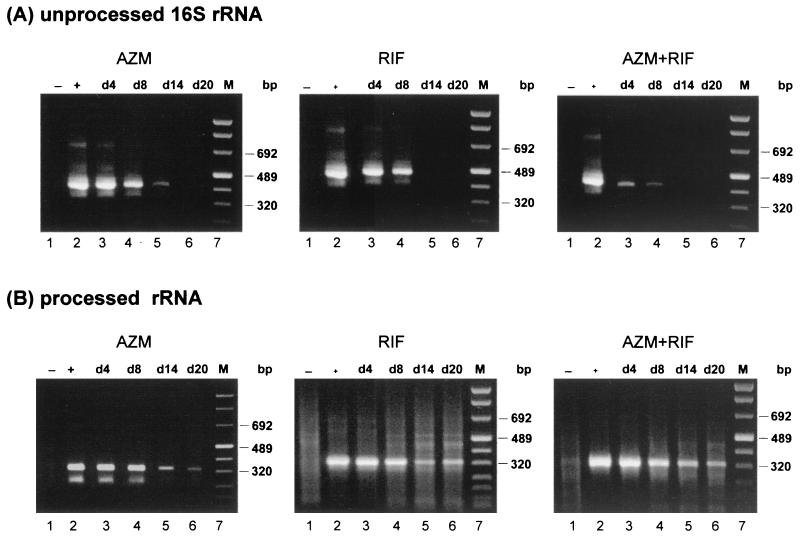
RT-PCR analyses of cells treated with azithromycin (AZM), rifampin (RIF), or azithromycin plus rifampin. Cells were infected at an MOI of 0.05 and were treated with 0.5 μg of azithromycin per ml or 0.015 μg of rifampin per ml, or both, starting 2 days after infection. Detection of unprocessed 16S rRNA transcripts (A) and processed, functional rRNA (B) was performed as described in Materials and Methods. Lanes: 1, uninfected cells; 2, control cells at 2 days postinfection; 3 to 6, chlamydia-infected cells treated with antibiotic on the indicated day (d); 7, marker (M).

References

    1. Agacfidan A, Moncada J, Schachter J. In vitro activity of azithromycin (CP-62, 993) against Chlamydia trachomatis and Chlamydia pneumoniae. Antimicrob Agents Chemother. 1993;37:1746–1748. - PMC - PubMed
    1. Beatty W L, Byrne G I, Morrison R P. Morphologic and antigenic characterization of interferon γ-mediated persistent Chlamydia trachomatis infection in vitro. Proc Natl Acad Sci USA. 1993;90:3998–4002. - PMC - PubMed
    1. Becker Y, Zackay-Rones Z. Rifampicin—a new antitrachoma drug. Nature. 1969;222:851–853. - PubMed
    1. Bianchi A, Scieux C, Salmeron C M, Casin I, Perol Y. Rapid determination of MICs of 15 antichlamydial agents by using an enzyme immunoassay (Chlamydiazyme) Antimicrob Agents Chemother. 1988;32:1350–1353. - PMC - PubMed
    1. Blackman H J, Yoneda C, Dawson C R, Schachter J. Antibiotic susceptibility of Chlamydia trachomatis. Antimicrob Agents Chemother. 1977;12:673–677. - PMC - PubMed

Publication types

MeSH terms