


doi: 10.1128/AAC.45.11.3209-3212.2001.
In vitro killing of Candida albicans by fatty acids and monoglycerides
Affiliations
- PMID: 11600381
- PMCID: PMC90807
- DOI: 10.1128/AAC.45.11.3209-3212.2001
Item in Clipboard
In vitro killing of Candida albicans by fatty acids and monoglycerides
Antimicrob Agents Chemother.
2001 Nov.
Abstract
The susceptibility of Candida albicans to several fatty acids and their 1-monoglycerides was tested with a short inactivation time, and ultrathin sections were studied by transmission electron microscopy (TEM) after treatment with capric acid. The results show that capric acid, a 10-carbon saturated fatty acid, causes the fastest and most effective killing of all three strains of C. albicans tested, leaving the cytoplasm disorganized and shrunken because of a disrupted or disintegrated plasma membrane. Lauric acid, a 12-carbon saturated fatty acid, was the most active at lower concentrations and after a longer incubation time.
Figures
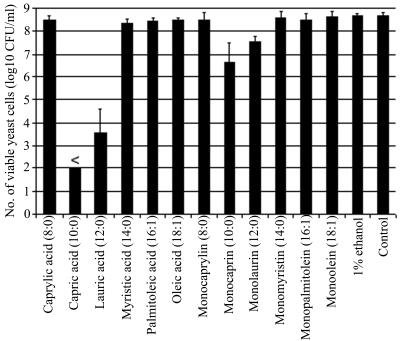
Number of C. albicans cells after treatment with 10 mM fatty acids and monoglycerides for 10 min at 37°C. At the top of the column for capric acid, < indicates that no colonies were detectable in 100 μl of the 10−1 dilution, which was the lowest dilution tested. The error bars indicate the standard deviation of the mean for all three strains, each tested at least two times.
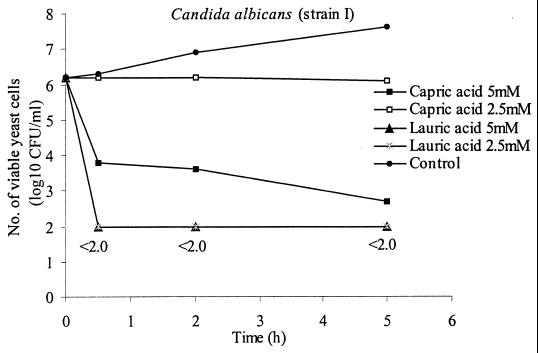
Killing activities of 5 and 2.5 mM concentrations of capric acid and lauric acid against C. albicans (strain I) incubated at 37°C for 30 min and 2 and 5 h. The values are the means from three experiments, with standard deviations ranging from 0 to 0.38; <2.0 indicates that no colony-forming yeast cells were detectable in 100 μl of the 10−1 dilution. Candida cells mixed with broth without lipid were used as a control. Addition of 1% ethanol to the control had no effect on cell growth.
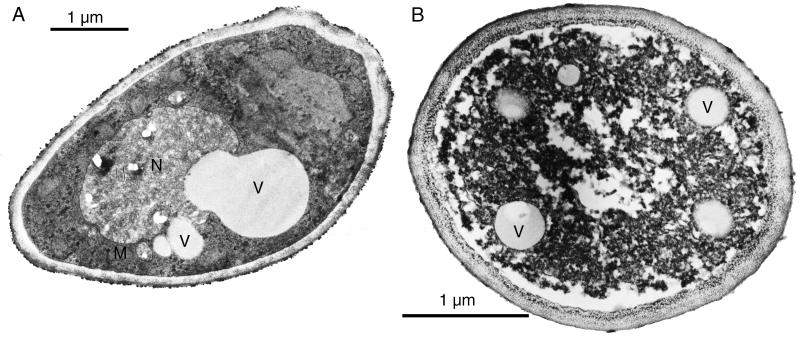
Effects of capric acid on the ultrastructure of C. albicans as demonstrated by TEM of ultrathin sections of yeast cells. (A) Cell from the control sample with intact cytoplasm, nucleus (N), vacuoles (V), and mitochondria (M). (B) Cell from samples treated with 10 mM capric acid for 30 min, demonstrating disorganization of the cytoplasm. No visible changes are seen in the shape or size of the cell wall.
References
-
- Bergsson, G., J. Arnfinnsson, Ó. Steingrímsson, and H. Thormar. Killing of gram-positive cocci by fatty acids and monoglycerides. APMIS, in press. - PubMed
-
- Isaacs C E, Kim K S, Thormar H. Inactivation of enveloped viruses in human bodily fluids by purified lipids. Ann N Y Acad Sci. 1994;724:457–464. - PubMed
-
- Isaacs C E, Litov R E, Thormar H. Antimicrobial activity of lipids added to human milk, infant formula, and bovine milk. Nutr Biochem. 1995;6:362–366. - PubMed
Publication types
MeSH terms
Substances
LinkOut - more resources
Full Text Sources
Other Literature Sources
