Review
. 2001 Oct;2(10):885-90.
doi: 10.1093/embo-reports/kve206.

From the cradle to the grave: molecular chaperones that may choose between folding and degradation

Affiliations
Review

From the cradle to the grave: molecular chaperones that may choose between folding and degradation

J Höhfeld et al. EMBO Rep. 2001 Oct.

Abstract

Molecular chaperones are known to facilitate cellular protein folding. They bind non-native proteins and orchestrate the folding process in conjunction with regulatory cofactors that modulate the affinity of the chaperone for its substrate. However, not every attempt to fold a protein is successful and chaperones can direct misfolded proteins to the cellular degradation machinery for destruction. Protein quality control thus appears to involve close cooperation between molecular chaperones and energy-dependent proteases. Molecular mechanisms underlying this interplay have been largely enigmatic so far. Here we present a novel concept for the regulation of the eukaryotic Hsp70 and Hsp90 chaperone systems during protein folding and protein degradation.


Figures
None
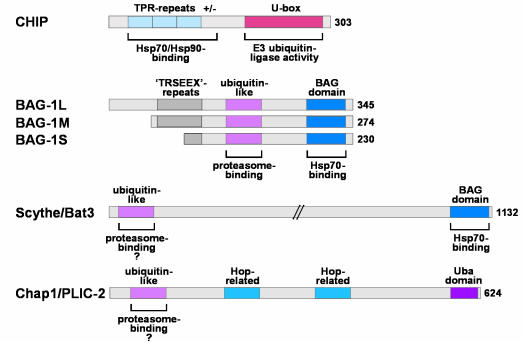
Fig. 1. Cofactors that appear to link molecular chaperones to the ubiquitin/proteasome system. CHIP possesses an N-terminal chaperone binding motif formed by three TPRs and an adjacent highly charged region. A U-box required for ubiquitin ligase activity is present at the C-terminus. The BAG-1 isoforms share a ubiquitin-like domain involved in proteasome binding and a BAG domain that mediates interaction with Hsp70. Like the BAG-1 proteins, Scythe/Bat3 possesses a ubiquitin-like domain that may be used for proteasome association and a BAG domain used for binding and regulation of Hsp70. Chap1/PLIC-2 combines a ubiquitin-like domain and a Uba domain, the latter of which is found in several proteins involved in ubiquitin conjugation. In addition, regions structurally related to the chaperone cofactor Hop are present in Chap1/PLIC-2.
None
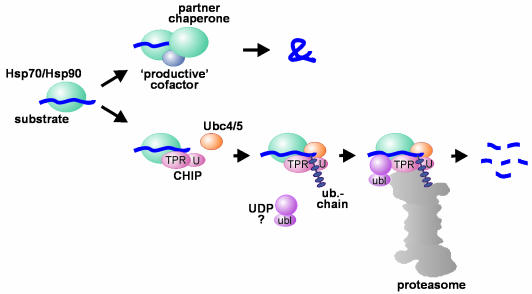
Fig. 2. Hsp70 and Hsp90 in protein folding and degradation. An initial decision to fold or degrade a Hsp70- or Hsp90-associated substrate protein may be reached through competition between a ‘productive’ cofactor such as Hop, and the ubiquitin ligase CHIP. During the folding process, Hsp70 and Hsp90 may co-operate with other chaperone proteins (termed partner chaperones). On the degradation pathway, CHIP associates with Hsp70 or Hsp90 via its TPR chaperone adaptor (TPR), and at the same time recruits E2 ubiquitin conjugating enzymes of the Ubc4/5 family to the chaperone complex. This may involve binding of the E2 to the U-box of the cofactor (U). In conjunction with E2, CHIP mediates ubiquitin attachment to the chaperone substrate and induces its targeting to the proteasome for degradation. The targeting process may be facilitated by a ubiquitin domain protein (UDP), such as BAG-1, which binds to Hsp70 and utilizes its ubiquitin-like domain (ubl) for proteasomal association.
None
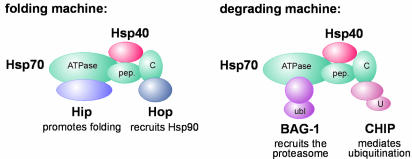
Fig. 3. Model for Hsp70 chaperone machines. Binding of distinct chaperone cofactors to the N-terminal ATPase domain of Hsp70 (ATPase) and to its C-terminus (C) may give rise to chaperone machines involved in protein folding and protein degradation, respectively. The cofactors Hip and BAG-1 compete for binding to the ATPase domain, while Hop and CHIP associate with the C-terminus in a competitive manner. During folding and degradation, Hsp70 appears to co-operate with cofactors of the Hsp40 protein family. pep., peptide binding domain of Hsp70; ubl, ubiquitin-like domain of BAG-1; U, U-box of CHIP.
None
Jörg Höhfeld, Douglas M. Cyr & Cam Patterson
None
None

References

    1. Aravind L. and Koonin, E.V. (2000) The U box is a modified RING finger — a common domain in ubiquitylation. Curr. Biol., 10, R132–R134. - PubMed
    1. Ballinger C.A., Connell, P., Wu, Y., Hu, Z., Thompson, L.J., Yin, L.-Y. and Patterson, C. (1999) Identification of CHIP, a novel tetratricopeptide repeat-containing protein that interacts with heat shock proteins and negatively regulates chaperone functions. Mol. Cell. Biol., 19, 4535–4545. - PMC - PubMed
    1. Baumeister W., Walz, J., Zühl, F. and Seemüller, E. (1998) The proteasome: a paradigm of a self-compartmentalizing protease. Cell, 92, 367–380. - PubMed
    1. Beere H.M. and Green, D.R. (2001) Stress management — heat shock protein-70 and the regulation of apoptosis. Trends Cell Biol., 11, 6–10. - PubMed
    1. Bercovich B., Stancovski, I., Mayer, A., Blumenfeld, N., Laszlo, A., Schwartz, A.L. and Ciechanover, A. (1997) Ubiquitin-dependent degradation of certain protein substrates in vitro requires the molecular chaperone Hsc70. J. Biol. Chem., 272, 9002–9010. - PubMed

Publication types