. 2001 Oct 15;194(8):1123-40.
doi: 10.1084/jem.194.8.1123.

Reprogramming of the macrophage transcriptome in response to interferon-gamma and Mycobacterium tuberculosis: signaling roles of nitric oxide synthase-2 and phagocyte oxidase

Affiliations

Reprogramming of the macrophage transcriptome in response to interferon-gamma and Mycobacterium tuberculosis: signaling roles of nitric oxide synthase-2 and phagocyte oxidase

S Ehrt et al. J Exp Med. .

Abstract

Macrophage activation determines the outcome of infection by Mycobacterium tuberculosis (Mtb). Interferon-gamma (IFN-gamma) activates macrophages by driving Janus tyrosine kinase (JAK)/signal transducer and activator of transcription-dependent induction of transcription and PKR-dependent suppression of translation. Microarray-based experiments reported here enlarge this picture. Exposure to IFN-gamma and/or Mtb led to altered expression of 25% of the monitored genome in macrophages. The number of genes suppressed by IFN-gamma exceeded the number of genes induced, and much of the suppression was transcriptional. Five times as many genes related to immunity and inflammation were induced than suppressed. Mtb mimicked or synergized with IFN-gamma more than antagonized its actions. Phagocytosis of nonviable Mtb or polystyrene beads affected many genes, but the transcriptional signature of macrophages infected with viable Mtb was distinct. Studies involving macrophages deficient in inducible nitric oxide synthase and/or phagocyte oxidase revealed that these two antimicrobial enzymes help orchestrate the profound transcriptional remodeling that underlies macrophage activation.


Figures

Figure 1
Figure 1
Functional and biochemical criteria for activation of macrophages from wt, phox-deficient, iNOS-deficient, and doubly deficient mice by IFN-γ and Mtb. (A) Control of viability of intracellular Mtb. (B) Respiratory burst triggered by phorbol myristate acetate (100 ng/ml), a surrogate for ingested bacteria. (C) Secretion of NO2 , an accumulating oxidation product of NO. Bars are depicted in the following order: no stimulus; IFN-γ; Mtb; and IFN-γ plus Mtb. Data are means ± SD of triplicates in one experiement representative of three to five.
Figure 2
Figure 2
Criteria for gene regulation: reproducibility compared with fold-change cut-off. The histograms bin genes according to the fold change in their expression in response to IFN-γ, Mtb, or both. Suppression (fold change <1) is represented as the negative inverse. Genes with fold change >20 or <(−)20 are omitted. P values were determined separately for each gene based on replication of results for that gene in six independent experiments. The left column tallies genes whose expression changed with P ≤ 0.05. The right column tallies genes whose expression changed (or not) with P > 0.05. Bars are black or white according to the twofold cut-off criterion typically used to identify regulated genes in microarray experiments that have been performed once or twice, but calculated here for 6 experiments. Black bars indicate genes that would be miscounted by this fold-change cut-off.
Figure 3
Figure 3
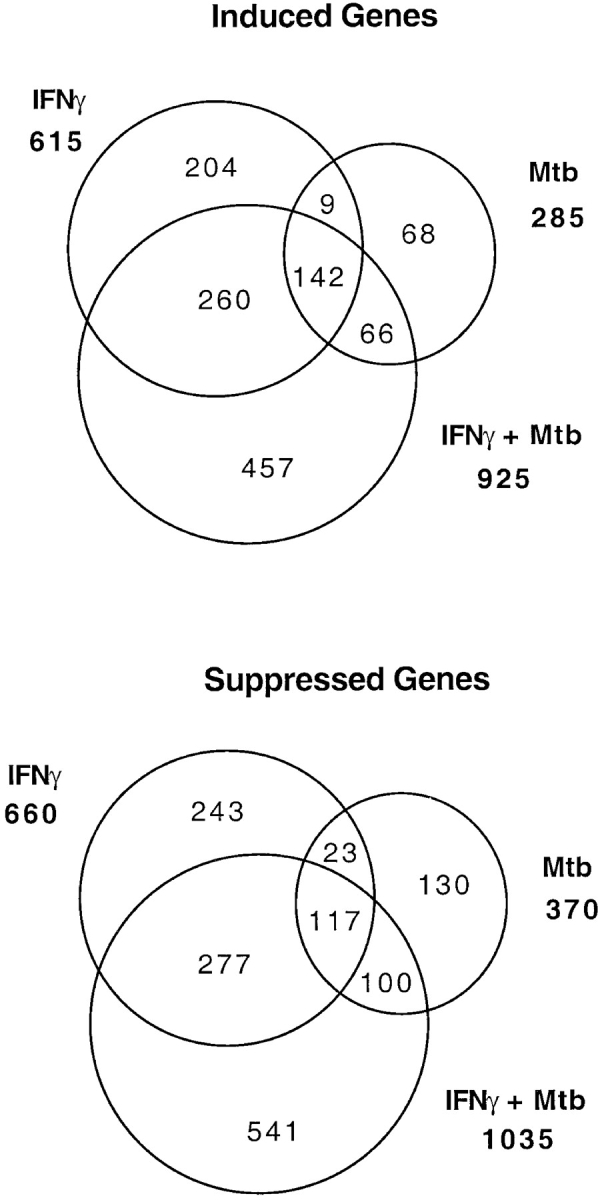
Extensive gene regulation in wt macrophages by IFN-γ and Mtb: extent of synergy. Numbers in bold face to the sides of the Venn diagrams report the total number of genes induced or suppressed (P ≤ 0.05) by IFN-γ, Mtb, or their combination. Numbers within the sectors tally the genes regulated uniquely or in common by these stimuli. The largest subsets of regulated genes were those that were only induced or suppressed by IFN-γ and Mtb acting synergistically. Instances in which IFN-γ and Mtb had opposite effects are omitted for clarity.
Figure 4
Figure 4
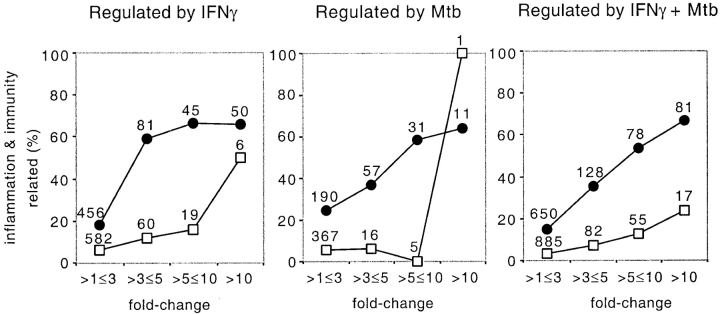
Genes directly related to inflammation or immunity are overrepresented among induced genes and among highly regulated genes. Genes regulated (P ≤ 0.05) in response to the stimuli named at the top of each graph were classified according to whether their products are directly related to immunity and inflammation (e.g., cytokines, chemokines, and metalloelastases versus ribosomal proteins, homeobox factors, and unannotated sequences), then binned according to the fold change in their expression. Black circles correspond to genes with fold change values >1. White squares indicate genes with fold change values <1 (suppression), represented as the inverse.
Figure 5
Figure 5
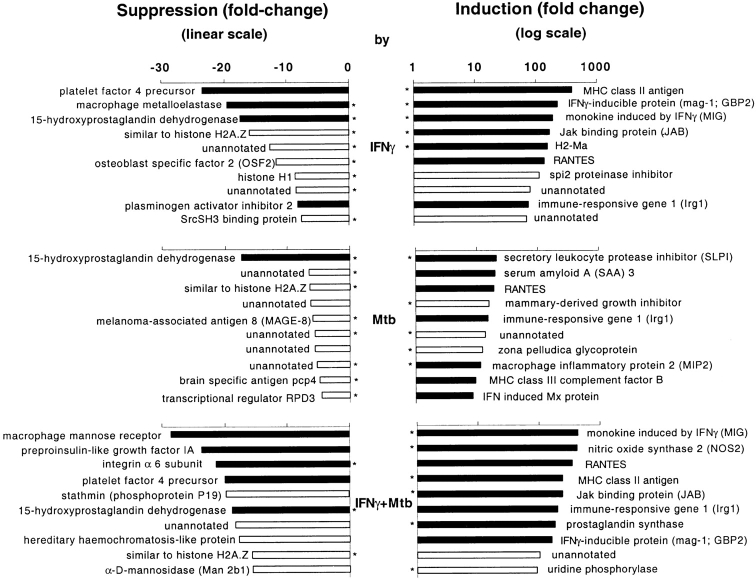
Ten most highly induced and suppressed genes in wt macrophages responding to IFN-γ, Mtb, or both. Genes directly related to inflammation and immunity are depicted by black bars, others by white bars. Suppression (fold change <1) is represented as the negative inverse on a linear scale, while induction is shown on a log scale. Probe sets with one value (baseline or treated) in the noise are starred. Online supplemental material (http://arrays.rockefeller. edu/murtb/) supplies Genbank accession numbers.
Figure 6
Figure 6
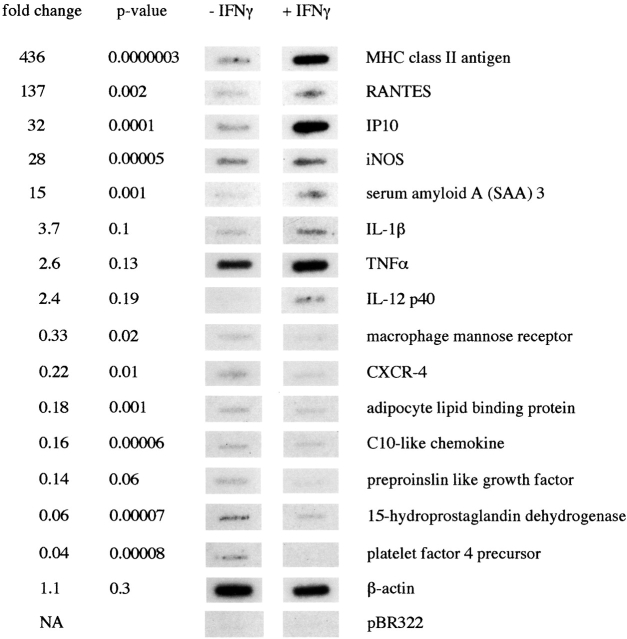
IFN-γ causes both transcriptional induction and suppression. Transcriptional run-ons were performed with nuclei from macrophages that had been treated with 0 or 100 U/ml IFN-γ for 48 h. Fold-change results by microarray analysis are indicated. Genes were selected based on high signal intensity on microarrays. Plasmid DNA (pBR322) served as a control.
Figure 7
Figure 7
Differential regulation of macrophage gene expression by viable Mtb versus heat-killed Mtb or polystyrene beads. Numbers in bold face to the sides of the Venn diagrams report the total number of genes induced (A and C) or suppressed (B and D) (P ≤ 0.05) by each of the three particles alone (A and B) or in the presence of IFN-γ (C and D). Numbers within the sectors tally the genes regulated uniquely by a given particle or in common with one or both of the others. The largest subsets of regulated genes were those that were only induced or suppressed by viable Mtb alone or with IFN-γ.

References

    1. Nathan C.F., Murray H.W., Wiebe M.E., Rubin B.Y. Identification of interferon-γ as the lymphokine that activates human macrophage oxidative metabolism and antimicrobial activity. J. Exp. Med. 1983;158:670–689. - PMC - PubMed
    1. Schreiber R.D., Pace J.L., Russell S.W., Altman A., Katz D.H. Macrophage-activating factor produced by a T cell hybridomaphysiochemical and biosynthetic resemblance to γ-interferon. J. Immunol. 1983;131:826–832. - PubMed
    1. Cooper A.M., Dalton D.K., Stewart T.A., Griffin J.P., Russell D.G., Orme I.M. Disseminated tuberculosis in interferon-γ gene-disrupted mice. J. Exp. Med. 1993;178:2243–2247. - PMC - PubMed
    1. Flynn J.L., Chan J., Triebold K.J., Dalton D.K., Stewart T.A., Bloom B.R. An essential role for interferon γ in resistance to Mycobacterium tuberculosis infection. J. Exp. Med. 1993;178:2249–2254. - PMC - PubMed
    1. Jouanguy E., Lamhamedi-Cherradi S., Lammas D., Dorman S.E., Fondaneche M.C., Dupuis S., Doffinger R., Altare F., Girdlestone J., Emile J.F. A human IFNGR1 small deletion hotspot associated with dominant susceptibility to mycobacterial infection. Nat. Genet. 1999;21:370–378. - PubMed

Publication types

MeSH terms