


Some measures of verbal and spatial working memory in eight- and nine-year-old hearing-impaired children with cochlear implants
- PMID: 11605947
- PMCID: PMC3429119
- DOI: 10.1097/00003446-200110000-00004
Some measures of verbal and spatial working memory in eight- and nine-year-old hearing-impaired children with cochlear implants
Abstract
Objective: The purpose of this study was to examine working memory for sequences of auditory and visual stimuli in prelingually deafened pediatric cochlear implant users with at least 4 yr of device experience.
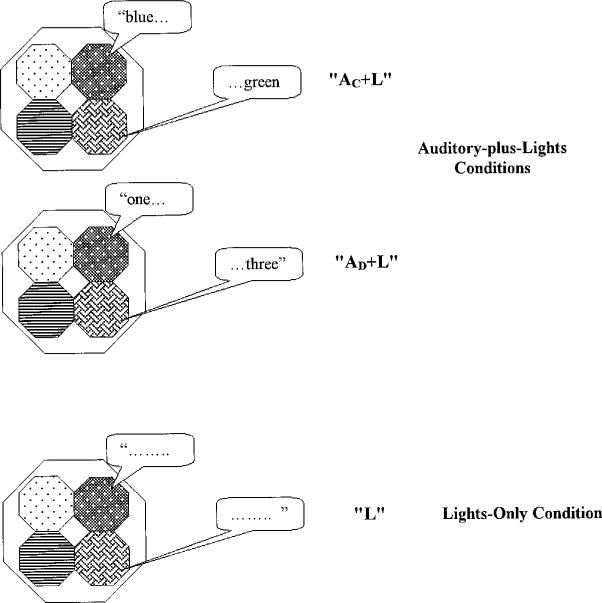
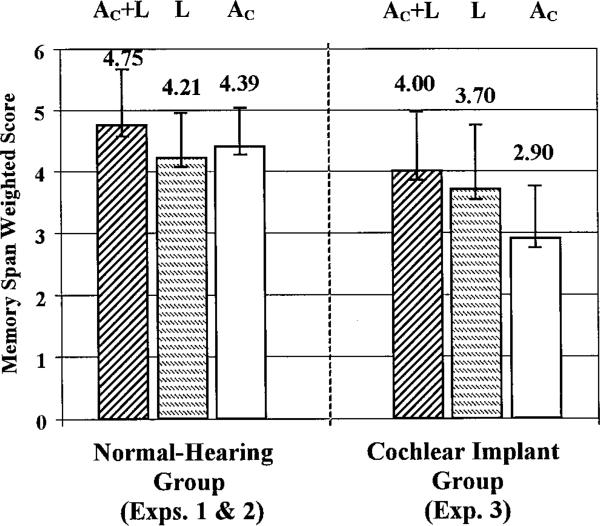
Design: Two groups of 8- and 9-yr-old children, 45 normal-hearing and 45 hearing-impaired users of cochlear implants, completed a novel working memory task requiring memory for sequences of either visual-spatial cues or visual-spatial cues paired with auditory signals. In each sequence, colored response buttons were illuminated either with or without simultaneous auditory presentation of verbal labels (color-names or digit-names). The child was required to reproduce each sequence by pressing the appropriate buttons on the response box. Sequence length was varied and a measure of memory span corresponding to the longest list length correctly reproduced under each set of presentation conditions was recorded. Additional children completed a modified task that eliminated the visual-spatial light cues but that still required reproduction of auditory color-name sequences using the same response box. Data from 37 pediatric cochlear implant users were collected using this modified task.
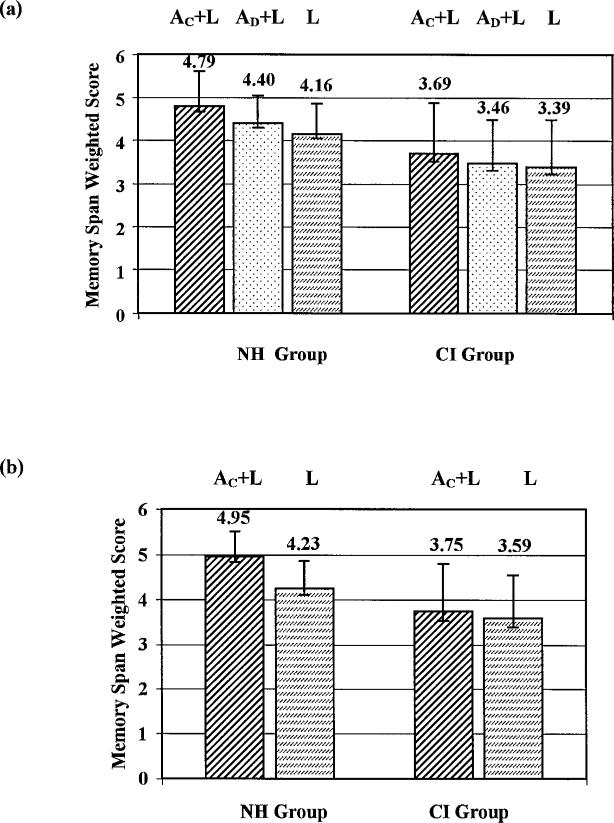
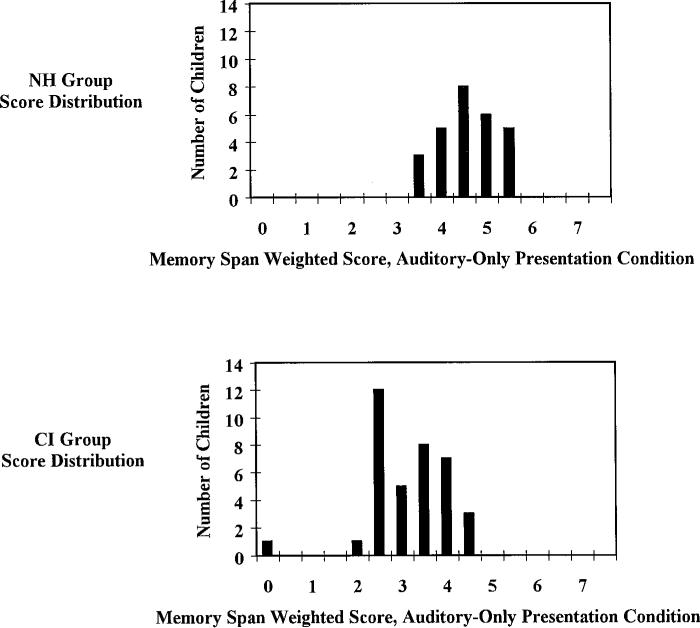
Results: The cochlear implant group obtained shorter span scores on average than the normal-hearing group, regardless of presentation format. The normal-hearing children also demonstrated a larger "redundancy gain" than children in the cochlear implant group-that is, the normal-hearing group displayed better memory for auditory-plus-lights sequences than for the lights-only sequences. Although the children with cochlear implants did not use the auditory signals as effectively as normal-hearing children when visual-spatial cues were also available, their performance on the modified memory task using only auditory cues showed that some of the children were capable of encoding auditory-only sequences at a level comparable with normal-hearing children.
Conclusions: The finding of smaller redundancy gains from the addition of auditory cues to visual-spatial sequences in the cochlear implant group as compared with the normal-hearing group demonstrates differences in encoding or rehearsal strategies between these two groups of children. Differences in memory span between the two groups even on a visual-spatial memory task suggests that atypical working memory development irrespective of input modality may be present in this clinical population.
Figures
References
-
- Aslin RN, Jusczyk PW, Pisoni DB. Speech and auditory processing during infancy: Constraints on and precursors to language. In: Damon W, Kuhn D, Siegler RS, editors. Handbook of Child Psychology, 5th Edition, Volume 2: Cognition, Perception, and Language. John Wiley & Sons; New York: 1998. pp. 147–198.
-
- Baddeley AD. Working Memory. Oxford University Press; London: 1986.
-
- Baddeley AD. Working memory. Science. 1992;255:556–559. - PubMed
-
- Baddeley AD, Gathercole S, Papagno C. The phonological loop as a language learning device. Psychological Review. 1998;105:158–173. - PubMed
-
- Brandimonte MA, Hitch GJ, Bishop DV. Verbal recoding of visual stimuli impairs mental image transformations. Memory and Cognition. 1992;20:449–455. - PubMed
Publication types
MeSH terms
Grants and funding
LinkOut - more resources
Full Text Sources
Medical
