. 2001 Oct 23;98(22):12608-13.
doi: 10.1073/pnas.231366398. Epub 2001 Oct 16.

A genome-wide screen in Saccharomyces cerevisiae for genes affecting UV radiation sensitivity

Affiliations

A genome-wide screen in Saccharomyces cerevisiae for genes affecting UV radiation sensitivity

G W Birrell et al. Proc Natl Acad Sci U S A. .

Abstract

The recent completion of the deletion of essentially all of the ORFs in yeast is an important new resource for identifying the phenotypes of unknown genes. Each ORF is replaced with a cassette containing unique tag sequences that allow rapid parallel analysis of strains in a pool by using hybridization to a high-density oligonucleotide array. We examined the utility of this system to identify genes conferring resistance to UV irradiation by using a pool of 4,627 individual homozygous deletion strains (representing deletions of all nonessential genes). We identified most of the nonessential genes previously shown to be involved in nucleotide excision repair, in cell cycle checkpoints, in homologous recombination, and in postreplication repair after UV damage. We also identified and individually confirmed, by replacing the genes, three new genes, to our knowledge not previously reported to confer UV sensitivity when deleted. Two of these newly identified genes have human orthologs associated with cancer, demonstrating the potential of this system to uncover human genes affecting sensitivity to DNA-damaging agents and genes potentially involved in cancer formation.


Figures
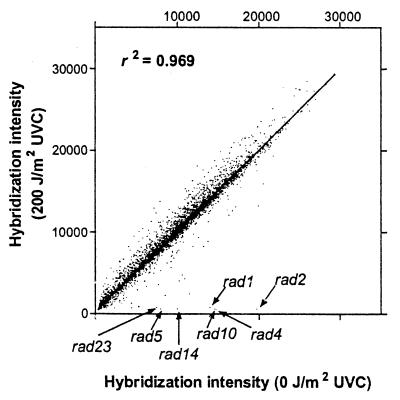
Figure 1
Figure 1
Scatterplot showing hybridization intensities of the 4,627 deletion strains in the untreated pool (0 J/m2 UVC) versus the treated pool (200 J/m2 UVC). Data for most strains fall close to the line of equivalence, whereas UV-sensitive strains fall near the x axis. Seven known UV sensitive strains are shown with arrows.
Figure 2
Figure 2
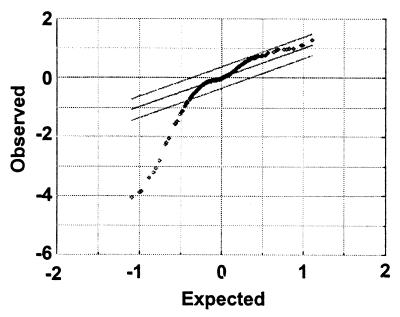
sam analysis of the UVC data set. sam computes a statistic for each strain measuring the strength of the relationship between the sensitivity ratios in the three repeat experiments. Each point represents an individual strain. The observed values are the paired t statistics for the signal intensities of strains in the treated and control pools. The expected values are the t statistic obtained when the paired data are randomly permuted 100 times. The region defined by the outer parallel lines is set by the investigator and varies the likely number of false positives. The lines shown define the strains with significant sensitivity to UV (outside the lines with no estimated false positives). The 31 strains considered sensitive to UVC are listed in Table 1 along with their ranking in the UVB experiments.
Figure 3
Figure 3
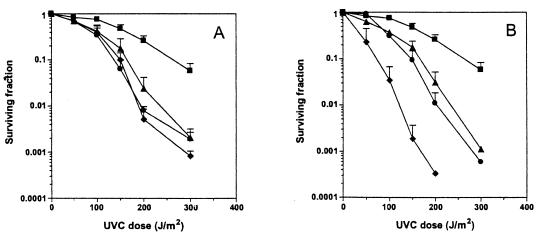
(A) UVC radiation survival curves of the parental strain, BY4743, and three strains not previously known to be UV sensitive. BY4743, filled squares; lsm1Δ/lsm1Δ, filled triangle; thr1Δ/thr1Δ, filled circle; yaf9Δ/yaf9Δ, filled diamond. (B) UVC radiation survival curves of the parental strain, BY4743, and three known sensitive strains. BY4743, filled squares; mus81Δ/mus81Δ, filled triangle; mms2Δ/mms2Δ, filled circle; rad18Δ/rad18Δ, filled diamond.
Figure 4
Figure 4
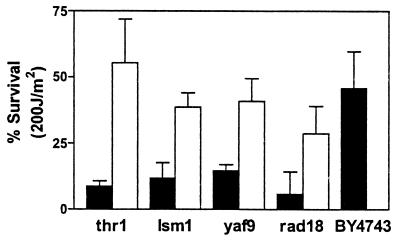
Reintroduction of deleted ORF abrogates UV sensitivity. We transformed four strains, thr1Δ/thr1Δ, lsm1Δ/lsm1Δ, yaf9Δ/yaf9Δ, and rad18Δ/rad18Δ, with vector alone (black bars) or vector containing the deleted ORF with a galactose inducible promoter (white bars) and tested survival to a single dose of 200 J/m2 UVC. The pooled results of three experiments are shown with the standard deviation.

References

    1. Foury F. Gene. 1997;195:1–10. - PubMed
    1. Schild D, Brake A J, Kiefer M C, Young D, Barr P J. Proc Natl Acad Sci USA. 1990;87:2916–2920. - PMC - PubMed
    1. Plon S E, Leppig K A, Do H N, Groudine M. Proc Natl Acad Sci USA. 1993;90:10484–10488. - PMC - PubMed
    1. Glerum D M, Tzagoloff A. Proc Natl Acad Sci USA. 1994;91:8452–8456. - PMC - PubMed
    1. Baudin A, Ozier K O, Denouel A, Lacroute F, Cullin C. Nucleic Acids Res. 1993;21:3329–3330. - PMC - PubMed

Publication types

MeSH terms