Comparative Study
. 2001 Nov;183(22):6699-706.
doi: 10.1128/JB.183.22.6699-6706.2001.

Integron integrases possess a unique additional domain necessary for activity

Affiliations
Comparative Study

Integron integrases possess a unique additional domain necessary for activity

N Messier et al. J Bacteriol. 2001 Nov.

Abstract

Integrons are genetic elements capable of integrating genes by a site-specific recombination system catalyzed by an integrase. Integron integrases are members of the tyrosine recombinase family and possess the four invariant residues (RHRY) and conserved motifs (boxes I and II and patches I, II, and III). An alignment of integron integrases compared to other tyrosine recombinases shows an additional group of residues around the patch III motif. We have analyzed the DNA binding and recombination properties of class I integron integrase (IntI1) variants carrying mutations at residues that are well conserved among all tyrosine recombinases and at some residues from the additional motif that are conserved among the integron integrases. The well-conserved residues studied were H277 from the conserved tetrad RHRY (about 90% conserved), E121 found in the patch I motif (about 80% conserved in prokaryotic recombinases), K171 from the patch II motif (near 100% conserved), W229 and F233 from the patch III motif, and G302 of box II (about 80% conserved in prokaryotic recombinases). Additional IntI1 mutated residues were K219 and a deletion of the sequence ALER215. We observed that E121, K171, and G302 play a role in the recombination activity but can be mutated without disturbing binding to DNA. W229, F233, and the conserved histidine (H277) may be implicated in protein folding or DNA binding. Some of the extra residues of IntI1 seem to play a role in DNA binding (K219) while others are implicated in the recombination activity (ALER215 deletion).


Figures
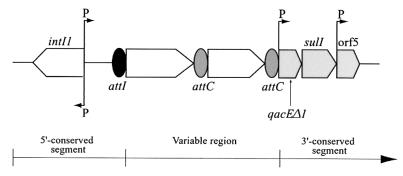
FIG. 1
FIG. 1
General structure of class 1 integrons. Cassettes are inserted in the variable region by the integrase using a site-specific recombination mechanism. The attI and attC sites are shown, respectively, by black and grey ovals and promoters are denoted by “P.” intI1, integrase gene; qacEΔ1, antiseptic resistance gene; sulI, sulfonamide resistance gene; orf5, gene of unknown function.
FIG. 2
FIG. 2
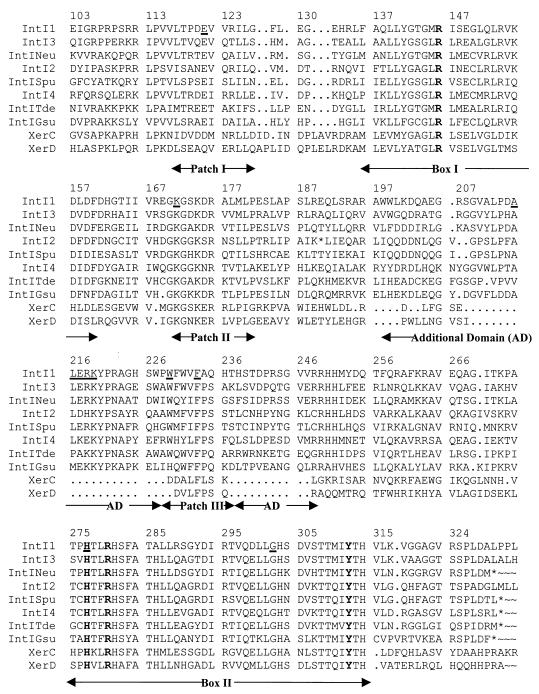
Alignment of C-terminal integron integrase sequences with those of other tyrosine recombinases. IntI1, class 1 integron integrase from plasmid pVS1; IntI2, class 2 integron integrase from Tn7; IntI3, class 3 integron integrase from a Serratia marcescens plasmid; IntI4, class 4 integron integrase from the Vibrio cholerae super-integron; IntISpu, integron integrase from Shewanella putrefaciens; IntINeu, integron integrase from Nitrosomonas europaea; IntITde, integron integrase from Treponema denticola; IntIGsu, integron integrase from Geobacter sulfurreducens; XerC, recombinase from E. coli; XerD, recombinase from E. coli. There are two potential IntI's in N. europaea; the one shown is the most likely to be translated. Numbering is based on the IntI1 sequence and residues mutated in this study are underlined. The additional domain and the different boxes and motifs are indicated under the alignment. Residues from the conserved tetrad (RHRY) are shown in bold.
FIG. 3
FIG. 3
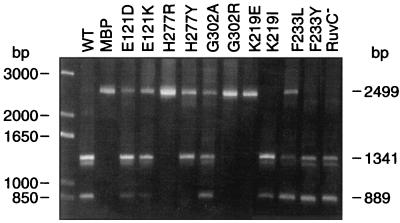
Electrophoresis of PCR products obtained with the pACYC184 primers and 100 ng of DNA preparation from overexpressed cultures on a 1% agarose gel. Lane 1, 1-kb-plus DNA ladder (Life Technologies); lane 2, DNA preparation of pLQ428-pLQ369 (wild type); lane 3, pLQ428-pMAL-c2 (MBP); lane 4, pLQ428-pLQ1101(E121D); lane 5, pLQ428-pLQ1102 (E121K); lane 6, pLQ428-pLQ1119 (H277R); lane 7, pLQ428-pLQ1120 (H277Y); lane 8, pLQ428-pLQ1121 (G302A); lane 9, pLQ428-pLQ1122 (G302R); lane 10, pLQ428-pLQ1109 (K219E); lane 11, pLQ428-pLQ1110 (K219I); lane 12, pLQ428-pLQ1114 (F233L); lane 13, pLQ428-pLQ1116 (F233Y); lane 14, pLQ428-pLQ369 (wild type) in a RuvC strain.
FIG. 4
FIG. 4
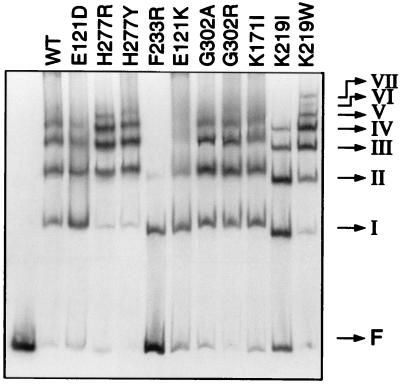
Gel retardation experiment with mutant MBP-IntI fusion proteins purified from E. coli TB1, on the complete attI1 site of the In2 integron (from nucleotide −96 to +71, relative to the G residue of the core site at position 0). A purified labeled fragment was incubated with a 200 nM concentration of mutant fusion proteins. Free DNA (F) and protein-DNA complexes (I to VII) were separated on 4% polyacrylamide gels and are indicated by arrows. Lane 1, free DNA; lane 2, wild-type MBP-IntI1 protein; lane 3, MBP-IntI1 (E121D) mutant; lane 4, MBP-IntI1 (H277R) mutant; lane 5, MBP-IntI1 (H277Y) mutant; lane 6, MBP-IntI1 (F233R) mutant; lane 7, MBP-IntI1 (E121K) mutant; lane 8, MBP-IntI1 (G302A) mutant; lane 9, MBP-IntI1 (G302R) mutant; lane 10, MBP-IntI1 (K171I) mutant; lane 11, MBP-IntI1 (K219I) mutant; lane 12, MBP-IntI1 (K219W) mutant.

References

    1. Bissonnette L, Roy P H. Characterization of In0 of Pseudomonas aeruginosa plasmid pVS1, an ancestor of integrons of multiresistance plasmids and transposons of gram-negative bacteria. J Bacteriol. 1992;174:1248–1257. - PMC - PubMed
    1. Blakely G W, Sherratt D J. Interactions of the site-specific recombinases XerC and XerD with the recombination site dif. Nucleic Acids Res. 1994;22:5613–5620. - PMC - PubMed
    1. Brown H J, Stokes H W, Hall R M. The integrons In0, In2, and In5 are defective transposon derivatives. J Bacteriol. 1996;178:4429–4437. - PMC - PubMed
    1. Cao Y, Hayes F. A newly identified, essential catalytic residue in a critical secondary structure element in the integrase family of site-specific recombinases is conserved in a similar element in eucaryotic type IB topoisomerases. J Mol Biol. 1999;289:517–527. - PubMed
    1. Chen Y, Narendra U, Iype L E, Cox M M, Rice P A. Crystal structure of a Flp recombinase-Holliday junction complex: assembly of an active oligomer by helix swapping. Mol Cell. 2000;6:885–897. - PubMed

Publication types

MeSH terms

LinkOut - more resources