


Synthesis of polyhydroxyalkanoate in the peroxisome of Saccharomyces cerevisiae by using intermediates of fatty acid beta-oxidation
- PMID: 11679353
- PMCID: PMC93298
- DOI: 10.1128/AEM.67.11.5254-5260.2001
Synthesis of polyhydroxyalkanoate in the peroxisome of Saccharomyces cerevisiae by using intermediates of fatty acid beta-oxidation
Abstract
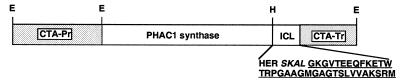
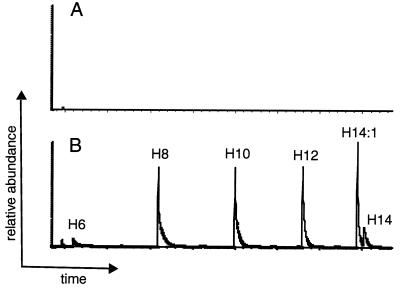
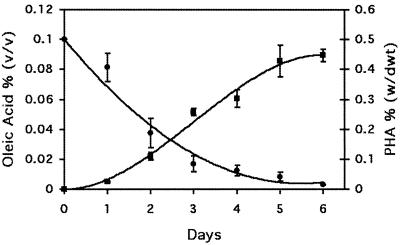
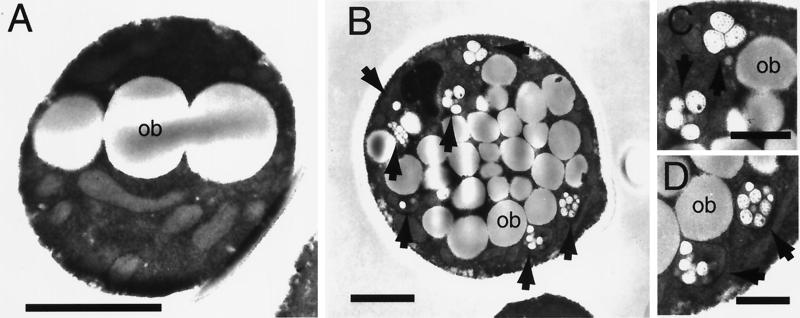
Medium-chain-length polyhydroxyalkanoates (PHAs) are polyesters having properties of biodegradable thermoplastics and elastomers that are naturally produced by a variety of pseudomonads. Saccharomyces cerevisiae was transformed with the Pseudomonas aeruginosa PHAC1 synthase modified for peroxisome targeting by the addition of the carboxyl 34 amino acids from the Brassica napus isocitrate lyase. The PHAC1 gene was put under the control of the promoter of the catalase A gene. PHA synthase expression and PHA accumulation were found in recombinant S. cerevisiae growing in media containing fatty acids. PHA containing even-chain monomers from 6 to 14 carbons was found in recombinant yeast grown on oleic acid, while odd-chain monomers from 5 to 15 carbons were found in PHA from yeast grown on heptadecenoic acid. The maximum amount of PHA accumulated was 0.45% of the dry weight. Transmission electron microscopy of recombinant yeast grown on oleic acid revealed the presence of numerous PHA inclusions found within membrane-bound organelles. Together, these data show that S. cerevisiae expressing a peroxisomal PHA synthase produces PHA in the peroxisome using the 3-hydroxyacyl coenzyme A intermediates of the beta-oxidation of fatty acids present in the media. S. cerevisiae can thus be used as a powerful model system to learn how fatty acid metabolism can be modified in order to synthesize high amounts of PHA in eukaryotes, including plants.
Figures

References
-
- Aitchison J D, Nuttley W M, Szilard R K, Brade A M, Glover J R, Rachubinski R A. Peroxisome biogenesis in yeast. Mol Microbiol. 1992;6:3455–3460. - PubMed
-
- Antonio R V, Steinbüchel A, Rehm B H A. Analysis of in vivo substrates specificity of the PHA synthase from Ralstonia eutropha: formation of novel copolyesters in recombinant Escherichia coli. FEMS Microbiol Lett. 2000;182:111–117. - PubMed
-
- Bohmert K, Balbo I, Kopka J, Mittendorf V, Nawrath C, Poirier Y, Tischendorf G, Trethewey R N, Willmitzer L. Transgenic Arabidopsis plants can accumulate polyhydroxybutyrate to up to 4% of their fresh weight. Planta. 2000;211:841–845. - PubMed
-
- de Koning G. Physical properties of bacterial poly[(R)3-hydroxyalkanoates] Can J Microbiol. 1995;41(Suppl.):303–309.
Publication types
MeSH terms
Substances
LinkOut - more resources
Full Text Sources
Other Literature Sources
Molecular Biology Databases
