. 2001 Nov;39(11):3865-70.
doi: 10.1128/JCM.39.11.3865-3870.2001.

PCR analyses of tRNA intergenic spacer, 16S-23S internal transcribed spacer, and randomly amplified polymorphic DNA reveal inter- and intraspecific relationships of Enterobacter cloacae strains

Affiliations

PCR analyses of tRNA intergenic spacer, 16S-23S internal transcribed spacer, and randomly amplified polymorphic DNA reveal inter- and intraspecific relationships of Enterobacter cloacae strains

M M Clementino et al. J Clin Microbiol. 2001 Nov.

Abstract

PCR analysis of tRNA intergenic spacer (tDNA-PCR) and of the 16S-23S internal transcribed spacer (ITS-PCR) and random amplified polymorphic DNA (RAPD) analysis were evaluated for their usefulness in characterization of Enterobacter cloacae strains isolated from both clinical origins and vaccine microbial contamination. tDNA-PCR presented specific and reproducible patterns for Enterobacter sakazakii ATCC 29004, Enterobacter aerogenes ATCC 13048, and Enterobacter cloacae ATCC 13047 and 23355 that presented the same profile for all 16 E. cloacae isolates, offering an alternative tool for species-level identification. ITS-PCR and RAPD analysis yielded completely different banding patterns for the 20 strains studied, except for E. cloacae strains isolated from different batches of vaccine that exhibited a unique pattern, suggesting contamination by the same strain. The combined use of tDNA-PCR and ITS-PCR in a one-step protocol allows accurate identification and typing of E. cloacae strains a few hours after the colony has been isolated.


Figures
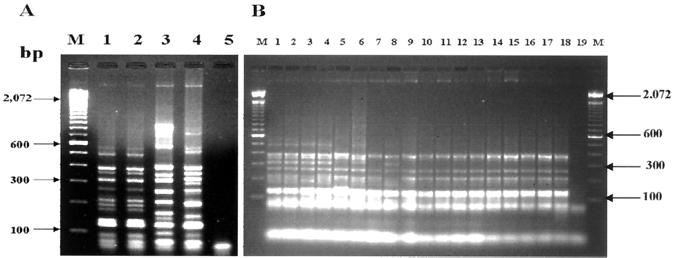
FIG. 1
FIG. 1
tDNA-PCR patterns of reference, clinical, and vaccine samples of Enterobacter species by electrophoresis in a 2% agarose gel. Lanes M, molecular size marker (100 bp). (A) Lane 1, E. cloacae ATCC 13047; lane 2, E. cloacae ATCC 23355; lane 3, E. sakazakii ATCC 29004; lane 4, E. aerogenes ATCC 13048; lane 5, negative control with no added template DNA. (B) Lane 1, E. cloacae ATCC 13047; lane 2, E. cloacae ATCC 23355; lanes 3 to 8, clinical isolates of E. cloacae from IAL; lanes 9 to 13, clinical isolates of E. cloacae from HU-UFRJ; lanes 14 to 18, vaccine isolates of E. cloacae; lane 19, negative control with no added template DNA.
FIG. 2
FIG. 2
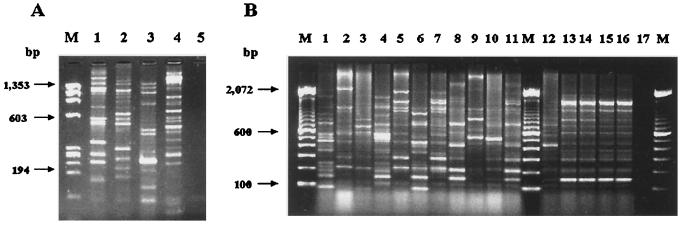
ITS-PCR patterns of reference, clinical, and vaccine samples of Enterobacter species by electrophoresis in a 2% agarose gel. (A) Lane M, molecular size marker (φX174 RF DNA/HaeIII); lane 1, E. cloacae ATCC 13047; lane 2, E. cloacae ATCC 23355; lane 3, E. sakazakii ATCC 29004; lane 4, E. aerogenes ATCC 13048; lane 5, negative control with no added template DNA. (B) Lanes M, molecular size markers (100-bp DNA ladder); lanes 1 to 6, clinical isolates of E. cloacae from IAL; lanes 7 to 11, clinical isolates of E. cloacae from HU-UFRJ; lanes 12 to 16, vaccine isolates; lane 17, negative control with no added template DNA.
FIG. 3
FIG. 3
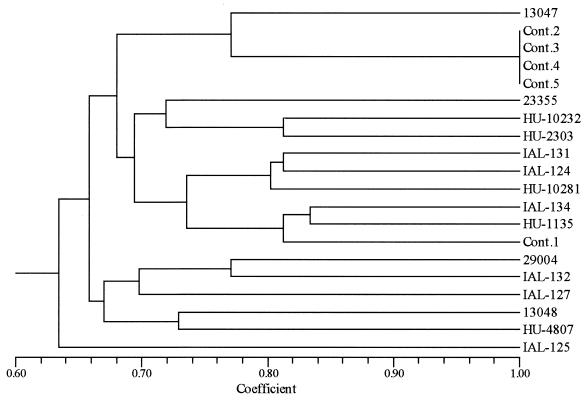
Phenetic relationship of 20 strains of Enterobacter sp. by ITS-PCR. The dendrogram was constructed by unweighted pair group method with arithmetic average. The numbers 13047, 23355, 29004, and 13048 are the ATCC strains; IAL and HU strains are E. cloacae strains from clinical samples; and Cont. 1 to 5 are E. cloacae strains from vaccine contaminants (Table 1).
FIG. 4
FIG. 4
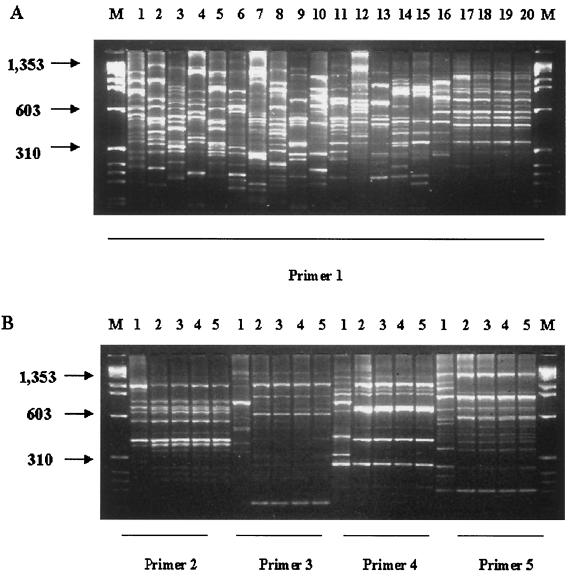
RAPD patterns of reference, clinical, and vaccine samples of Enterobacter species by electrophoresis in a 2% agarose gel. Lanes M, molecular size marker (φX174 RF DNA/HaeIII). (A) Lane 1, E. sakazakii ATCC 29004; lane 2, E. aerogenes ATCC 13048; lane 3, E. cloacae ATCC 13047; lane 4, E. cloacae ATCC 23355; lanes 5 to 10, clinical isolates of E. cloacae from IAL; lanes 11 to 15, clinical isolates of E. cloacae from HU-UFRJ; lanes 16 to 20, vaccine isolates. (B) Lanes 1 to 5, vaccine isolates analyzed with RAPD primers 2, 3, 4, and 5.

References

    1. Akers M J. Parenteral quality control: sterility, pyrogen, particulate, and package integrity testing. 2nd ed. New York, N.Y: Marcel Dekker; 1994.
    1. Baele M, Baele P, Vaneechoutte M, Storms V, Butaye P, Devriese L, Verschraegen G, Gillis M, Haesebrouck F. Application of tRNA intergenic spacer for identification of Enterococcus species. J Clin Microbiol. 2000;38:4201–4207. - PMC - PubMed
    1. Bean P, Olive D M. Principles and applications of methods for DNA-based typing of microbial organisms. J Clin Microbiol. 1999;37:1661–1669. - PMC - PubMed
    1. Benter T, Papadopoulos S, Pape M, Manns M, Poliwada H. Optimization and reproducibility of random amplified DNA in human. Anal Biochem. 1995;230:92–100. - PubMed
    1. Bingen E, Denamur E, Lambert-Zechovsky N, Brahimi N, El Lakami M, Elion J. Rapid genotyping shows the absence of cross contamination in Enterobacter cloacae nosocomial infections. J Hosp Infect. 1992;21:95–101. - PubMed

Publication types

MeSH terms

LinkOut - more resources