


Review
doi: 10.1186/rr70.
Epub 2001 Jul 13.
Role of free radicals in the pathogenesis of acute chest syndrome in sickle cell disease
Affiliations
- PMID: 11686897
- PMCID: PMC59517
- DOI: 10.1186/rr70
Item in Clipboard
Review
Role of free radicals in the pathogenesis of acute chest syndrome in sickle cell disease
Respir Res.
2001.
Abstract
Acute chest syndrome (ACS) of sickle cell disease (SCD) is characterized pathologically by vaso-occlusive processes that result from abnormal interactions between sickle red blood cells (RBCs), white blood cells (WBCs) and/or platelets, and the vascular endothelium. One potential mechanism of vascular damage in ACS is by generation of oxygen-related molecules, such as superoxide (O2-), hydrogen peroxide (H2O2), peroxynitrite (ONOO-), and the hydroxyl (*OH) radical. The present review summarizes the evidence for alterations in oxidant stress during ACS of SCD, and the potential contributions of RBCs, WBCs and the vascular endothelium to this process.
Figures
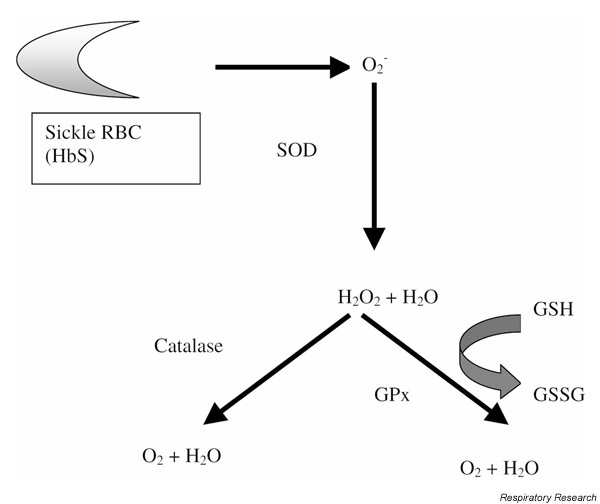
Mechanisms of oxidant production in sickle RBCs. Sickle RBCs, through the auto-oxidation of hemoglobin (Hb)S, produce O2-, which is metabolized to H2O2 by superoxide dismutase (SOD). H2O2 is then metabolized to O2 and H2O by catalase and GPx. Deficiencies in SOD, catalase, and GPx in sickle RBCs lead to increased O2- and H2O2 production. GSSG, oxidized glutathione.
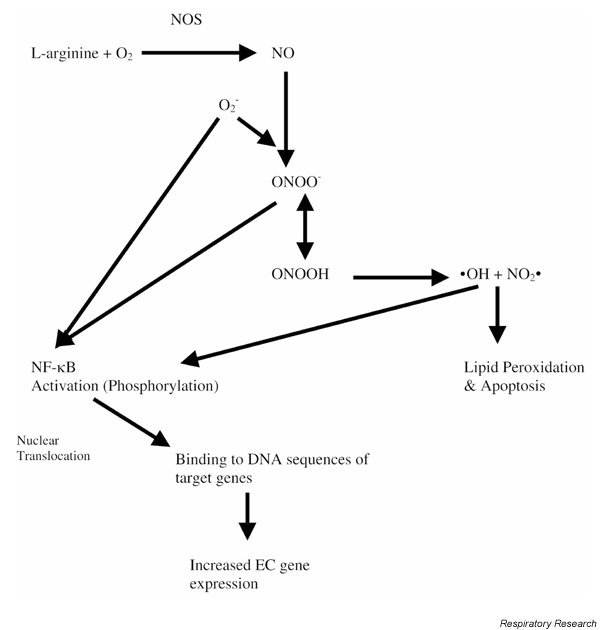
Mechanism by which free radicals alter NO bioavailability and endothelial cell biology. Under conditions of increased O2- production, NO preferentially forms ONOO-. Both O2- and ONOO- can alter endothelial cell (EC) gene expression via activation and nuclear translocation of second messengers such as NF-κB.
References
-
- Johnson CS, Verdigem TD. Pulmonary complications of sickle cell disease. Semin Respir Med. 1988;9:287–296.
-
- Gee BE, Platt OS. Sickle erythrocytes adhere to VCAM-1. Blood. 1995;85:268–274. - PubMed
Publication types
MeSH terms
Substances
LinkOut - more resources
Full Text Sources
Medical
