


Oestrogens alone or with amniotomy for cervical ripening or induction of labour
- PMID: 11687200
- PMCID: PMC6991160
- DOI: 10.1002/14651858.CD003393
Oestrogens alone or with amniotomy for cervical ripening or induction of labour
Abstract
Background: Studies in sheep showed that there is a pre-labour rise in oestrogen and a decrease in progesterone, both of these changes stimulate prostaglandin production and may help initiate labour. Though oestrogen has been suggested as an effective cervical ripening or induction agent, research in humans have failed to demonstrate a similar physiological mechanism. The use of oestrogen as an induction agent is not currently common practice, as such this systematic review should be regarded as an historical review. This is one of a series of reviews of methods of cervical ripening and labour induction using a standardised methodology.
Objectives: To determine, from the best available evidence, the effectiveness and safety of oestrogens alone or with amniotomy for third trimester cervical ripening and induction of labour in comparison with other methods of induction of labour.
Search strategy: The Cochrane Pregnancy and Childbirth Group trials register, the Cochrane Controlled Trials Register and bibliographies of relevant papers. Last searched: April 2001.
Selection criteria: (1) randomised controlled trials comparing oestrogens alone used for third trimester cervical ripening or labour induction with placebo/no treatment or other methods listed above it on a predefined list of labour induction methods; (2) random allocation to the treatment or control group; (3) adequate allocation concealment; (4) violations of allocated management not sufficient to materially affect conclusions; (5) clinically meaningful outcome measures reported; (6) data available for analysis according to the random allocation; (7) missing data insufficient to materially affect the conclusions.
Data collection and analysis: A generic strategy has been developed to deal with the large volume and complexity of trial data relating to labour induction. This involved a two-stage method of data extraction. The initial data extraction was done centrally.
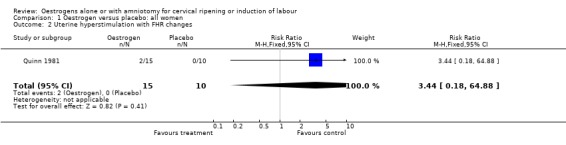
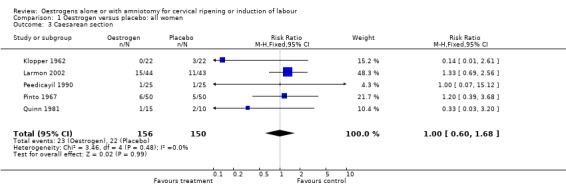
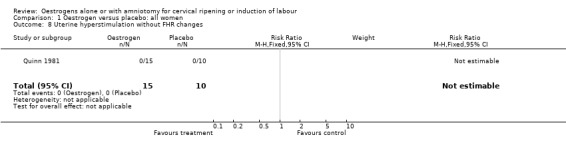
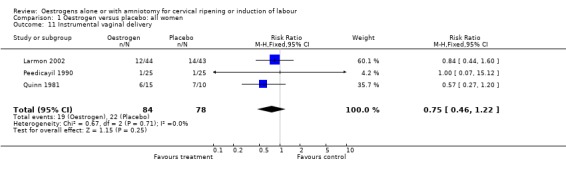
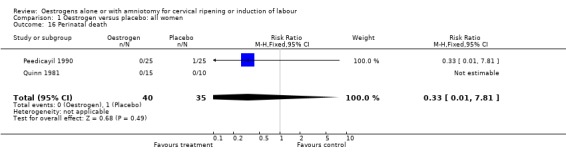
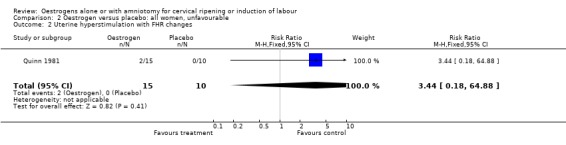
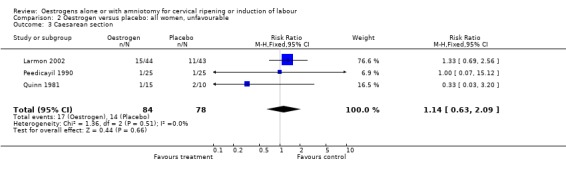
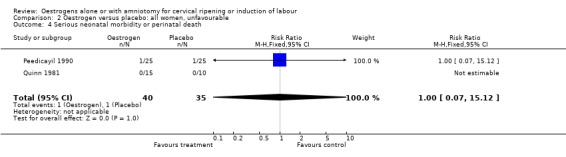
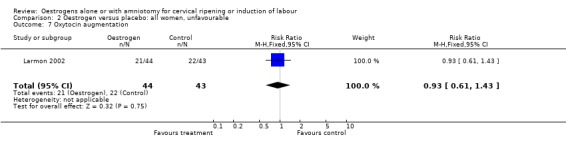
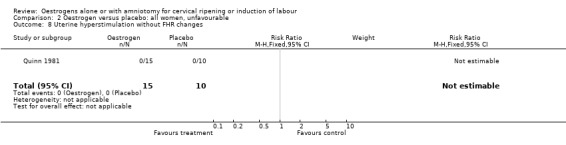
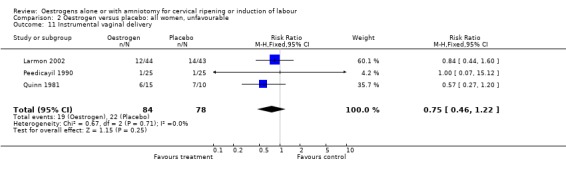
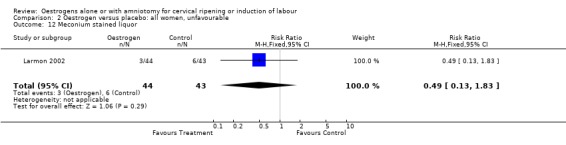
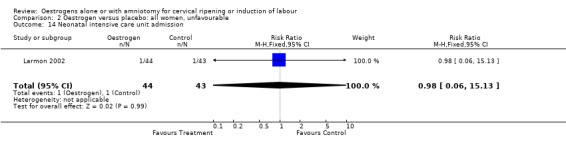
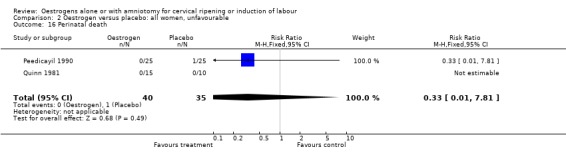
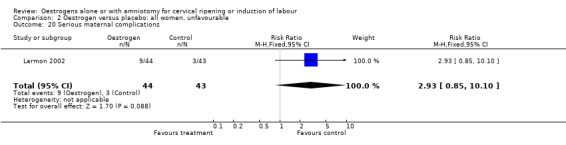
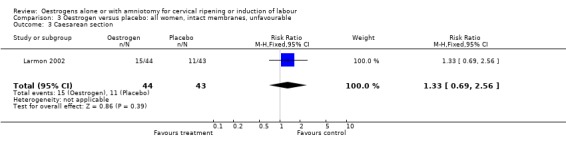
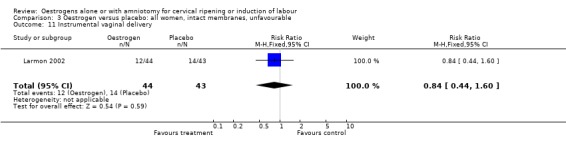
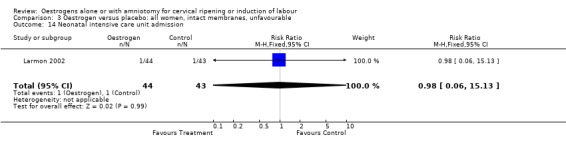
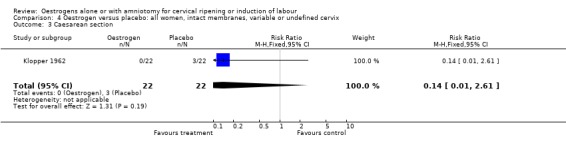
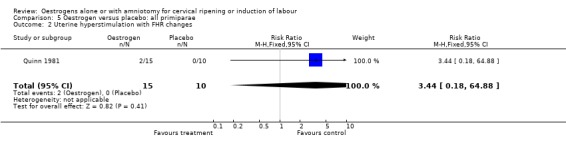
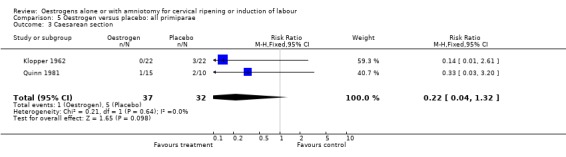
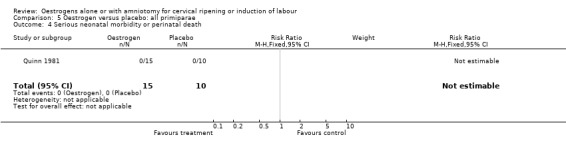
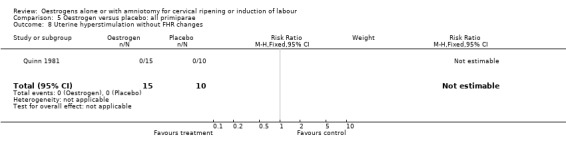
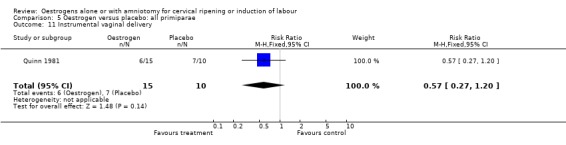
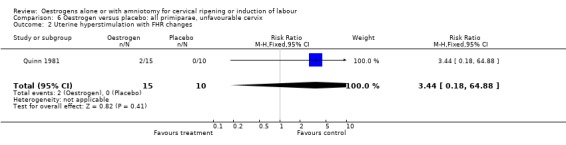
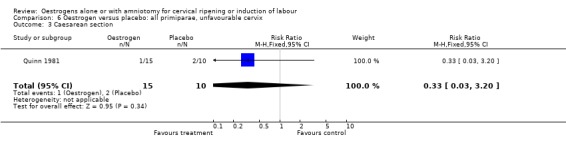
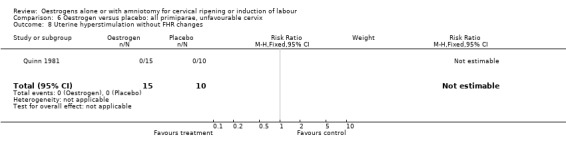
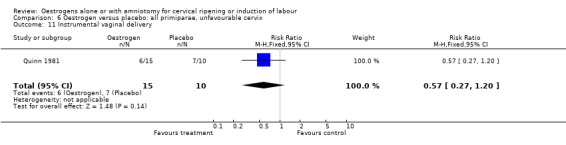
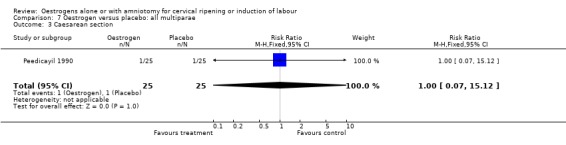
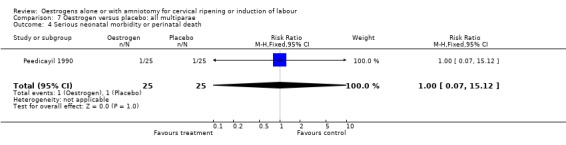
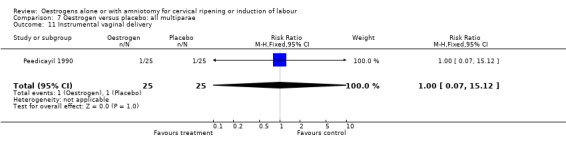
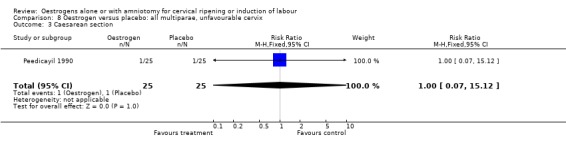
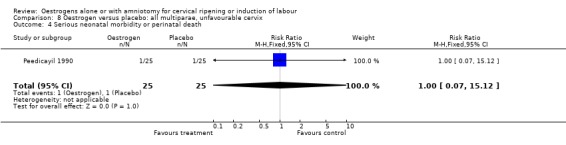
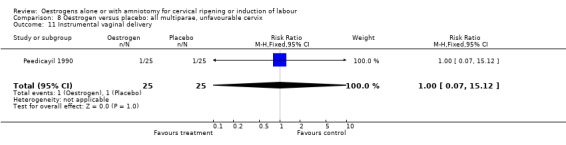
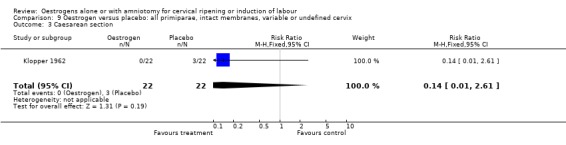
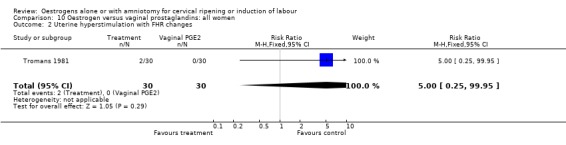
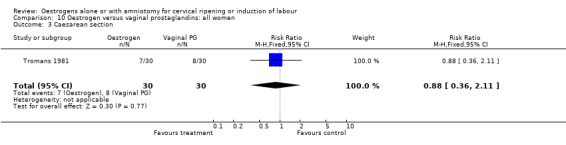
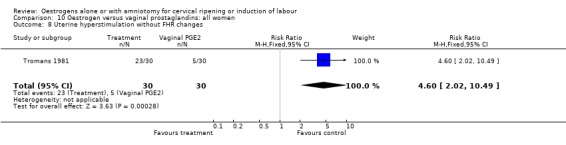
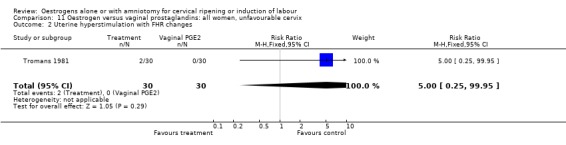
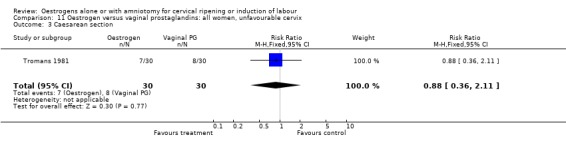
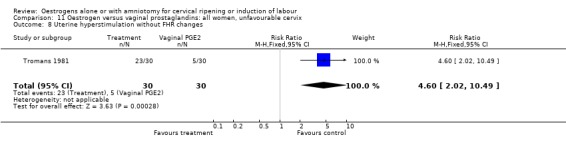
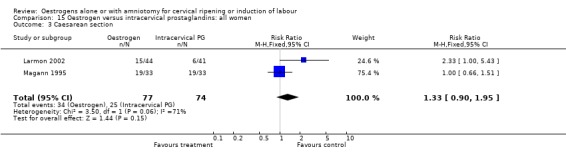
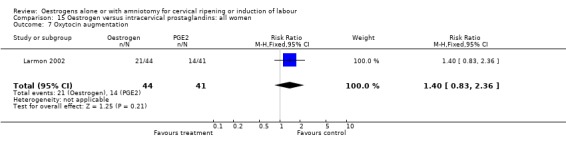
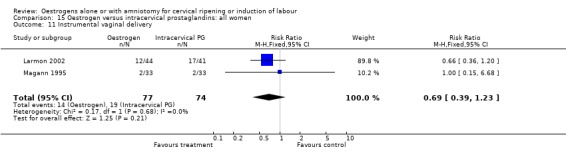
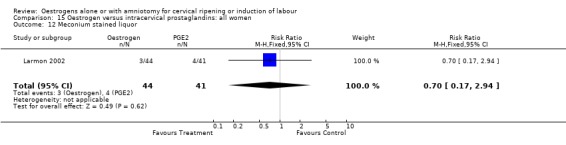
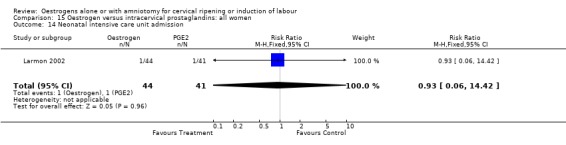
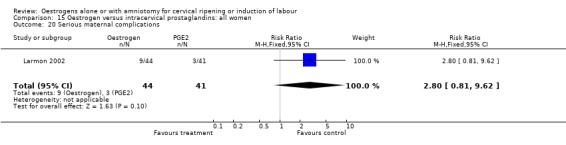
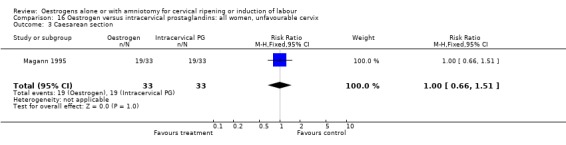
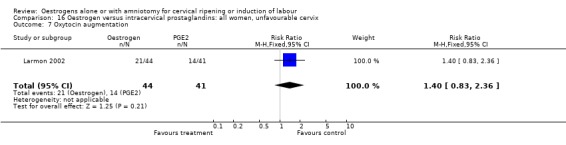
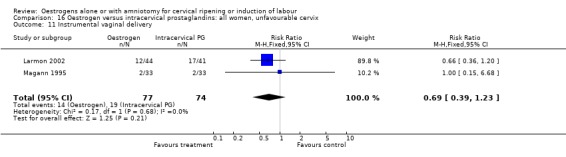
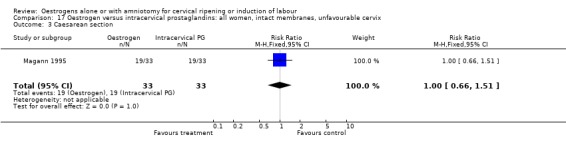
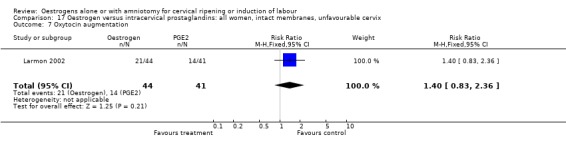
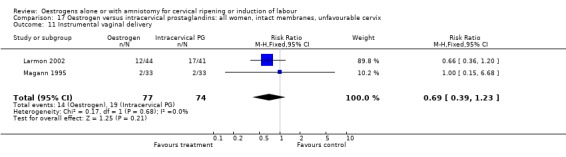
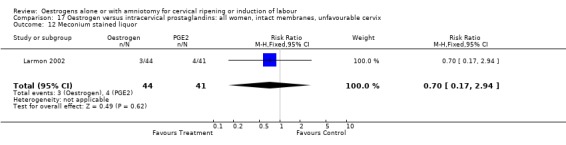
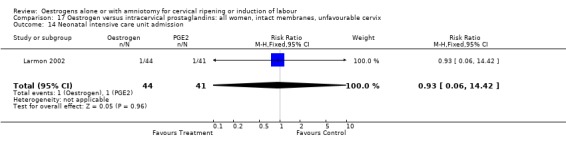
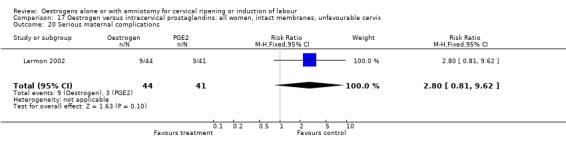
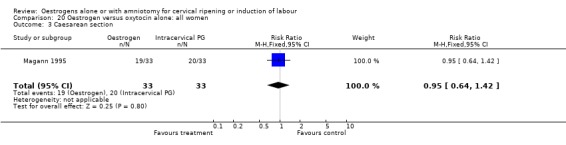
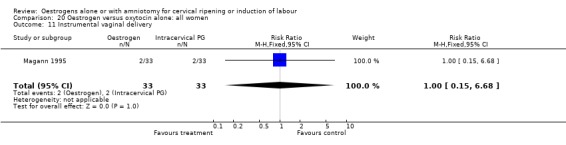
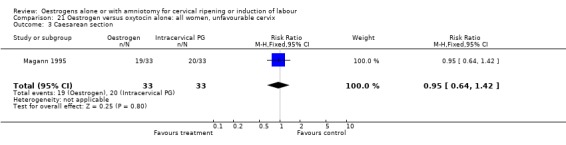
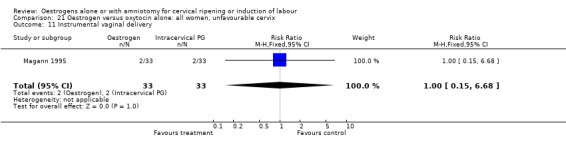
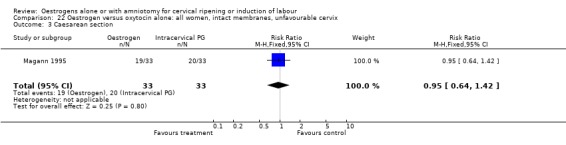
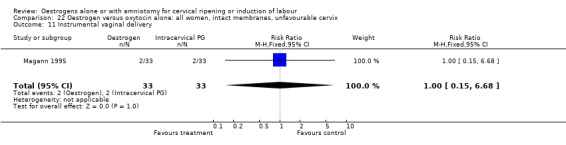
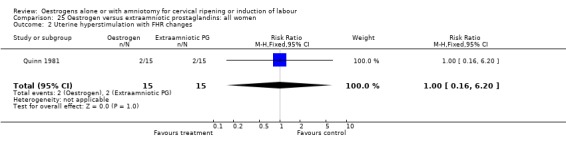
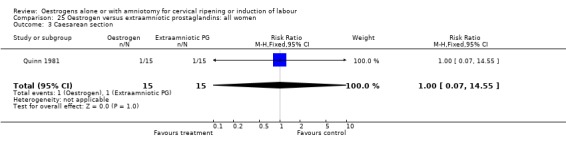
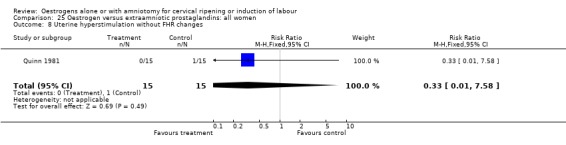
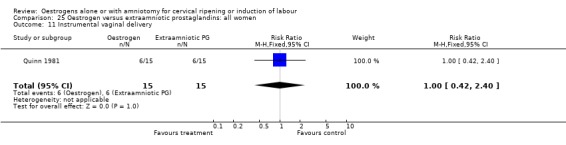
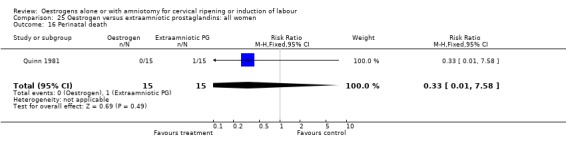
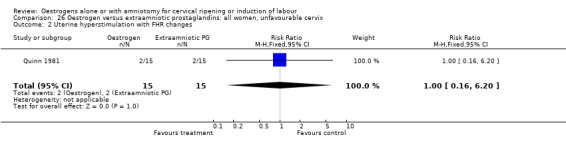
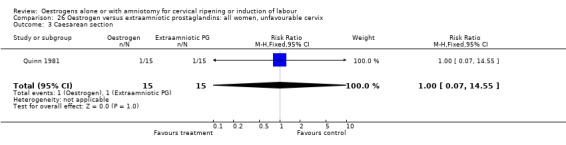
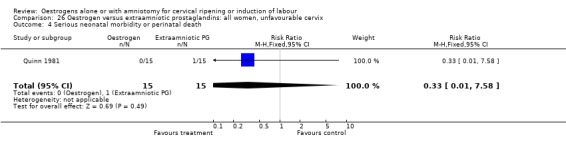
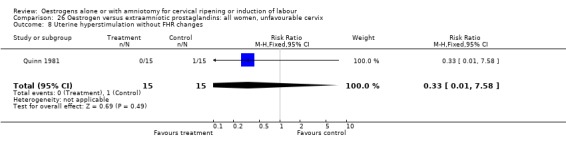
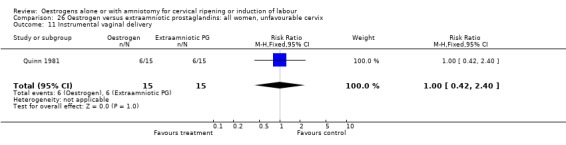
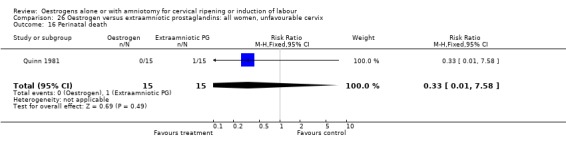
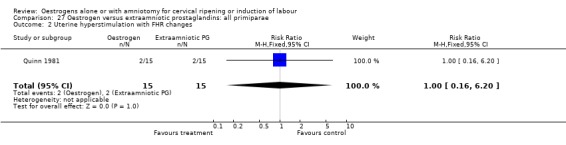
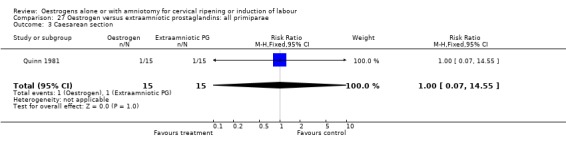
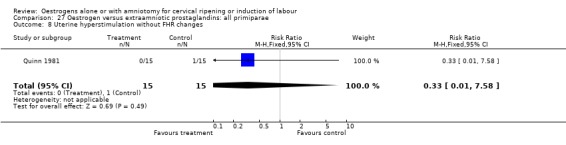
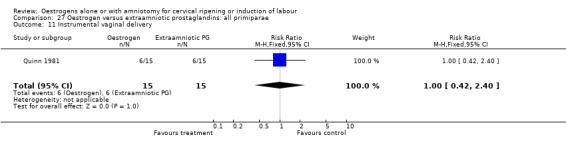
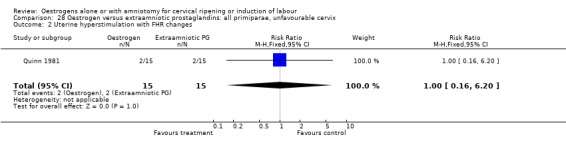
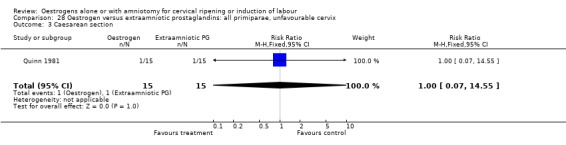
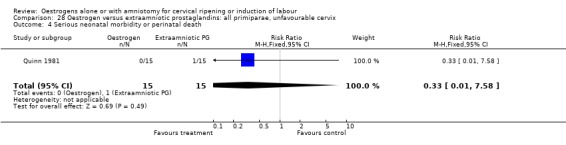
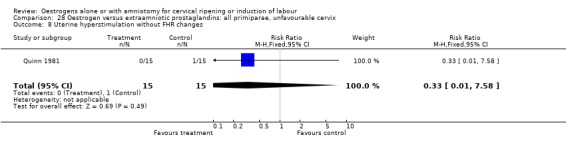
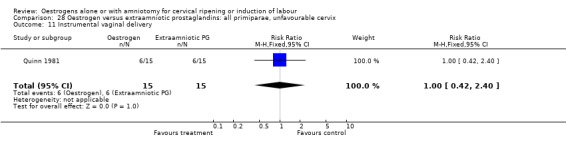
Main results: When comparing oestrogen with placebo there was no difference between the rate of caesarean section (7.1% versus 10.3%, relative risk (RR) 0.70, 95% confidence interval (CI) 0.30,1.62). There were no differences between rates of uterine hyperstimulation with or without fetal heart rate changes or instrumental vaginal delivery. None of the studies reported the rates of either vaginal delivery not achieved in 24 hours, or cervix unfavourable/unchanged after 12-24 hours. There were insufficient data to make any meaningful conclusions when comparing oestrogen with vaginal PGE2, intracervical PGE2, oxytocin alone or extra amniotic PGF2a, as to whether oestrogen is effective in inducing labour.
Reviewer's conclusions: There were insufficient data to draw any conclusions regarding the efficacy of oestrogen as an induction agent.
Conflict of interest statement
None known.
Figures
References
References to studies included in this review
Klopper 1962 {published data only}
Larmon 2002 {published data only}
-
- Larmon JE, Magann EF, Dickerson GA, Morrison JC. Outpatient cervical ripening with prostaglandin E2 and estradiol. Journal of Maternal‐Fetal and Neonatal Medicine 2002;11:113‐7. - PubMed
Magann 1995 {published data only}
-
- Magann EF, Perry KG, Dockery JR, Bass JD, Chauhan SP, Morrison JC. Cervical ripening before medical induction of labor: a comparison of prostaglandin E2, estradiol, and oxytocin. American Journal of Obstetrics and Gynecology 1995;172:1702‐8. - PubMed
Peedicayil 1990 {published data only}
-
- Peedicayil A, Jasper P, Balasubramaniam N, Jairaj P. A randomized controlled trial of extra‐amniotic ethinyloestradiol for cervical ripening in multiparas. Australian and New Zealand Journal of Obstetrics and Gynaecology 1990;30:127‐30. - PubMed
Pinto 1967 {published data only}
-
- Pinto RM, Leon C, Mazzocco N, Scasserra U. Action of estradiol‐17B at term and at onset of labor. American Journal of Obstetrics and Gynecology 1967;98:540‐6. - PubMed
Quinn 1981 {published data only}
-
- Quinn MA, Murphy AJ, Kuhn RJP, Robinson HP, Brown JB. A double blind trial of extra‐amniotic oestriol and prostaglandin F2alpha gels in cervical ripening. British Journal of Obstetrics and Gynaecology 1981;88:644‐9. - PubMed
References to studies excluded from this review
Gordon 1977 {published data only}
-
- Gordon AJ, Calder AA. Oestradiol applied locally to ripen the unfavourable cervix. Lancet 1977;2:1319‐21. - PubMed
Griffin 2003 {published data only}
-
- Griffin C. Outpatient cervical ripening using sequential oestrogen ‐ a randomised controlled pilot study [abstract]. Australian and New Zealand Journal of Obstetrics and Gynaecology 2003;43:183.
Klopper 1969 {published data only}
Klopper 1973 {published data only}
-
- Klopper AI, Farr V, Dennis KJ. The effect of intra‐amniotic oestriol sulphate on uterine contractility at term. Journal of Obstetrics and Gynaecology of the British Commonwealth 1973;80:34‐40. - PubMed
Luther 1980 {published data only}
-
- Luther ER, Roux J, Popat R, Gardner A, Gray J, Soubiran E, Korcaz Y. The effect of estrogen priming on induction of labor with prostaglandins. American Journal of Obstetrics and Gynecology 1980;137:351‐7. - PubMed
Magnani 1986 {published data only}
-
- Magnani M, Cabrol D. Induction of labour with PGE2 after cervical ripening with oestradiol. Control and Management of Parturition. Paris: INSERM, 1986:109‐18.
Mamo 1994 {published data only}
-
- Mamo J. Intravaginal oestriol pessary for preinduction cervical ripening. International Journal of Gynecology & Obstetrics 1994;46:137.
Martin 1955 {published data only}
-
- Martin, RH, Menzies, DN. Oestrogen therapy in missed abortion and labour. Journal of Obstetrics and Gynaecology of the British Commonwealth 1955;62:256‐8. - PubMed
Moran 1994 {published data only}
-
- Moran DJ, McGarrigle HHG, Lachelin GCL. Maternal plasma progesterone levels fall after rectal administration of estriol. Journal of Clinical Endocrinology & Metabolism 1994;78(1):70‐2. - PubMed
Palmero 1997 {published data only}
-
- Palermo MSF, Damiano MS, Lijdens E, Cassale E, Monaco A, Gamarino S, et al. Dinoprostone vs. oestradiol for induction to delivery. Clinical controlled trial. Acta Obstetricia et Gynecologica Scandinavica 1997;76:97.
Pedersen 1981 {unpublished data only}
-
- Pedersen S, Moller‐Petersen, Egidius J. The effect on induction of labour of endocervical balloon catheter with and without oestrogen therapy [Effekten pa fodselsigangsaettelse af endocerviklat balonkateter med og uden ostraiolbehandling]. Ugeskrift for Laeger 1975;143:3379‐81. - PubMed
Peedicayil 1989 {published data only}
-
- Peedicayil A, Jasper P, Balasubramaniam N, Jairaj P. A randomized controlled trial of extra‐amniotic ethinyloestradiol in ripening the cervix at term. British Journal of Obstetrics and Gynaecology 1989;96:973‐7. - PubMed
Roztocil 1998 {published data only}
-
- Roztocil A, Pilka L, Jelinek J, Koudelka M, Miklica J. A comparison of three preinduction cervical priming methods: prostaglandin e2 gel, dilapan s rods and estradiol gel. Ceska Gynekologie 1998;63:3‐9. - PubMed
Sasaki 1982 {published data only}
-
- Sasaki K, Nakano R, Kadoya Y, Iwao M, Shima K, Sowa M. Cervical ripening with dehydroepiandrosterone sulphate. British Journal of Obstetrics and Gynaecology 1982;89:195‐8. - PubMed
Stewart 1981 {published data only}
-
- Stewart P, Kennedy JH, Barlow DH, Calder AA. A comparison of oestradiol and prostaglandin E2 for ripening the cervix. British Journal of Obstetrics and Gynaecology 1981;88:236‐9. - PubMed
Thiery 1978 {published data only}
-
- Thiery M, Gezelle H, Kets H, Voorhoof L, Verheugen C, Smis B, et al. Extra‐amniotic oestrogens for the unfavourable cervix. Lancet 1978;2:835‐6. - PubMed
Thiery 1979 {published data only}
-
- Thiery M, Gezelle H, Kets H, Voorhoof L, Verheugen B, Sims J, et al. The effect of locally adminstered estrogens on the human cervix. Zeitschrift fur Geburtshilfe und Perinatologie 1979;183:448‐52. - PubMed
Williams 1988 {published data only}
-
- Williams JK, Lewis ML, Cohen GR, O'Brien WF. The sequential use of estradiol and prostaglandin E2 topical gels for cervical ripening in high‐risk term pregnancies requiring induction of labour. American Journal of Obstetrics and Gynecology 1988;158:55‐58. - PubMed
Additional references
Alfirevic 2006
Boulvain 2001
Boulvain 2005
Boulvain 2008
Bricker 2000
Cochrane 2008
-
- Higgins JPT, Green S (editors). Cochrane Handbook for Systematic Reviews of Interventions 5.0.0 [Updated February 2008]. The Cochrane Collaboration, 2008. Available from www.cochrane‐handbook.org.
Curtis 1987
-
- Curtis P, Evans S, Resnick J. Uterine hyperstimulation. The need for standard terminology. Journal of Reproductive Medicine 1987;32:91‐5. - PubMed
French 2001
Hofmeyr 2000
Hofmeyr 2003
Howarth 2001
Hutton 2001
Kavanagh 2001
Kavanagh 2005
Kavanagh 2006
Kavanagh 2006a
Kelly 2001
Kelly 2001a
Kelly 2001b
Kelly 2003
Kelly 2008
-
- Kelly T, Doswell T, Alfirevic Z. Outpatient versus inpatient induction of labour for improving birth outcomes. Cochrane Database of Systematic Reviews 2008, Issue 4. [DOI: 10.1002/14651858.CD007372] - DOI
Kelly 2008a
-
- Kelly AJ, Kavanagh J. Nitric oxide donors for cervical ripening and induction of labour. Cochrane Database of Systematic Reviews 2008, Issue 1. [DOI: 10.1002/14651858.CD006901] - DOI
Luckas 2000
Muzonzini 2004
Neilson 2000
RevMan 2008 [Computer program]
-
- The Nordic Cochrane Centre, The Cochrane Collaboration. Review Manager (RevMan). Version 5.0. Copenhagen: The Nordic Cochrane Centre, The Cochrane Collaboration, 2008.
Smith 2003
Smith 2004
Publication types
MeSH terms
Substances
LinkOut - more resources
Full Text Sources
Miscellaneous
