


Personality traits and brain dopaminergic function in Parkinson's disease
- PMID: 11687621
- PMCID: PMC60860
- DOI: 10.1073/pnas.231313198
Personality traits and brain dopaminergic function in Parkinson's disease
Abstract
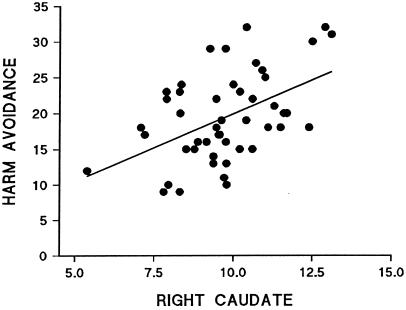
A distinctive personality type, characterized by introversion, inflexibility, and low novelty seeking, has been suggested to be associated with Parkinson's disease. To test the hypothesis that Parkinson's disease is associated with a specific dopamine-related personality type, the personality structures of 61 unmedicated Parkinson's disease patients and 45 healthy controls were examined. Additionally, in 47 Parkinson's disease patients, the dopaminergic function in the brain was directly measured with 6-[(18)F]fluoro-l-dopa ((18)F-dopa) positron emission tomography (PET) with MRI coregistration. The novelty-seeking personality score, supposedly associated with the parkinsonian personality, was slightly lower in the Parkinson's disease group compared with controls, but it did not have a significant relationship with (18)F-dopa uptake in any of the brain regions studied (r = -0.12 to 0.11, P > 0.15). The harm-avoidance personality score, associated with anxiety and depression, was clearly increased in patients with Parkinson's disease and it had a paradoxical, highly significant positive correlation with the (18)F-dopa uptake in the right caudate nucleus (r = 0.53, P = 0.04, Bonferroni corrected for 220 comparisons). Although the results of this study are not in disagreement with the concept of low-novelty-seeking personality type in Parkinson's disease, the personality type does not seem to be dopamine dependent. The correlation between the personality trait of harm avoidance and (18)F-dopa may reflect a specific feedback circuitry of neurotransmitters that is associated with negative emotionality in Parkinson's disease.
Figures
References
-
- Menza M. Curr Psychiatry Rep. 2000;2:421–426. - PubMed
-
- Menza M A, Golbe L I, Cody R A, Forman N E. Neurology. 1993;43:505–508. - PubMed
-
- Hubble J P, Koller W C. Adv Neurol. 1995;65:43–48. - PubMed
-
- Fujii C, Harada S, Ohkoshi N, Hayashi A, Yoshizawa K. Am J Med Genet. 2000;96:1–3. - PubMed
-
- Cloninger C R. Arch Gen Psychiatry. 1987;44:573–588. - PubMed
Publication types
MeSH terms
Substances
LinkOut - more resources
Full Text Sources
Other Literature Sources
Medical
