


Common origin of four diverse families of large eukaryotic DNA viruses
- PMID: 11689653
- PMCID: PMC114758
- DOI: 10.1128/JVI.75.23.11720-11734.2001
Common origin of four diverse families of large eukaryotic DNA viruses
Abstract
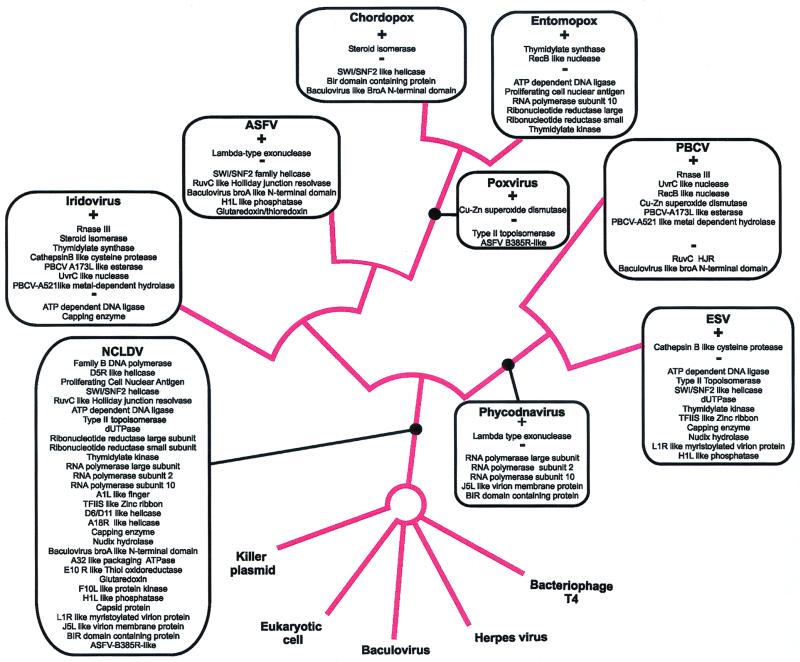
Comparative analysis of the protein sequences encoded in the genomes of three families of large DNA viruses that replicate, completely or partly, in the cytoplasm of eukaryotic cells (poxviruses, asfarviruses, and iridoviruses) and phycodnaviruses that replicate in the nucleus reveals 9 genes that are shared by all of these viruses and 22 more genes that are present in at least three of the four compared viral families. Although orthologous proteins from different viral families typically show weak sequence similarity, because of which some of them have not been identified previously, at least five of the conserved genes appear to be synapomorphies (shared derived characters) that unite these four viral families, to the exclusion of all other known viruses and cellular life forms. Cladistic analysis with the genes shared by at least two viral families as evolutionary characters supports the monophyly of poxviruses, asfarviruses, iridoviruses, and phycodnaviruses. The results of genome comparison allow a tentative reconstruction of the ancestral viral genome and suggest that the common ancestor of all of these viral families was a nucleocytoplasmic virus with an icosahedral capsid, which encoded complex systems for DNA replication and transcription, a redox protein involved in disulfide bond formation in virion membrane proteins, and probably inhibitors of apoptosis. The conservation of the disulfide-oxidoreductase, a major capsid protein, and two virion membrane proteins indicates that the odd-shaped virions of poxviruses have evolved from the more common icosahedral virion seen in asfarviruses, iridoviruses, and phycodnaviruses.
Figures
References
-
- Altschul S F, Koonin E V. PSI-BLAST—a tool for making discoveries in sequence databases. Trends Biochem Sci. 1998;23:444–447. - PubMed
Publication types
MeSH terms
Substances
LinkOut - more resources
Full Text Sources
