


The type 2 iodothyronine deiodinase is essential for adaptive thermogenesis in brown adipose tissue
- PMID: 11696583
- PMCID: PMC209445
- DOI: 10.1172/JCI13803
The type 2 iodothyronine deiodinase is essential for adaptive thermogenesis in brown adipose tissue
Abstract
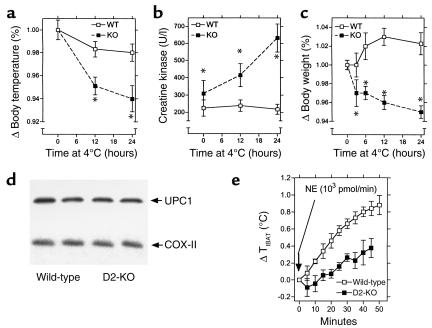
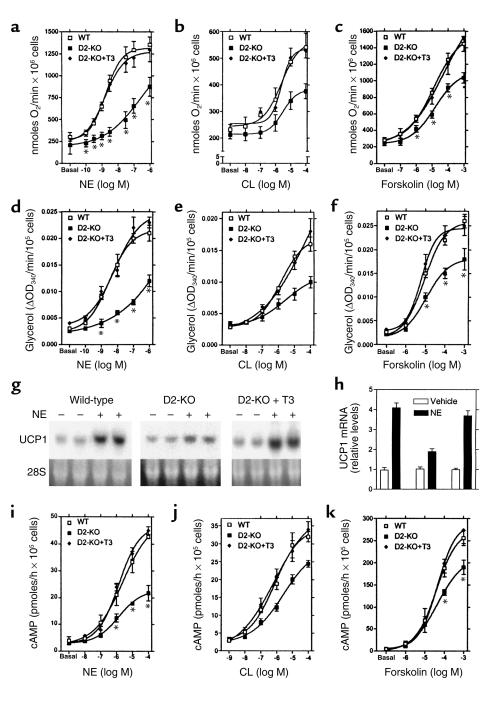
Type 2 iodothyronine deiodinase (D2) is a selenoenzyme, the product of the recently cloned cAMP-dependent Dio2 gene, which increases 10- to 50-fold during cold stress only in brown adipose tissue (BAT). Here we report that despite a normal plasma 3,5,3'-triiodothyronine (T3) concentration, cold-exposed mice with targeted disruption of the Dio2 gene (Dio2(-/-)) become hypothermic due to impaired BAT thermogenesis and survive by compensatory shivering with consequent acute weight loss. This occurs despite normal basal mitochondrial uncoupling protein 1 (UCP1) concentration. In Dio2(-/-) brown adipocytes, the acute norepinephrine-, CL316,243-, or forskolin-induced increases in lipolysis, UCP1 mRNA, and O(2) consumption are all reduced due to impaired cAMP generation. These hypothyroid-like abnormalities are completely reversed by a single injection of T3 14 hours earlier. Recent studies suggest that UCP1 is primarily dependent on thyroid hormone receptor beta (TR beta) while the normal sympathetic response of brown adipocytes requires TR alpha. Intracellularly generated T3 may be required to saturate the TR alpha, which has an approximately fourfold lower T3-binding affinity than does TR beta. Thus, D2 is an essential component in the thyroid-sympathetic synergism required for thermal homeostasis in small mammals.
Figures

References
-
- Nicholls DG, Locke RM. Thermogenic mechanisms in brown fat. Physiol Rev. 1984;64:1–64. - PubMed
-
- Himms-Hagen J. Brown adipose tissue thermogenesis: interdisciplinary studies. FASEB J. 1990;4:2890–2898. - PubMed
-
- Lowell BB, Spiegelman BM. Towards a molecular understanding of adaptive thermogenesis. Nature. 2000;404:652–660. - PubMed
-
- Nedergaard J, et al. UCP1: the only protein able to mediate adaptive non-shivering thermogenesis and metabolic inefficiency. . Biochim Biophys Acta. 2001; 1504:82–106. - PubMed
-
- Silva JE, Larsen PR. Adrenergic activation of triiodothyronine production in brown adipose tissue. Nature. 1983;305:712–713. - PubMed
Publication types
MeSH terms
Substances
Grants and funding
LinkOut - more resources
Full Text Sources
Other Literature Sources
Medical
Molecular Biology Databases
Research Materials
