


Membrane-associated quinoprotein formaldehyde dehydrogenase from Methylococcus capsulatus Bath
- PMID: 11698372
- PMCID: PMC95524
- DOI: 10.1128/JB.183.23.6832-6840.2001
Membrane-associated quinoprotein formaldehyde dehydrogenase from Methylococcus capsulatus Bath
Abstract
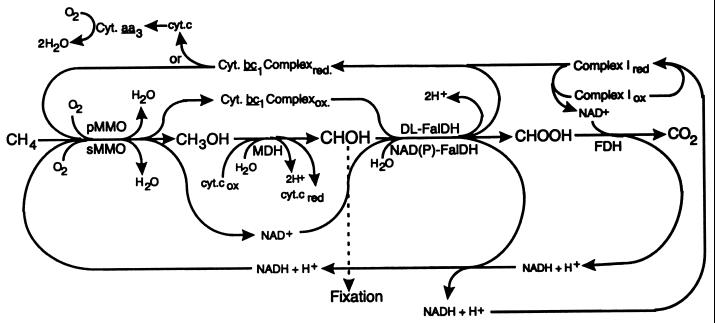
A membrane-associated, dye-linked formaldehyde dehydrogenase (DL-FalDH) was isolated from the obligate methylotroph Methylococcus capsulatus Bath. The enzyme was the major formaldehyde-oxidizing enzyme in cells cultured in high (above 1 micromol of Cu per mg of cell protein) copper medium and expressing the membrane-associated methane monooxygenase. Soluble NAD(P)(+)-linked formaldehyde oxidation was the major activity in cells cultured in low-copper medium and expressing the soluble methane monooxygenase (Tate and Dalton, Microbiology 145:159-167, 1999; Vorholt et al., J. Bacteriol. 180:5351-5356, 1998). The membrane-associated enzyme is a homotetramer with a subunit molecular mass of 49,500 Da. UV-visible absorption, electron paramagnetic resonance, and electrospray mass spectrometry suggest the redox cofactor of the DL-FalDH is pyrroloquinoline quinone (PQQ), with a PQQ-to-subunit stochiometry of approximately 1:1. The enzyme was specific for formaldehyde, oxidizing formaldehyde to formate, and utilized the cytochrome b(559/569) complex as the physiological electron acceptor.
Figures
References
-
- Anthony C. The biochemistry of methylotrophs. London, England: Academic Press; 1982.
-
- Ariel B, Shahak Y, Taglicht D, Hauska G, Padan E. Purification and characterization of sulfide-quinone reductase, a novel enzyme driving anoxygenic photosynthesis in Oscillatoria limnetica. J Biol Chem. 1994;268:5705–5711. - PubMed
-
- Attwood M, Quayle J R. Formaldehyde as a central intermediary metabolite in methylotrophic metabolism. In: Crawford R L, Hanson R H, editors. Microbial growth on C1 compounds. Washington, D.C.: ASM Press; 1984. pp. 315–323.
Publication types
MeSH terms
Substances
LinkOut - more resources
Full Text Sources
