


Combined effects of intrinsic facilitation and modulatory inhibition of identified interneurons in the siphon withdrawal circuitry of Aplysia
- PMID: 11698609
- PMCID: PMC6762296
- DOI: 10.1523/JNEUROSCI.21-22-08990.2001
Combined effects of intrinsic facilitation and modulatory inhibition of identified interneurons in the siphon withdrawal circuitry of Aplysia
Abstract
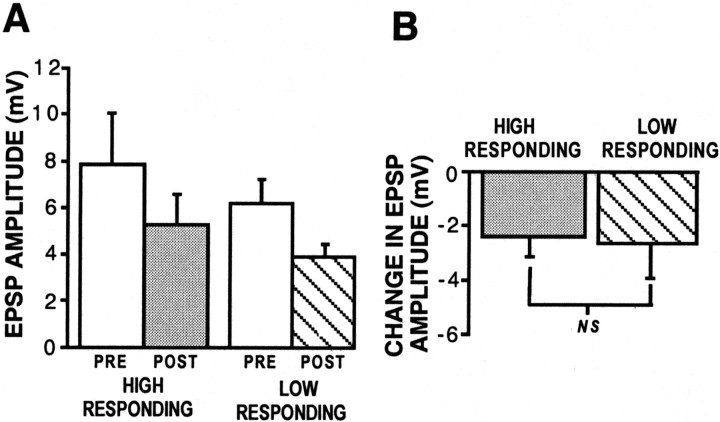
Synaptic plasticity can be induced through mechanisms intrinsic to a synapse or through extrinsic modulatory mechanisms. In this study, we investigated the relationship between these two forms of plasticity at the excitatory synapse between L29 interneurons and siphon motor neurons (MNs) in Aplysia. Using isolated ganglia, we confirmed that the L29-MN synapses exhibit a form of intrinsic facilitation: post-tetanic potentiation (PTP). We also found that L29-MN synapses are modulated by exogenous application of 5-HT: they are depressed after 5-HT exposure. We next investigated the functional relationship between an intrinsic facilitatory process (PTP) and extrinsic inhibitory modulation (5-HT-induced depression). First, we found that application of 5-HT just before L29 activation results in a reduction of PTP. Second, using semi-intact preparations, we found that tail shock (TS) mimics the effect of 5-HT by both depressing L29 synaptic transmission and by reducing L29 PTP. Third, we observed a significant correlation between L29 activity during TS and subsequent synaptic change: low-responding L29s showed synaptic depression after TS, whereas high-responding L29s showed synaptic facilitation. Finally, we found that we could directly manipulate the sign and magnitude of TS-induced synaptic plasticity by controlling L29 activity during TS. Collectively, our results show that the L29-MN synapses exhibit intrinsic facilitation and extrinsic modulation and that the sign and magnitude of L29-MN plasticity induced by TS is governed by the combined effects of these two processes. This circuit architecture, which combines network inhibition with cell-specific facilitation, can enhance the signal value of a specific stimulus within a neural network.
Figures



References
-
- Barbeau H, Rossignol S. Initiation and modulation of the locomotor pattern in the adult chronic spinal cat by noradrenergic, serotonergic, and dopaminergic drugs. Brain Res. 1991;546:250–260. - PubMed
-
- Belkin KJ, Abrams TW. The effect of the neuropeptide FMRFamide on Aplysia californica siphon motoneurons involves multiple ionic currents that vary seasonally. J Exp Biol. 1998;201:2225–2234. - PubMed
-
- Bristol AS, Fischer TM, Carew TJ. Characterization and modulation of activity-dependent plasticity at the L29-MN synapse in Aplysia. Soc Neurosci Abstr. 1998;24:702.
Publication types
MeSH terms
Substances
Grants and funding
LinkOut - more resources
Full Text Sources
