. 2001 Nov 20;98(24):14174-9.
doi: 10.1073/pnas.231491298. Epub 2001 Nov 6.

Regulation of cyclic peptide biosynthesis in a plant pathogenic fungus by a novel transcription factor

Affiliations

Regulation of cyclic peptide biosynthesis in a plant pathogenic fungus by a novel transcription factor

K F Pedley et al. Proc Natl Acad Sci U S A. .

Abstract

Strains of the filamentous fungus Cochliobolus carbonum that produce the host-selective compound HC-toxin, a cyclic tetrapeptide, are highly virulent on certain genotypes of maize (Zea mays L.). Production of HC-toxin is under the control of a complex locus, TOX2, which is composed of at least seven linked and duplicated genes that are present only in toxin-producing strains of C. carbonum. One of these genes, TOXE, was earlier shown to be required for the expression of the other TOX2 genes. TOXE has four ankyrin repeats and a basic region similar to those found in basic leucine zipper (bZIP) proteins, but lacks any apparent leucine zipper. Here we show that TOXE is a DNA-binding protein that recognizes a ten-base motif (the "tox-box") without dyad symmetry that is present in the promoters of all of the known TOX2 genes. Both the basic region and the ankyrin repeats are involved in DNA binding. A region of TOXE that includes the first ankyrin repeat is necessary and sufficient for transcriptional activation in yeast. The data indicate that TOXE is the prototype of a new family of transcription factor, so far found only in plant-pathogenic fungi. TOXE plays a specific regulatory role in HC-toxin production and, therefore, pathogenicity by C. carbonum.


Figures
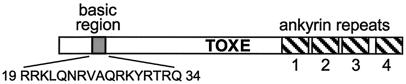
Figure 1
Figure 1
Structure of TOXE. TOXE has a molecular mass of 49 kDa and 441 aa. The bZIP-like basic domain is between residues 19 and 34 and the four ankyrin repeats are located between residues 290 and 315, 323 and 350, 357 and 384, and 415 and 441 (19).
Figure 2
Figure 2
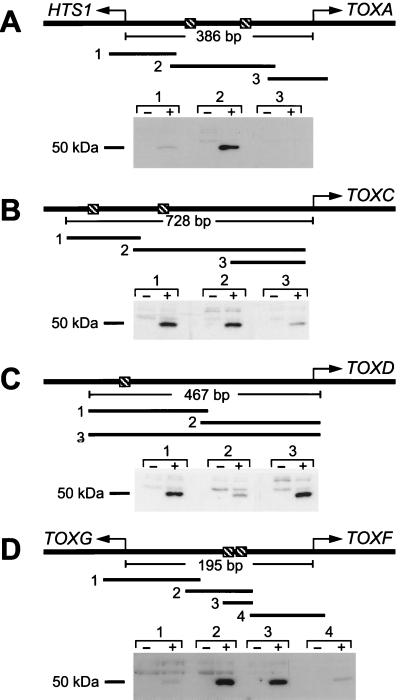
TOXE binds to the promoters of the TOX2 genes. Total protein extracts from E. coli expressing (+) or not expressing (−) TOXE were separated by SDS/PAGE and transferred to nitrocellulose membranes. After renaturing the bound proteins, the membranes were probed with the indicated 32P-labeled DNA fragments. Hatched boxes indicate tox-box sequences (see Fig. 3) relative to the transcriptional start sites and transcriptional directions of the TOX2 genes, indicated by the arrows. Note that AD are not drawn to scale.
Figure 3
Figure 3
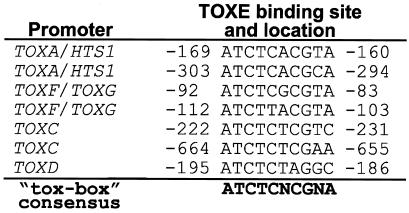
Sequences of the TOXE-binding sites from the promoters of the TOX2 genes, as deduced from the results shown in Fig. 2 and from comparative sequence analysis. Sequence locations are relative to the transcriptional start sites. For the HTS1/TOXA and the TOXF/TOXG promoters, the locations are relative to TOXA and TOXF, respectively (see Fig. 2). Note that the first tox-box of TOXC is in the opposite orientation to the others.
Figure 4
Figure 4
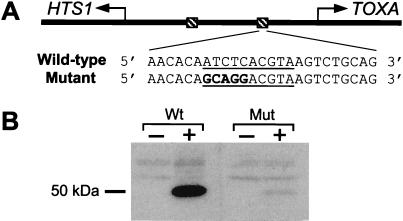
Mutation of the conserved residues in the tox-box eliminate TOXE binding. (A) Representation of the TOXA/HTS1 promoter. Hatched boxes indicate the two tox-boxes. (B) Double-stranded oligonucleotides containing the wild-type (Wt) tox-box sequence (underlined) and surrounding nucleotides, and a mutant version (Mut) in which all five of the highly conserved nucleotides were changed (indicated in bold lettering), were used as 32P-labeled probes against southwestern blots. “−” Indicates total protein extracts from E. coli not expressing TOXE (control), and “+” indicates E. coli expressing TOXE.
Figure 5
Figure 5
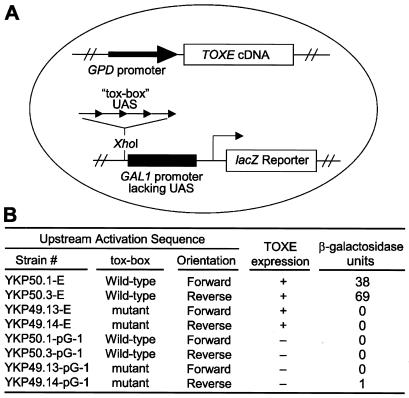
TOXE acts as a sequence-specific DNA binding protein and transcriptional activator in yeast. (A) Four tandem copies of a double-stranded oligonucleotide containing either the wild-type or the mutant tox-box (see Fig. 4) were fused in both orientations upstream of GAL1 without upstream activating sequences (UAS) fused to lacZ (27). TOXE driven by the constitutive yeast GPD promoter was expressed from a plasmid. (B) Resulting β-galactosidase activities of the various yeast strains. “TOXE expression” indicates whether the yeast cells contained the plasmid expressing TOXE.
Figure 6
Figure 6
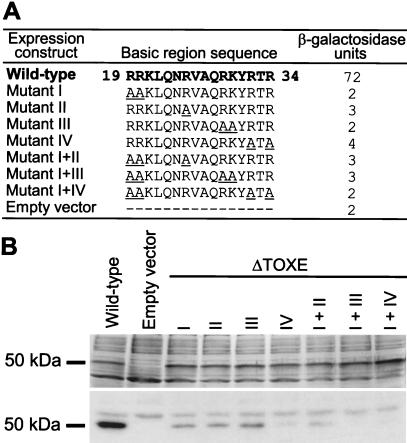
Mutations in the TOXE basic region reduce in vivo transcriptional activity and in vitro DNA binding. (A) Underlined amino acids indicate the changes made in TOXE in each mutant. β-Galactosidase activities were measured in yeast strain YKP50.1 (see Fig. 5) expressing mutant TOXE constructs. (B) Southwestern blotting. Mutant TOXE constructs were expressed in E. coli. (Upper) The SDS/PAGE gel stained with Coomassie blue; (Lower) the autoradiograph of the blot probed with a 32P-labeled DNA fragment from the TOXA/HTS1 promoter containing a single tox-box.
Figure 7
Figure 7
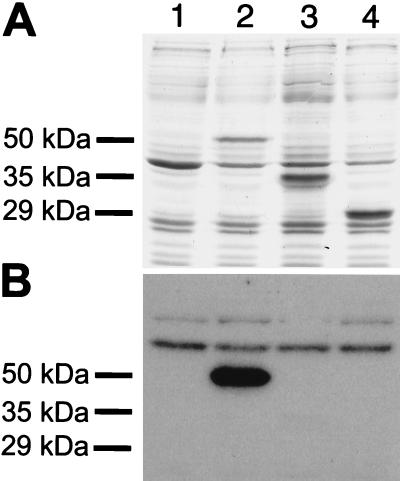
TOXE lacking the carboxy-terminus does not bind DNA. (A) SDS/PAGE (stained with Coomassie blue) of total extracts of E. coli expressing different TOXE constructs. Lane 1, empty plasmid (negative control); lane 2, full-length TOXE (amino acids 1–441) (positive control); lane 3, TOXE amino acids 1–317; lane 4, TOXE amino acids 1–254. The sizes of the expressed proteins are given on the left. (B) Southwestern blotting of the gel shown in A probed with a DNA fragment from the TOXA/HTS1 promoter containing a single tox-box.
Figure 8
Figure 8
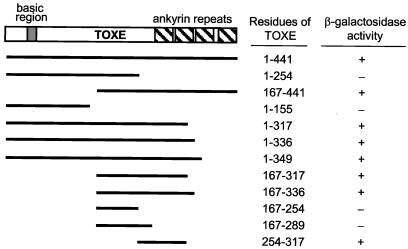
Mapping of the TOXE activation region. The indicated fragments of TOXE were fused to the GAL4DBD, expressed in yeast strain Y190, and the yeast transformants assayed for β-galactosidase activity.
Figure 9
Figure 9
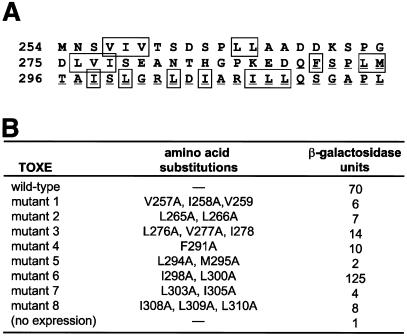
Mutational analysis of the activation domain of TOXE. (A) Sequence of the activation domain. Hydrophobic residues that were mutated are boxed, and the first ankyrin repeat is underlined. (B) Full-length TOXE proteins containing the indicated mutations were fused to the GAL4DBD, expressed in yeast strain Y190, and the yeast transformants assayed for β-galactosidase activity.

Comment in

References

    1. Hammond-Kosack K, Jones J D G. In: Biochemistry and Molecular Biology of Plants. Buchanan B B, Gruissem W, Jones R L, editors. Rockville, MD: Am. Soc. Plant Biologists; 2000. pp. 1102–1156.
    1. Kohmoto K, Otani H. Experientia. 1991;47:755–764. - PubMed
    1. Walton J D. Plant Cell. 1996;8:1723–1733. - PMC - PubMed
    1. Meeley R M, Johal G, Briggs S P, Walton J D. Plant Cell. 1992;4:71–77. - PMC - PubMed
    1. Johal G S, Briggs S P. Science. 1992;258:985–987. - PubMed

Publication types

MeSH terms

LinkOut - more resources