


Vestigial preference functions in neural networks and túngara frogs
- PMID: 11698682
- PMCID: PMC60841
- DOI: 10.1073/pnas.231296998
Vestigial preference functions in neural networks and túngara frogs
Abstract
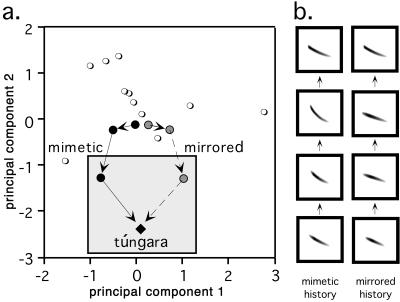
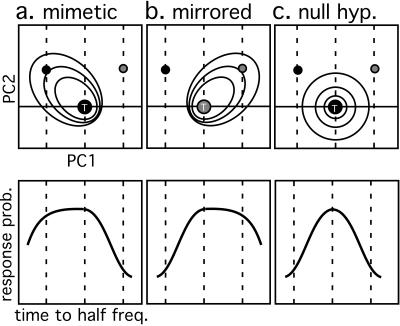
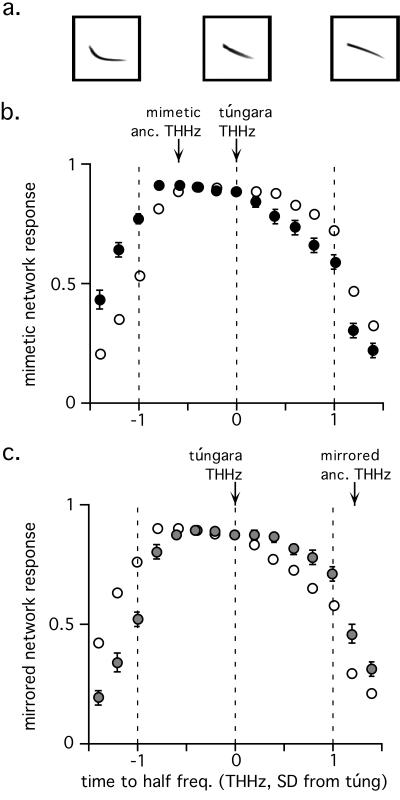
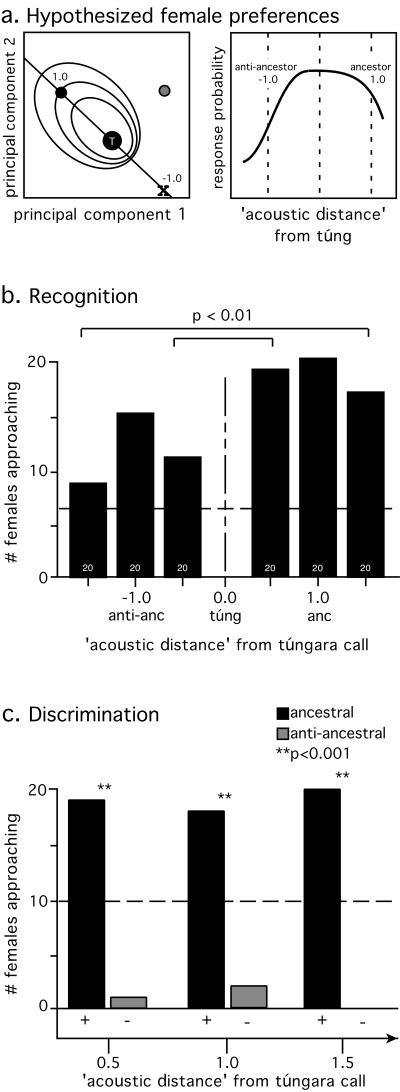
Although there is a growing interest in understanding how perceptual mechanisms influence behavioral evolution, few studies have addressed how perception itself is shaped by evolutionary forces. We used a combination of artificial neural network models and behavioral experiments to investigate how evolutionary history influenced the perceptual processes used in mate choice by female túngara frogs. We manipulated the evolutionary history of artificial neural network models and observed an emergent bias toward calls resembling known ancestral states. We then probed female túngara frogs for similar preferences, finding strong biases toward stimuli that resemble a call hypothesized for a recent ancestor. The data strongly suggest that female túngara frogs exhibit vestigial preferences for ancestral calls, and provide a general strategy for exploring the role of historical contingency in perceptual biases.
Figures
References
-
- Russell E S. Proc Linn Soc Lond. 1943;154:195–216.
-
- Tinbergen N. The Study of Instinct. Oxford: Oxford Univ. Press; 1951.
-
- Ryan M J, Fox J H, Wilczynski W W, Rand A S. Nature (London) 1990;343:66–67. - PubMed
-
- Basolo A. Science. 1990;250:808–810. - PubMed
-
- Guilford T, Dawkins M S. Anim Behav. 1991;42:1–14.
Publication types
MeSH terms
Grants and funding
LinkOut - more resources
Full Text Sources
Miscellaneous
