. 2001 Nov;127(3):817-31.
doi: 10.1104/pp.010188.

Antioxidant systems and O(2)(.-)/H(2)O(2) production in the apoplast of pea leaves. Its relation with salt-induced necrotic lesions in minor veins

Affiliations

Antioxidant systems and O(2)(.-)/H(2)O(2) production in the apoplast of pea leaves. Its relation with salt-induced necrotic lesions in minor veins

J A Hernández et al. Plant Physiol. 2001 Nov.

Abstract

The present work describes, for the first time, the changes that take place in the leaf apoplastic antioxidant defenses in response to NaCl stress in two pea (Pisum sativum) cultivars (cv Lincoln and cv Puget) showing different degrees of sensitivity to high NaCl concentrations. The results showed that only superoxide dismutase, and probably dehydroascorbate reductase (DHAR), were present in the leaf apoplastic space, whereas ascorbate (ASC) peroxidase, monodehydroascorbate reductase (MDHAR), and glutathione (GSH) reductase (GR) seemed to be absent. Both ASC and GSH were detected in the leaf apoplastic space and although their absolute levels did not change in response to salt stress, the ASC/dehydroascorbate and GSH to GSH oxidized form ratios decreased progressively with the severity of the stress. Apoplastic superoxide dismutase activity was induced in NaCl-treated pea cv Puget but decreased in NaCl-treated pea cv Lincoln. An increase in DHAR and GR and a decrease in ASC peroxidase, MDHAR, ASC, and GSH levels was observed in the symplast from NaCl-treated pea cv Lincoln, whereas in pea cv Puget an increase in DHAR, GR, and MDHAR occurred. The results suggest a strong interaction between both cell compartments in the control of the apoplastic ASC content in pea leaves. However, this anti-oxidative response does not seem to be sufficient to remove the harmful effects of high salinity. This finding is more evident in pea cv Lincoln, which is characterized by a greater inhibition of the growth response and by a higher rise in the apoplastic hydrogen peroxide content, O(2)(.-) production and thiobarbituric acid-reactive substances, and CO protein levels. This NaCl-induced oxidative stress in the apoplasts might be related to the appearance of highly localized O(2)(.-)/H(2)O(2)-induced necrotic lesions in the minor veins in NaCl-treated pea plants. It is possible that both the different anti-oxidative capacity and the NaCl-induced response in the apoplast and in the symplast from pea cv Puget in comparison with pea cv Lincoln contributes to a better protection of pea cv Puget against salt stress.


Figures
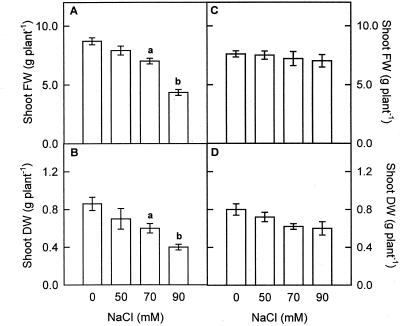
Figure 1
Figure 1
Plant growth response from pea cv Lincoln (A and B) and pea cv Puget (C and D) plants to increasing salinity, expressed as shoot fresh weight and shoot dry weight after 15 d of growth in hydroponic culture. Differences from control values were significant at: (a) P < 0.05 and (b) P < 0.01 according to Duncan's Multiple Range Test.
Figure 2
Figure 2
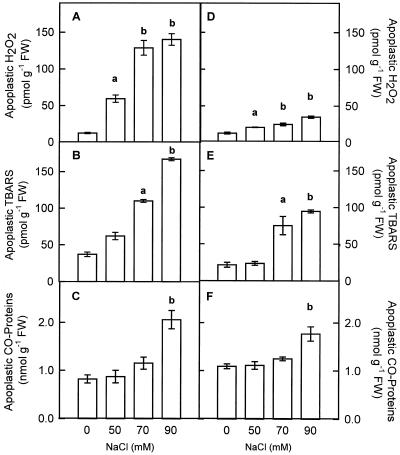
Effects of salinity on the levels of apoplastic H2O2, lipid peroxidation estimated as apoplastic thiobarbituric acid-reactive substances (TBARS), and apoplastic carbonyl (CO)-proteins in pea leaves cv Lincoln (A, B, and C) and cv Puget (D, E, and F). Differences from control values were significant at: (a) P < 0.01 and (b) P < 0.001 according to Duncan's Multiple Range Test.
Figure 3
Figure 3
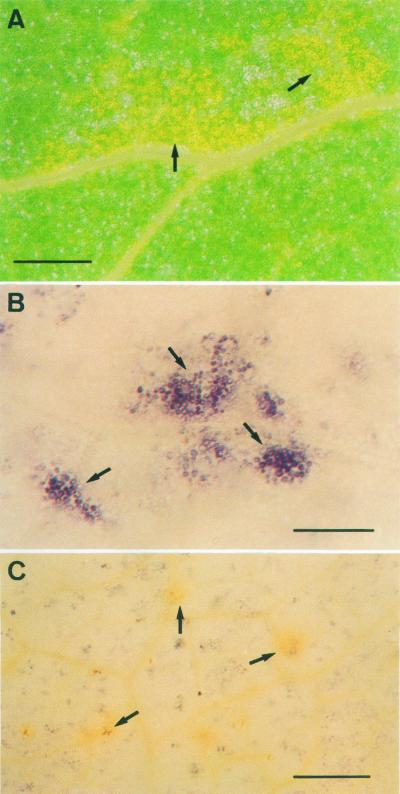
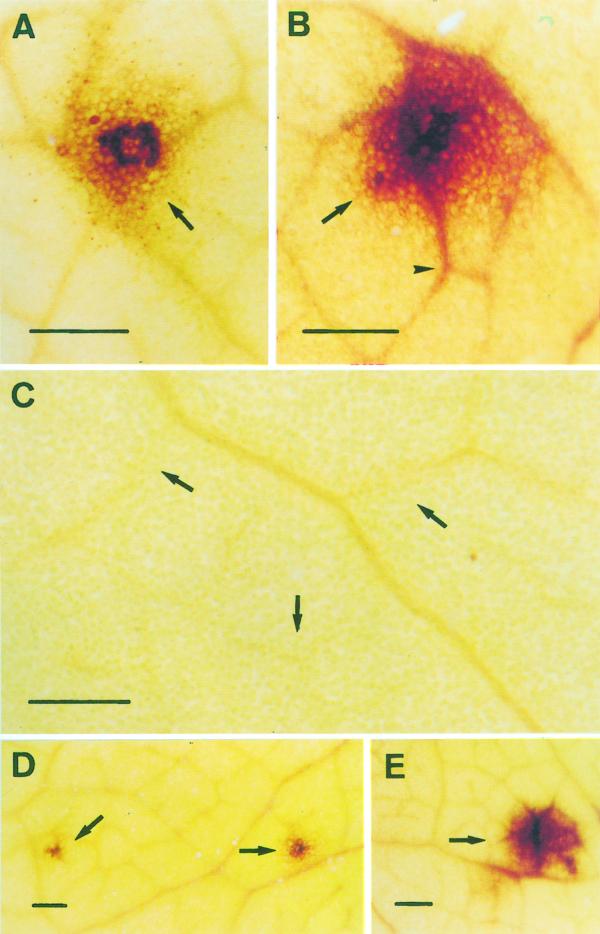
Periveinal chlorotic lesions (arrows) in pea cv Lincoln leaves of plants treated with 90 mm NaCl for 14 d (A). Periveinal chlorotic lesions (arrows) in pea leaves of plants treated with 90 mm NaCl for 14 d, and stained with NBT in the absence (B) and in the presence (C) of 100 units mL−1 SOD. Bars = 250 μm.
Figure 4
Figure 4
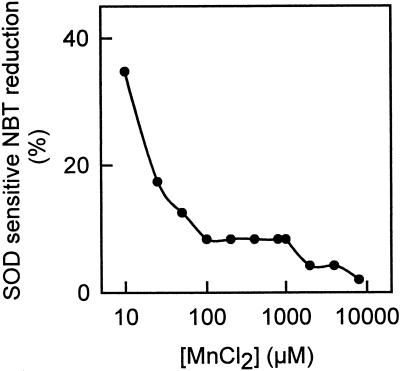
Effect of MnCl2 concentration on the scavenging of O2.− generated in a xanthine/xanthine oxidase reaction (at pH 7.6) and determined by the SOD-sensitive NBT reduction. NBT concentration in the reaction medium was 0.1 mg mL−1.
Figure 5
Figure 5
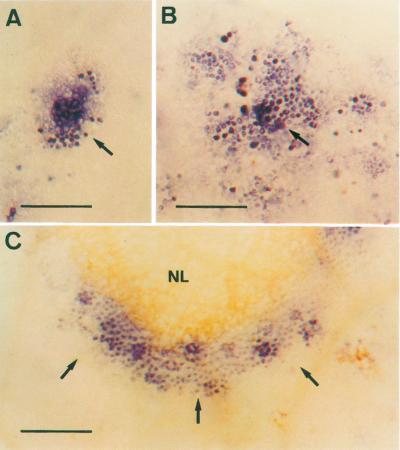
Periveinal chlorotic lesions (arrows) in pea cv Lincoln leaves of plants treated with 90 mm NaCl for 14 d and stained with NBT during the early (A), intermediate (B), and later (C) stages of development. The development rating was taken as the enlargement of the necrotic lesion. Bars = 250 μm.
Figure 6
Figure 6
Periveinal chlorotic lesions (arrows) in pea leaves of both pea cultivars, cv Lincoln (A–C and E) and cv Puget (D), treated with 90 mm NaCl for 14 d and stained with DAB during the early (A) and intermediate (B–E) stages of development. The development rating was taken as the enlargement of the necrotic lesion. Periveinal chlorotic lesions (arrows) in pea leaves of plants treated with 90 mm NaCl for 14 d stained with DAB in the presence (C) of 10 mm ascorbic acid. Bars = 250 μm. D (pea cv Puget) and E (pea cv Lincoln) showed the same magnification for comparison between the two cultivars.
Figure 7
Figure 7
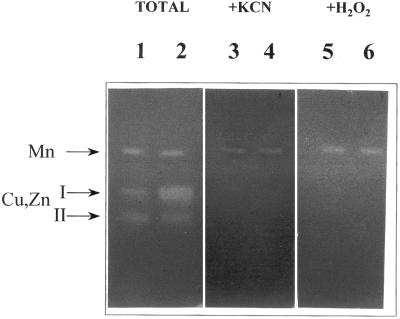
SOD isozyme identification after native PAGE on 10% (w/v) acrylamide gels from crude extracts and apoplastic fractions from pea cv Lincoln leaves. 1, 3, and 5, Leaf crude extracts. 2, 4, and 6, Apoplastic fractions. Identification of SOD isoforms was performed by pre-incubation of gels with inhibitors. 1 and 2, Total activity (no inhibitors); 3 and 4, stained in the presence of 2 mm KCN; 5 and 6, stained in the presence of 5 mm H2O2.
Figure 8
Figure 8
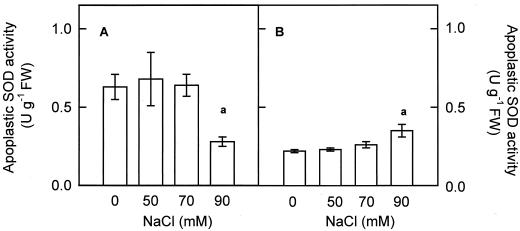
Effect of NaCl concentration in the culture medium on the level of apoplastic SOD activity in pea cv Lincoln (A) and cv Puget (B) leaves, after corrections for chloroplastic and cytosolic contaminations. Differences from control values were significant at: (a) P < 0.05 according to Duncan's Multiple Range Test.
Figure 9
Figure 9
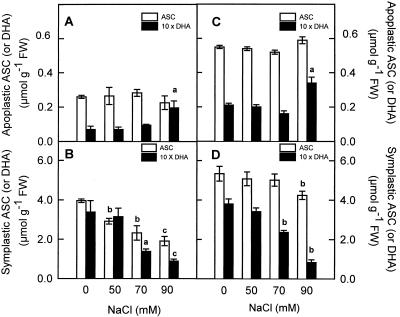
Effect of NaCl concentration in the culture medium on apoplastic and “symplastic” ASC and DHA contents of pea cv Lincoln (A and B) and cv Puget (C and D) leaves. Differences from control values were significant at: (a) P < 0.05, (b) P < 0.01, and (c) P < 0.001 according to Duncan's Multiple Range Test.
Figure 10
Figure 10
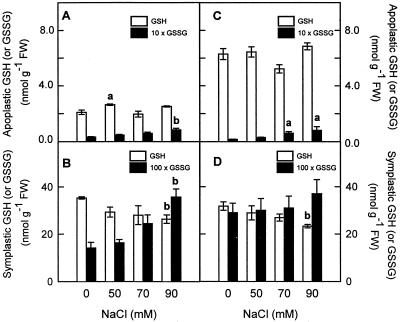
Effect of NaCl concentration in the culture medium on apoplastic and “symplastic” GSH and GSSG contents of pea cv Lincoln (A and B) and cv Puget (C and D) leaves. Differences from control values were significant at: (a) P < 0.05 and (b) P < 0.01 according to Duncan's Multiple Range Test.

References

    1. Allan AC, Fluhr R. Two distinct sources of elicited reactive oxygen species in tobacco epidermal cells. Plant Cell. 1997;9:1559–1572. - PMC - PubMed
    1. Alvarez ME, Pennell RI, Meijer PJ, Ishikawa A, Dixon RA, Lamb C. Reactive oxygen intermediates mediate a systemic signal network in the establishment of plant immunity. Cell. 1998;92:773–784. - PubMed
    1. Arnon DI. Copper enzymes in isolated chloroplasts: polyphenoloxidase in Beta vulgaris. Plant Physiol. 1949;24:1–15. - PMC - PubMed
    1. Bérczi A, Möller IM. NADH-monodehydroascorbate oxidoreductase is one of the redox enzymes in spinach leaf plasma membranes. Plant Physiol. 1998;116:1029–1036. - PMC - PubMed
    1. Blinda A, Koch B, Ramanjulu S, Dietz KJ. De novo synthesis and accumulation of apoplastic proteins in leaves of heavy metal-exposed barley seedlings. Plant Cell Environ. 1997;20:969–981.

Publication types

MeSH terms