. 2001 Nov;127(3):937-48.

The Arabidopsis protein SHI represses gibberellin responses in Arabidopsis and barley

Affiliations

The Arabidopsis protein SHI represses gibberellin responses in Arabidopsis and barley

I Fridborg et al. Plant Physiol. 2001 Nov.

Abstract

The current model of gibberellin (GA) signal transduction is based on a derepressible system and a number of candidate negative regulators have been identified in Arabidopsis. We previously have reported the identification of the Arabidopsis gene SHORT INTERNODES (SHI) that causes suppression of GA responses when constitutively activated. In this paper, we show by using reporter gene analysis that the SHI gene is expressed in young organs, e.g. shoot apices and root tips. The model predicts a suppressor of GA responses to be active in these tissues to prevent premature growth or development. To study the effect of SHI on GA signaling, we used a functional assay that measures effects of signaling components on a well-defined GA response; the up-regulation of alpha-amylase in barley (Hordeum vulgare) aleurones in response to GA treatment. We found that SHI was able to specifically block the activity of a high-isoelectric point alpha-amylase promoter following GA(3) treatment, which further supports that SHI is a suppressor of GA responses. We have identified two putative loss-of-function insertion alleles of SHI and lines homozygous for either of the new alleles show no phenotypic deviations from wild type. Because SHI belongs to a gene family consisting of nine members, we suggest that SHI and the SHI-related genes are functionally redundant. We also show that a functional ERECTA allele is able to partly suppress the dwarfing effect of the shi gain-of-function mutation, suggesting that the erecta mutation harbored by the Landsberg erecta ecotype is an enhancer of the shi dwarf phenotype.


Figures
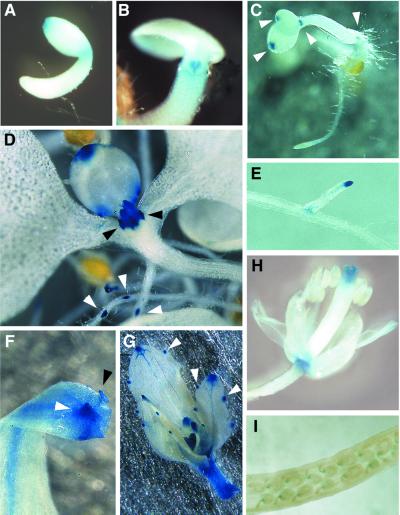
Figure 1
Figure 1
Expression of SHI in different tissues. Shown are the results from line 6:1 12-1-1 harboring a construct with an approximately 1.5-kb sequence upstream of the SHI ATG start site plus the first exon, the intron, and part of the second exon of SHI fused to GUS. A, Two-day-old seedling; B, shoot apex of 4-d-old seedling, front cotyledon is removed; C, 4-d-old seedling. White arrowheads indicate apical hydathodes, apex, and transition zone. D, Shoot apex of 9-d-old seedling, front leaf is removed. Black arrowheads indicate stipules, white arrowheads indicate lateral root primordial. E, Lateral root; F, developing axillary bud (white arrowhead) and stipules (black arrowhead) on the base of a rosette leaf; G, developing secondary shoot from rosette axis. White arrowheads indicate three of the lateral hydathodes. H, Flower; I, mature silique.
Figure 2
Figure 2
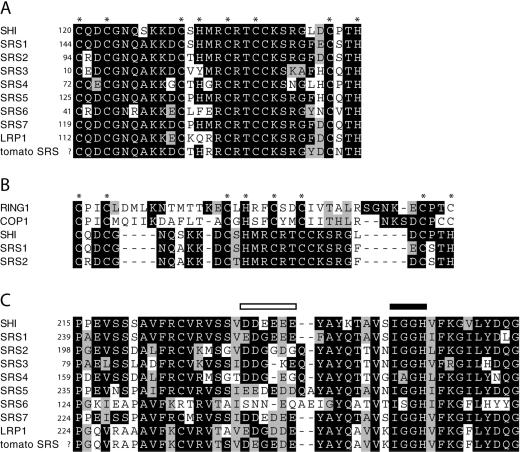
Amino acid sequence similarites between SHI, SHI family members, and other RING proteins. A, Sequence comparison of the RING domains of the SHI related proteins. The amino acid position of the domain in the different proteins is indicated relative to the translational start site. Asterisks indicate the conserved Cys and His zinc ligand residues in the RING finger motif. Identical and similar residues are displayed in black and gray boxes, respectively. B, Alignment of the RING domains of SHI, SRS1, and SRS2 with RING domains from different organisms. RING1, Human; COP1, Arabidopsis. C, Comparison of the IGGH domain of the SHI-related proteins. Acidic stretches (white box) and the four IGGH residues (black box) are indicated.
Figure 3
Figure 3
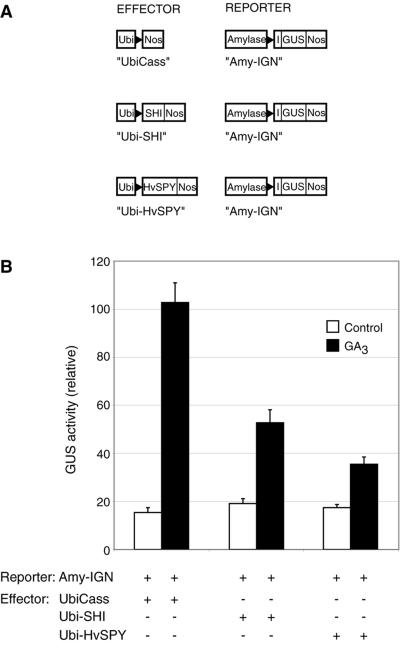
Analysis of SHI function in barley aleurone cells. A, Effector and reporter constructs used in cobombardment experiments. UbiCass is a blank effector cassette with a ubiquitin promoter lacking a coding region. Ubi-SHI and Ubi-HvSPY are effector constructs carrying the SHI cDNA and the HvSPY cDNA, respectively, fused to the ubiquitin promoter. The reporter construct, Amy-IGN, contains the high-pI α-amylase promoter fused to the IGN (intron-GUS-NOS) reporter cassette. B, Response of the high-pI α-amylase promoter to SHI and HvSPY expression in transient expression analyses. De-embryonated barley half-grains were cobombarded with effector and reporter constructs and incubated with 10 mm CaCl2 (control) or with 10−6 m GA3 in 10 mm CaCl2. Induction of α-amylase promoter activity was measured as relative GUS activity. The results represent two experiments, each with six shootings and three independent GUS measurements of each shooting. Bars represent ses. The difference between the effect of the control effector UbiCass and Ubi-SHI on GUS activity in GA-treated barley half-grains is statistically significant (P < 0.0001).
Figure 4
Figure 4
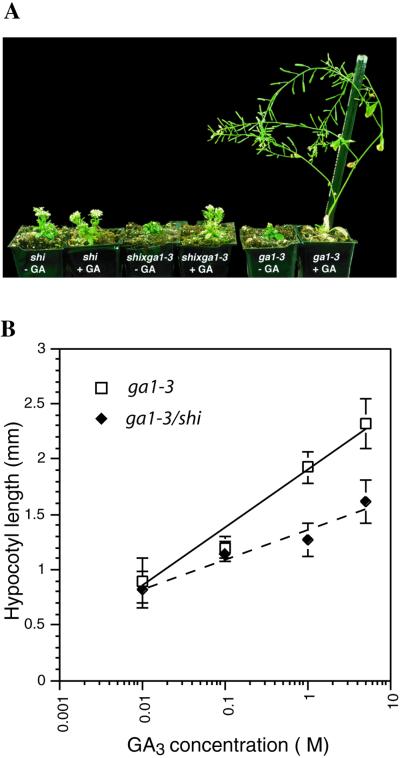
Sensitivity of shi to reductions in endogenous GAs. A, shi ga1-3 double-mutant plants were grown in long-day conditions, repeatedly sprayed with 10−4 m GA3, and compared with GA-treated shi and ga1-3 plants, plus untreated plants of the same genotypes. B, shi ga1-3 and ga1-3 seedlings were grown on different concentrations of GA3 and the hypocotyl length under these conditions are shown as the mean ± se of 10 to 15 plants measured. The equations for the linear regression are as follows: shi ga1-3, y = 1.37+0.269log(x) and R = 0.97; and ga1-3, y = 1.9+0.546log(x) and R = 0.99.
Figure 5
Figure 5
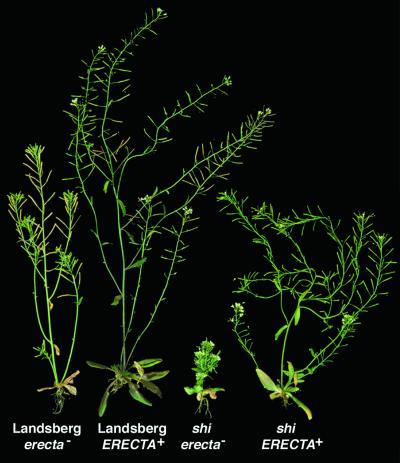
The impact of ERECTA on the shi phenotype. The shi mutant in erecta and ERECTA background compared with wild-type Ler and Ler+. Plants were grown on soil under long-day conditions.

References

    1. Bent AF, Clough SJ. Agrobacterium germ line transformation: transformation of Arabidopsis without tissue culture. Plant Mol Biol Manual. 1998;B7:1–14.
    1. Borden KL. RING domains: master builders of molecular scaffolds? J Mol Biol. 2000;295:1103–1112. - PubMed
    1. Edwards K, Johnstone C, Thompson C. A simple and rapid method for the preparation of plant genomic DNA for PCR analysis. Nucleic Acids Res. 1991;19:1349. - PMC - PubMed
    1. Elomaa P, Honkanen J, Puska R, Seppänen P, Helariutta Y, Mehto M, Kotilainen M, Nevalainen L, Teeri TH. Agrobacterium-mediated transfer of antisense chalcone synthase cDNA to Gerbera hybrida inhibits flower pigmentation. Bio/Technology. 1993;11:508–511.
    1. Freemont PS. The RING finger: a novel protein sequence motif related to the zinc finger. Ann N Y Acad Sci. 1993;684:174–192. - PubMed

Publication types

MeSH terms