. 2001 Dec;86(6):687-92.
doi: 10.1136/heart.86.6.687.

Absence of viral nucleic acids in early and late dilated cardiomyopathy

Affiliations

Absence of viral nucleic acids in early and late dilated cardiomyopathy

N G Mahon et al. Heart. 2001 Dec.

Abstract

Objective: To investigate whether viral infection acts as a trigger factor for the development of dilated cardiomyopathy in genetically predisposed individuals with a family history of disease.

Setting: Patients attending the cardiomyopathy unit in a cardiac tertiary referral centre.

Design: Nested polymerase chain reaction (nPCR) was used to determine whether enteroviral, adenoviral, or cytomegaloviral nucleic acids were detectable in the myocardium of 19 asymptomatic relatives of patients with dilated cardiomyopathy; all these relatives had echocardiographic abnormalities thought to represent early disease. Explanted hearts from patients with end stage dilated cardiomyopathy were also studied and were compared with 25 controls (ischaemic heart disease (21), valvar heart disease (2), hypertrophic cardiomyopathy (1), restrictive cardiomyopathy (1)). Myocardial tissue from two fatal cases of culture positive coxsackie myocarditis was used as a positive control.

Results: No viral nucleic acid was detected in any group other than in those with myocarditis. Spiking of random wells with purified recombinant viral nucleic acids confirmed the sensitivity and reproducibility of the assays.

Conclusions: Myocardial viral infection is not detectable in relatives of patients with dilated cardiomyopathy who are suspected of having early disease. There is no evidence that viruses act as a trigger factor for initiating the dilated cardiomyopathy in these patients.


Figures
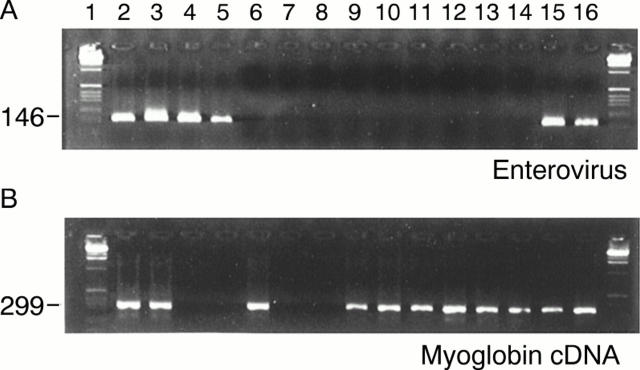
Figure 1
Figure 1
(A) Nested enteroviral reverse transcription polymerase chain reaction (PCR), performed on left ventricular and septal tissue obtained from explanted hearts and biopsies taken from patients with familial early dilated cardiomyopathy. Representative data are shown in lanes 9 to 14. Other lanes are: culture grown coxsackie virus B3 (CVB3; lane 2), CVB3 infected mouse heart (lane 3), 5 and 0.5 copies of pBlue script plasmid carrying CVB3 cDNA (lanes 4 and 5, respectively), and CVB3 infected human hearts (lanes 15 and 16); molecular weight markers are shown in the first and last lanes; reagent contamination controls from first and second rounds of PCR amplification are shown in lanes 7 and 8, respectively; an uninfected mouse heart used as negative control is shown in lane 6. (B) Amplification of the myoglobin housekeeping gene following reverse transcription. The order of samples as for panel (A).
Figure 2
Figure 2
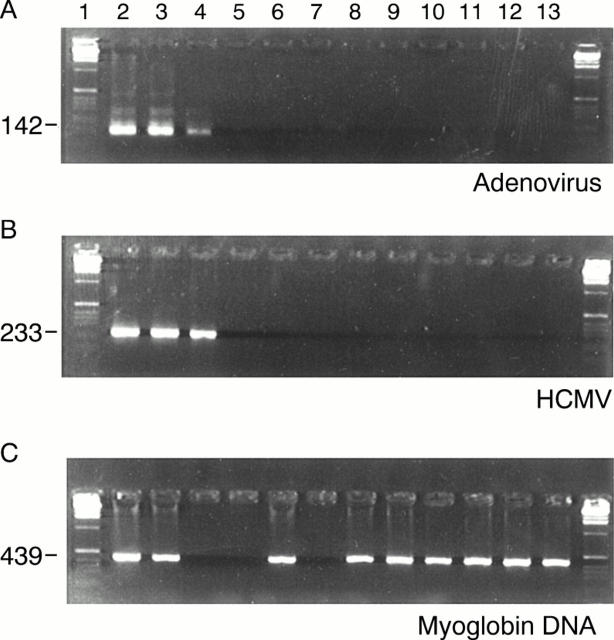
(A) Nested polymerase chain reaction (PCR) amplification of adenovirus, performed on left ventricular and septal tissue obtained from explanted hearts and biopsies taken from patients with familial early dilated cardiomyopathy. Representative data are shown in lanes 8-13. Other lanes are: molecular weight markers in the first and last lanes; culture grown adenovirus (lane 2), 10 and 5 copies of plasmid pJM17 carrying adenovirus sequences used for sensitivity assessments (lanes 3 and 4, respectively), uninfected mouse heart (lane 5), reagent contamination controls for first and second round of PCR amplification (lanes 6 and 7, respectively). (B) Nested PCR amplification of human cytomegalovirus (HCMV). The order of presentation of samples is as for panel (A). Culture grown HCMV is shown in lane 2. The sensitivity controls used were 100 and 10 copies of the plasmid pMV100 carrying HCMV sequences (lanes 3 and 4, respectively). (C) Amplification of the myoglobin gene from DNA. Cardiac samples are shown in wells 8 to 13. Adenovirus and HCMV cell cultures are shown in wells 2 and 3, respectively. Uninfected murine heart is shown in well 6 and the reagent negative control in well 7. No samples were loaded in wells 4 and 5.

References

    1. J Med Virol. 1992 May;37(1):76-82 - PubMed
    1. Circulation. 1989 Sep;80(3):564-72 - PubMed
    1. Circulation. 1992 Aug;86(2):522-30 - PubMed
    1. Br Heart J. 1992 Dec;68(6):554-9 - PubMed
    1. J Med Virol. 1993 Jan;39(1):6-10 - PubMed

Publication types

MeSH terms