. 2001 Dec;21(24):8357-64.
doi: 10.1128/MCB.21.24.8357-8364.2001.

Involvement of proteasome alpha-subunit PSMA7 in hepatitis C virus internal ribosome entry site-mediated translation

Affiliations

Involvement of proteasome alpha-subunit PSMA7 in hepatitis C virus internal ribosome entry site-mediated translation

M Krüger et al. Mol Cell Biol. 2001 Dec.

Abstract

Ribozymes are small catalytic RNA molecules that can be engineered to enzymatically cleave RNA transcripts in a sequence-specific fashion and thereby inhibit expression and function of the corresponding gene product. With their simple structures and site-specific cleavage activity, they have been exploited as potential therapeutic agents in a variety of human disorders, including hepatitis C virus (HCV) infection. We have designed a hairpin ribozyme (Rz3'X) targeting the HCV minus-strand replication intermediate at position 40 within the 3'X tail. Surprisingly, Rz3'X was found to induce ganciclovir (GCV)-resistant colonies in a bicistronic cellular reporter system with HCV internal ribosome entry site (IRES)-dependent translation of herpes simplex virus thymidine kinase (TK). Rz3'X-transduced GCV-resistant HeLa reporter cells showed substantially reduced IRES-mediated HCV core protein translation compared with control vector-transduced cells. Since these reporter systems do not contain the HCV 3'X tail sequences, the results indicate that Rz3'X probably exerted an inhibitory effect on HCV IRES activity fortuitously through another gene target. A novel technique of ribozyme cleavage-based target gene identification (cleavage-specific amplification of cDNA ends) (M. Krüger, C. Beger, P. J. Welch, J. R. Barber, and F. Wong-Staal, Nucleic Acids Res. 29:e94, 2001) revealed that human 20S proteasome alpha-subunit PSMA7 mRNA was a target RNA recognized and cleaved by Rz3'X. We then showed that additional ribozymes directed against PSMA7 RNA inhibited HCV IRES activity in two assay systems: GCV resistance in the HeLa IRES TK reporter cell system and a transient transfection assay performed with a bicistronic Renilla-HCV IRES-firefly luciferase reporter in Huh7 cells. In contrast, ribozymes were inactive against IRES of encephalomyocarditis virus and human rhinovirus. Additionally, proteasome inhibitor MG132 exerted a dose-dependent inhibitory effect on HCV IRES-mediated translation but not on cap-dependent translation. These data suggest a principal role for PSMA7 in regulating HCV IRES activity, a function essential for HCV replication.


Figures
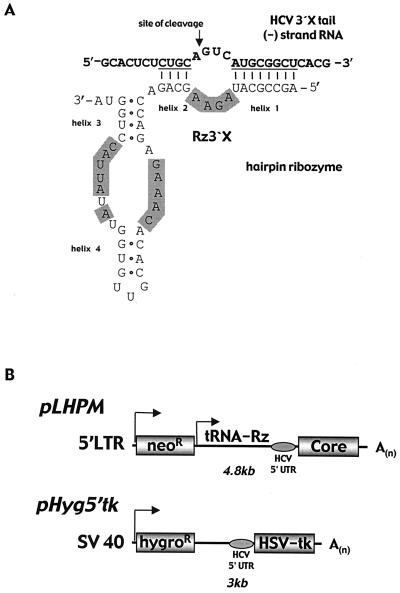
FIG. 1
FIG. 1
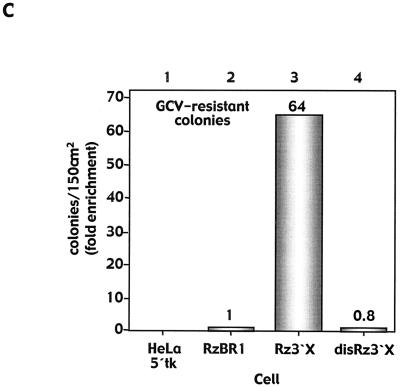
Hairpin ribozyme Rz3′X in a GCV-reporter assay with HeLa 5′tk cells stably expressing a bicistronic hygromycin-HCV IRES-HSV TK transcript. (A) Schematic representation of Rz3′X binding to the antigenomic HCV RNA within the highly conserved 3′X tail. The substrate is cleaved 5′ of the GUC triplet required for hairpin ribozyme recognition (arrow). Conserved areas of the hairpin ribozyme are shaded. (B) Vector constructs for retrovirus vector production of the ribozyme (pLHPM) (including IRES-mediated translation of HCV core protein) and for expression of a bicistronic hygromycin-HCV 5′UTR-HSV TK transcript for negative selection in cell culture (14). The ribozyme is driven independently from the retrovirus transcript by a tRNAVal promoter expression cassette. (C) GCV-resistant HeLa 5′tk reporter colonies derived from transduction with Rz3′X retrovirus particles. Colonies were enumerated 21 days after GCV application (20 μM, 4 days), and numbers are fold enrichment values compared with that for control ribozyme RzBR1-transduced reporter cells.
FIG. 1
FIG. 1
Hairpin ribozyme Rz3′X in a GCV-reporter assay with HeLa 5′tk cells stably expressing a bicistronic hygromycin-HCV IRES-HSV TK transcript. (A) Schematic representation of Rz3′X binding to the antigenomic HCV RNA within the highly conserved 3′X tail. The substrate is cleaved 5′ of the GUC triplet required for hairpin ribozyme recognition (arrow). Conserved areas of the hairpin ribozyme are shaded. (B) Vector constructs for retrovirus vector production of the ribozyme (pLHPM) (including IRES-mediated translation of HCV core protein) and for expression of a bicistronic hygromycin-HCV 5′UTR-HSV TK transcript for negative selection in cell culture (14). The ribozyme is driven independently from the retrovirus transcript by a tRNAVal promoter expression cassette. (C) GCV-resistant HeLa 5′tk reporter colonies derived from transduction with Rz3′X retrovirus particles. Colonies were enumerated 21 days after GCV application (20 μM, 4 days), and numbers are fold enrichment values compared with that for control ribozyme RzBR1-transduced reporter cells.
FIG. 2
FIG. 2
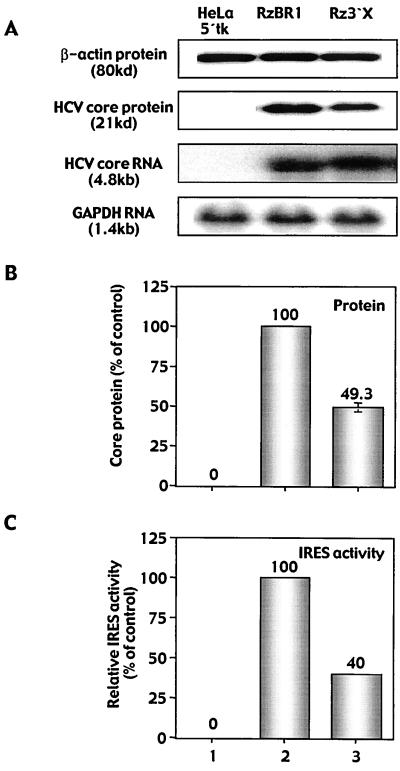
Protein and RNA analyses of GCV-resistant HeLa 5′tk reporter cells. (A) The HCV core protein was determined by immunoblotting with cell lysates, and Northern blot analysis was performed on total RNA extracted from GCV-resistant reporter cells. Parental cells expressing bicistronic vector 5′tk (lane 1) lack the HCV core protein and core RNA expression derived from transduction with the retrovirus ribozyme construct. (B) Bands were quantified by densitometry using NIH Image software or phosphorimager analysis (Molecular Dynamics), and signals were normalized against β-actin (for protein) or GAPDH (for RNA). Results from triplicate experiments are expressed as percentages of control and are presented as means ± standard errors of the means. (C) Relative HCV IRES activity expressed as the ratio of core protein translation relative to the amount of corresponding transcript detected in GCV-resistant cells.
FIG. 3
FIG. 3
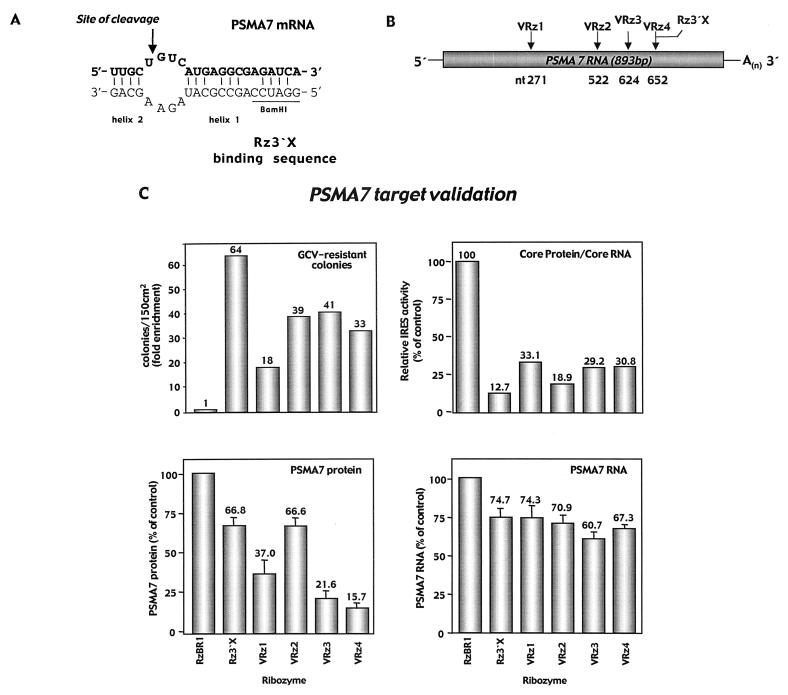
Ribozyme-mediated identification of human PSMA7 proteasome α-subunit mRNA and confirmation of functional relevance for HCV IRES-mediated translation. (A) Rz3′X binds to its target site (position 652) within the human PSMA7 proteasome α-subunit mRNA. Partial sequence information from the gene was obtained by using the sequence flanking the GUC site as the oligonucleotide primer binding sites in a C-SPACE amplification (Krüger et al., submitted). The entire cDNA of human PSMA7 mRNA was cloned by additional 5′- and 3′-rapid amplification of cDNA ends using cDNA derived from HeLa 5′tk cells and confirmed by standard sequencing techniques (GenBank accession no. NM 002792) (7). The BamHI recognition sequence (underlined) derived from ribozyme cloning into retrovirus vector pLHPM stabilizes the ribozyme-target interaction. (B) Four validation ribozymes (VRz1 to -4) were engineered against unique GUC sites within the human PSMA7 mRNA. The binding arms of VRz4 are designed to perfectly match the Rz3′X GUC site at position 652. (C) Analysis of GCV-resistant HeLa 5′tk reporter cells derived from stable transduction with retrovirus ribozyme vector particles. Colonies were enumerated 21 days after GCV application (20 μM, 4 days), and numbers are fold enrichment values compared with that for control ribozyme RzBR1-transduced reporter cells. GCV-resistant colonies were analyzed by immunoblotting and Northern blotting. Bands were quantified by densitometry using NIH Image software or by phosphorimager analysis (Molecular Dynamics), and signals were normalized against β-actin (for protein) or GAPDH (for RNA). Results from triplicate experiments are expressed as percentages of control and are presented as means ± standard errors of the means.
FIG. 4
FIG. 4
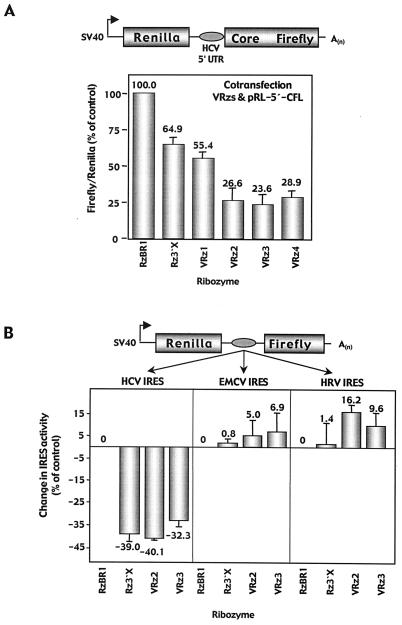
Transient transfection of Huh7 cells with Rz3′X or PSMA7-directed ribozymes and bicistronic reporter plasmids expressing FL dependent on HCV, EMCV, or HRV IRES. (A) PSMA7-directed ribozymes VRz1 to -4, Rz3′X, and control RzBR1 were cotransfected into Huh7 cells with a bicistronic reporter construct (RL-5′-CFL), allowing for cap-dependent translation of the RL gene, followed by the HCV 5′UTR for IRES-mediated translation of the HCV core protein and FL gene. Luciferase activities were measured by dual-luciferase assay, and the FL/RL ratio detected in RzBR1-transfected cells was set to 100%. (B) Rz3′X, PSMA7-directed ribozymes VRz2 and -3, and control RzBR1 were cotransfected into Huh7 cells with bicistronic reporter construct RL-HCV-FL (HCV 5′ UTR, allowing for IRES-mediated translation of the FL gene), RL-EMCV-FL, or RL-HRV-FL. Changes in IRES activities (FL/RL ratios) from triplicate experiments are expressed relative to the activity of the RzBR1 control and are presented as means ± standard errors of the means.
FIG. 5
FIG. 5
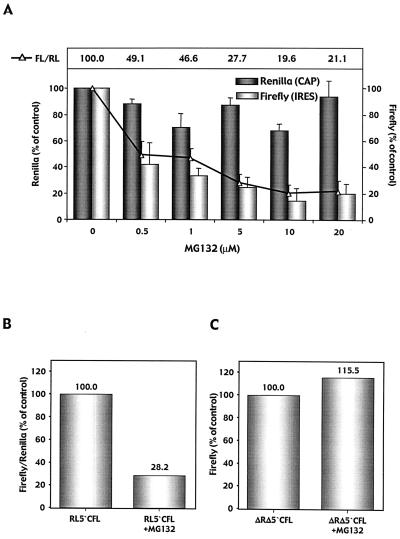
Effect of proteasome inhibitor MG132 on HCV IRES activity. (A) HeLa cells stably expressing the RL-5′-CFL reporter construct were analyzed for luciferase activities following exposure to increasing doses of MG132. Signals for RL and FL as well as the FL/RL ratio (relative HCV IRES activity) measured in untreated cells were set to 100%. Results from triplicate experiments are expressed as percentages of control and are presented as means ± standard errors of the means. (B) Huh7 cells were transfected with plasmid pRL-5′-CFL in the presence or absence of MG132 (1 μM). (C) A reporter plasmid lacking RL and the HCV IRES sequence while expressing HCV core protein and FL via a cap-dependent mechanism (pΔRLΔ5′-CFL) was transfected into Huh7 cells in the presence or absence of MG132.

References

    1. Adams J, Palombella V J, Elliott P J. Proteasome inhibition: a new strategy in cancer treatment. Investig New Drugs. 2000;18:109–121. - PubMed
    1. Beger C, Krüger M, Wong-Staal F. Ribozymes in cancer gene therapy. In: Lattime E C, Gerson S L, editors. Gene therapy of cancer. San Diego, Calif: Academic Press; 1998. pp. 139–152.
    1. Beger C, Pierce L N, Krüger M, Marcusson E G, Robbins J M, Welcsh P, Welch P J, Welte K, King M C, Barber J R, Wong-Staal F. Identification of Id4 as a regulator of BRCA1 expression by using a ribozyme-library-based inverse genomics approach. Proc Natl Acad Sci USA. 2001;98:130–135. - PMC - PubMed
    1. Blight K J, Kolykhalov A A, Rice C M. Efficient initiation of HCV RNA replication in cell culture. Science. 2000;290:1972–1974. - PubMed
    1. Goldberg A L, Rock K L. Proteolysis, proteasomes and antigen presentation. Nature. 1992;357:375–379. - PubMed

Publication types

MeSH terms

LinkOut - more resources