


Shake-up and shake-off excitations with associated electron losses in X-ray studies of proteins
- PMID: 11714915
- PMCID: PMC2374029
- DOI: 10.1110/ps.ps.26201
Shake-up and shake-off excitations with associated electron losses in X-ray studies of proteins
Abstract
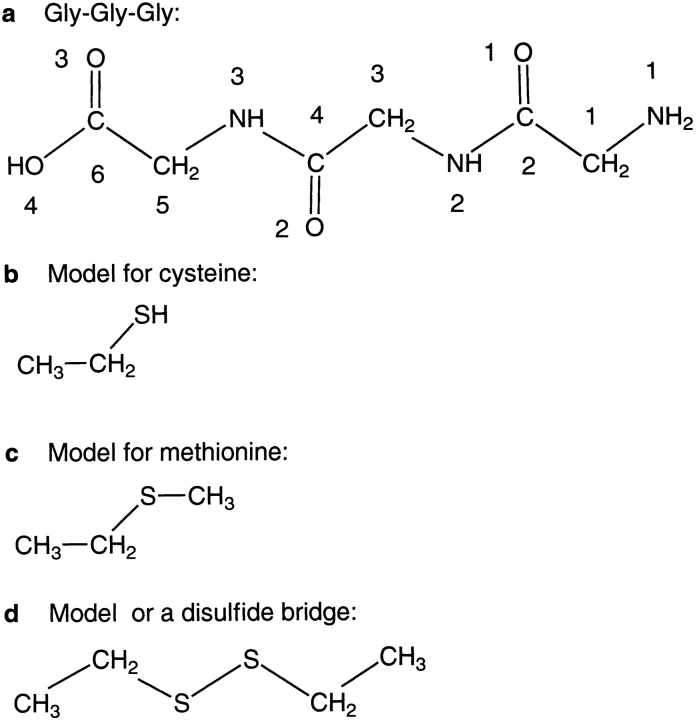
Photoionization of an atom by X-rays usually removes an inner shell electron from the atom, leaving behind a perturbed "hollow ion" whose relaxation may take different routes. In light elements, emission of an Auger electron is common. However, the energy and the total number of electrons released from the atom may be modulated by shake-up and shake-off effects. When the inner shell electron leaves, the outer shell electrons may find themselves in a state that is not an eigen-state of the atom in its surroundings. The resulting collective excitation is called shake-up. If this process also involves the release of low energy electrons from the outer shell, then the process is called shake-off. It is not clear how significant shake-up and shake-off contributions are to the overall ionization of biological materials like proteins. In particular, the interaction between the outgoing electron and the remaining system depends on the chemical environment of the atom, which can be studied by quantum chemical methods. Here we present calculations on model compounds to represent the most common chemical environments in proteins. The results show that the shake-up and shake-off processes affect approximately 20% of all emissions from nitrogen, 30% from carbon, 40% from oxygen, and 23% from sulfur. Triple and higher ionizations are rare for carbon, nitrogen, and oxygen, but are frequent for sulfur. The findings are relevant to the design of biological experiments at emerging X-ray free-electron lasers.
Figures
References
-
- Åberg, T. 1967. Multiple excitation of a many-electron system by photon and electron impact. Ann. Acad. Sci. Fenn. Series A, VI. PHYSICA, Nr. 303.
-
- Amusia, M.Ya., Lee, I.S., and Kilin, V.A. 1992. Double Auger decay in atoms. Probability and angular distribution. Phys. Rev. A 45 4576–4587. - PubMed
-
- Armen, G.B., Åberg, T., Rezaul Karim, Kh., Levin, J.C., Crasemann, B., Brown, G.S., Hsiung Chen, M., and Ice, G.E. 1985. Threshold double photoexcitation of argon with synchrotron radiation. Phys. Rev. Lett. 54 182–185. - PubMed
-
- Ashley, J.C. 1990. Energy-loss rate and inelastic mean free-path of low-energy electrons and positrons in condensed matter. J. Elec. Spec. Rel. Phenom. 50 323–334.
-
- Bacon, A.D. and Zerner, M.C. 1979. An intermediate neglect of differential overlap theory for transition metal complexes: Fe, Co and Cu chlorides. Theor. Chim. Acta 53 21–54.
Publication types
MeSH terms
Substances
LinkOut - more resources
Full Text Sources
Other Literature Sources
