. 2001 Nov 20;98(24):13913-8.
doi: 10.1073/pnas.251532298.

Adeno-associated virus vector-mediated IL-10 gene delivery prevents type 1 diabetes in NOD mice

Affiliations

Adeno-associated virus vector-mediated IL-10 gene delivery prevents type 1 diabetes in NOD mice

K Goudy et al. Proc Natl Acad Sci U S A. .

Abstract

The development of spontaneous autoimmune diabetes in nonobese diabetic (NOD) mice provides for their use as a model of human type 1 diabetes. To test the feasibility of muscle-directed gene therapy to prevent type 1 diabetes, we developed recombinant adeno-associated virus (rAAV) vectors containing murine cDNAs for immunomodulatory cytokines IL-4 or IL-10. Skeletal muscle transduction of female NOD mice with IL-10, but not IL-4, completely abrogated diabetes. rAAV-IL-10 transduction attenuated the production of insulin autoantibodies, quantitatively reduced pancreatic insulitis, maintained islet insulin content, and altered splenocyte cytokine responses to mitogenic stimulation. The beneficial effects were host specific, as adoptive transfer of splenocytes from rAAV IL-10-treated animals rapidly imparted diabetes in naive hosts, and the cells contained no protective immunomodulatory capacity, as defined through adoptive cotransfer analyses. These results indicate the utility for rAAV, a vector with advantages for therapeutic gene delivery, to transfer immunoregulatory cytokines capable of preventing type 1 diabetes. In addition, these studies provide foundational support for the concept of using immunoregulatory agents delivered by rAAV to modulate a variety of disorders associated with deleterious immune responses, including allergic reactions, transplantation rejection, immunodeficiencies, and autoimmune disorders.


Figures
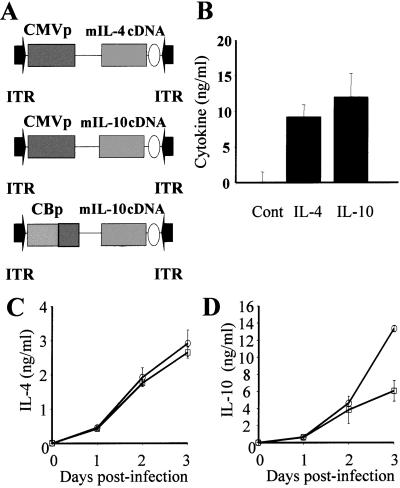
Figure 1
Figure 1
rAAV-CMV-IL-4, rAAV-CMV-IL-10, and rAAV-CB-IL-10 constructs and expression in mouse myoblasts. (A) Vector cassette map where ITR, rAAV inverted terminal repeat, CMVp, CMV immediate early promoter, and CBp, CMV enhancer and chicken-β actin promoter with a hybrid chicken–rabbit β-globin intron. The circle after the gene is the simian virus 40 poly(A) signal. (B) The concentrations of IL-4 and -10 48 h after plasmid (pCMV–green fluorescent protein, pCMV-IL-4, pCMV-IL-10) transfection of C2C12 cells (performed in triplicate). (C and D) The concentrations of (C) IL-4 and (D) IL-10 0–3 days after viral (rAAV-CMV-IL-4, rAAV-CB-IL-10) transduction of C2C12 cells (performed in triplicate). Transductions with rAAV alone (□, multiplicity of infection 2,000) or under coinfection with rAAV (○, multiplicity of infection 2,000) and Ad5 (multiplicity of infection 5).
Figure 2
Figure 2
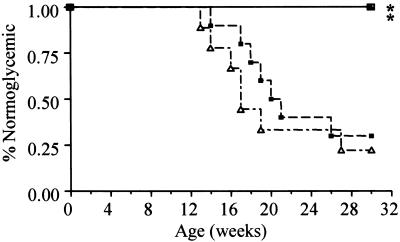
Type 1 diabetes in NOD mice undergoing various treatment modalities. These life-table analyses demonstrate the percentage of mice (n =10 for each group) remaining normoglycemic after injection with saline (– ⋅ – ▵), rAAV-IL-4 (– – – ■), rAAV-IL-10 (—— ▴), or the combination of rAAV-IL-4 and rAAV-IL-10 (—— □). *, P < 0.005 versus the control group and the rAAV-IL-4-treated group.
Figure 3
Figure 3
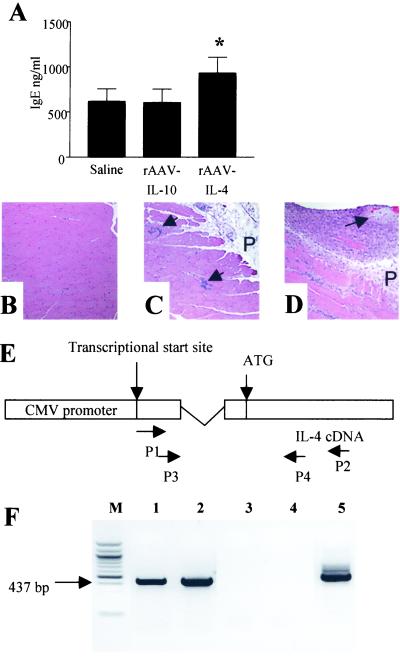
Analyses of the efficacy and function of viral transduction in vivo. (A) Total serum IgE from 10- to 14-week-old saline-, rAAV-IL-4-, and rAAV-IL-10-treated animals (n = 8 per group). *, P < 0.008 for rAAV-IL-4-treated animals versus control or rAAV-IL-10-treated animals. (B–D) Representative longitudinal cross sections of muscle (hematoxylin/eosin stained) from mice injected with (B) saline-injected, normal histology; (C) rAAV-IL-10-treated, focal myositis (arrows); or (D) rAAV-IL-4-treated, moderate myositis and perimyositis in surrounding fascia and perimysium (P; arrow denotes peripheral nerve). (E) Diagram of nested PCR strategy. Specifically, the first PCR was performed with primers P1 (downstream of the transcription start site) and P2 (within the IL-4 coding region). The second PCR was performed with primers P3 (between P1 and the site of the splicing donor) and P4 (between ATG and P2). (F) Reverse transcription–PCR products with total RNA from the muscle injection site. Lane m, 100-bp marker; lanes 1 and 2, mice injected with of rAAV-CMV-IL-4 (n = 2); lanes 3 and 4, saline-injected mice (n = 2); lane 5, C2C12 cells transduced with rAAV-CMV-IL-4. The transgene-specific product (437 bp) was confirmed by TA cloning and sequencing.
Figure 4
Figure 4
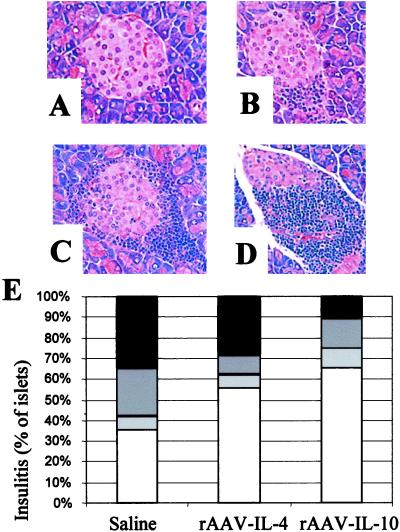
The effect of rAAV cytokine gene delivery on pancreatic islets. (A–D) Representative hematoxylin/eosin-stained pancreas sections obtained from various NOD mice used in these experiments, displayed to illustrate scoring categories shown in (E) (×400). (A) Normal islet architecture, devoid of lymphocytes (stage 0); (B) peri-insulitis only (stage 1); (C) insulitis involving <50% of the islet in cross section (stage 3); (D) insulitis involving >50% of the islet (stage 4); (E) histogram depicting percentage of normal islets (stage 1, unfilled bar), peri-insulitits (stage 2, light gray bar), insulitis involving <50% of the islet in cross section (stage 3, dark gray bar), or insulitis involving >50% of the islet (stage 4, black bar). A total of 171 islets obtained from 17 animals (n = 5–6 per group; 10-, 12-, and 14-week-old animals; average 10 islets per animal) were scored. The frequency of stage 0 insulitis was significantly lower in the PBS than in the IL-10 group (P = 0.01), and, conversely, stage 3 insulitis was significantly higher in PBS- than in IL-10-treated animals (P = 0.025).
Figure 5
Figure 5
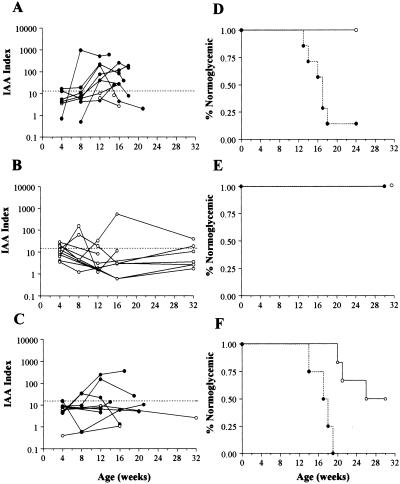
rAAV cytokine gene delivery and the natural history of insulin autoantibodies in NOD mice. Longitudinal analysis of animals followed from 4 until 16 weeks or later. (A) Saline; (B) rAAV-IL-10; (C) rAAV-IL-4 (developed diabetes, ●; no diabetes, ○). The dashed line represents the definition for positive IAA responses. Life-table presentation of animals as a function of treatment group: (D) saline; (E) rAAV-IL-10; (F) rAAV-IL-4 (ever IAA positive, ●; never IAA positive, ○). P < 0.03 for IL-10 versus saline controls based on the frequency of IAA-positive animals at 12 or 16 weeks.
Figure 6
Figure 6
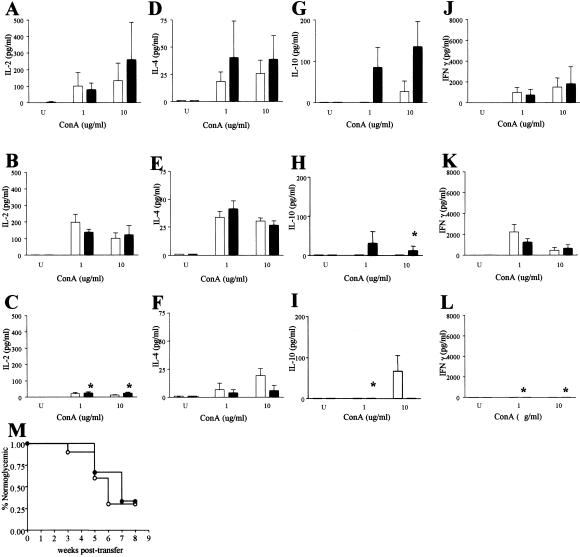
The effect of rAAV cytokine gene delivery in skeletal muscle on splenocyte function. Splenocyte responses in the absence of Con A (U; untreated) or at two different Con A concentrations (1 and 10 μg/ml) at 24 (clear bar) and 48 h (solid bar) after stimulation are shown. (A–C) IL-2 production in (A) saline-treated, (B) rAAV-IL-4-treated, and (C) rAAV-IL-10-treated mice. (D–F) IL-4 production in (D) saline-treated, (E) rAAV-IL-4-treated, and (F) rAAV-IL-10-treated mice. (G–I) IL-10 production in (G) saline-treated, (H) rAAV-IL-4-treated, and (I) rAAV-IL-10-treated mice. (J–L) IFN-γ production in (J) saline-treated, (K) rAAV-IL-4-treated, and (L) rAAV-IL-10-treated mice. *, P < 0.01 versus control group. Note that statistical comparisons were made with the use of “peak” concentrations (1 or 10 μg/ml) at 24 and 48 h only. (M) Life-table analysis of incidence of hyperglycemia in irradiated male NOD mice adoptively transferred with splenocytes from NOD mice recently diagnosed with type 1 diabetes (●) or 30-week-old rAAV-IL-10-treated NOD mice.

References

    1. Bach J F. Endocr Rev. 1994;15:516–542. - PubMed
    1. Atkinson M A, Leiter E H. Nat Med. 1999;5:601–604. - PubMed
    1. Serreze D V. FASEB J. 1993;7:1092–1096. - PubMed
    1. Wong F S, Janeway C A. J Autoimmun. 1999;13:290–295. - PubMed
    1. Yoon J W, Jun H S, Santamaria P. Autoimmunity. 1998;27:109–122. - PubMed

Publication types