


Incidence, distribution, and spread of tetracycline resistance determinants and integron-associated antibiotic resistance genes among motile aeromonads from a fish farming environment
- PMID: 11722922
- PMCID: PMC93359
- DOI: 10.1128/AEM.67.12.5675-5682.2001
Incidence, distribution, and spread of tetracycline resistance determinants and integron-associated antibiotic resistance genes among motile aeromonads from a fish farming environment
Abstract
A collection of 313 motile aeromonads isolated at Danish rainbow trout farms was analyzed to identify some of the genes involved in high levels of antimicrobial resistance found in a previous field trial (A. S. Schmidt, M. S. Bruun, I. Dalsgaard, K. Pedersen, and J. L. Larsen, Appl. Environ. Microbiol. 66:4908-4915, 2000), the predominant resistance phenotype (37%) being a combined oxytetracycline (OTC) and sulphadiazine/trimethoprim resistance. Combined sulphonamide/trimethoprim resistance (135 isolates) appeared closely related to the presence of a class 1 integron (141 strains). Among the isolates containing integrons, four different combinations of integrated resistance gene cassettes occurred, in all cases including a dihydrofolate reductase gene and a downstream aminoglycoside resistance insert (87 isolates) and occasionally an additional chloramphenicol resistance gene cassette (31 isolates). In addition, 23 isolates had "empty" integrons without inserted gene cassettes. As far as OTC resistance was concerned, only 66 (30%) out of 216 resistant aeromonads could be assigned to resistance determinant class A (19 isolates), D (n = 6), or E (n = 39); three isolates contained two tetracycline resistance determinants (AD, AE, and DE). Forty OTC-resistant isolates containing large plasmids were selected as donors in a conjugation assay, 27 of which also contained a class 1 integron. Out of 17 successful R-plasmid transfers to Escherichia coli recipients, the respective integrons were cotransferred along with the tetracycline resistance determinants in 15 matings. Transconjugants were predominantly tetA positive (10 of 17) and contained class 1 integrons with two or more inserted antibiotic resistance genes. While there appeared to be a positive correlation between conjugative R-plasmids and tetA among the OTC-resistant aeromonads, tetE and the unclassified OTC resistance genes as well as class 1 integrons were equally distributed among isolates with and without plasmids. These findings indicate the implication of other mechanisms of gene transfer besides plasmid transfer in the dissemination of antibiotic resistance among environmental motile aeromonads.
Figures
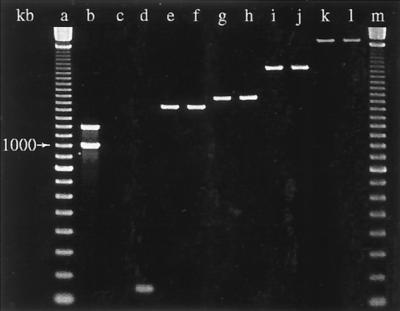
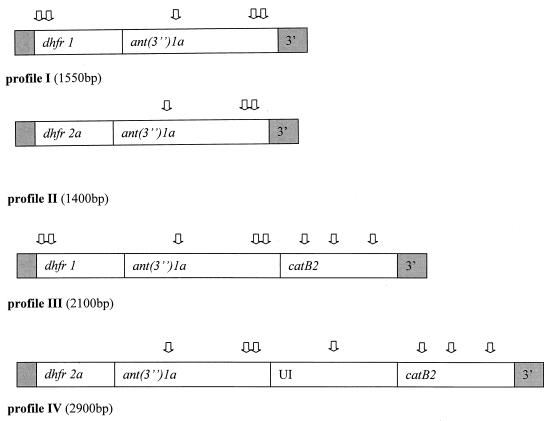
 ) used for comparison of gene cassette content of different sizes
of amplicons obtained with primers targeting the conserved segments
(shaded areas) of class 1 integrons. Out of 141 integron-positive
isolates, 74 belonged to profile I, 13 to profile II, 22 to profile
III, and 9 to profile IV. Twenty-three isolates had “empty”
integrons with no genes inserted into the variable region. UI,
unidentified gene insert.
) used for comparison of gene cassette content of different sizes
of amplicons obtained with primers targeting the conserved segments
(shaded areas) of class 1 integrons. Out of 141 integron-positive
isolates, 74 belonged to profile I, 13 to profile II, 22 to profile
III, and 9 to profile IV. Twenty-three isolates had “empty”
integrons with no genes inserted into the variable region. UI,
unidentified gene insert.References
Publication types
MeSH terms
Substances
LinkOut - more resources
Full Text Sources
Molecular Biology Databases
