. 2001 Dec 1;15(23):3144-54.
doi: 10.1101/gad.931401.

Histone H3 specific acetyltransferases are essential for cell cycle progression

Affiliations

Histone H3 specific acetyltransferases are essential for cell cycle progression

L Howe et al. Genes Dev. .

Abstract

Longstanding observations suggest that acetylation and/or amino-terminal tail structure of histones H3 and H4 are critical for eukaryotic cells. For Saccharomyces cerevisiae, loss of a single H4-specific histone acetyltransferase (HAT), Esa1p, results in cell cycle defects and death. In contrast, although several yeast HAT complexes preferentially acetylate histone H3, the catalytic subunits of these complexes are not essential for viability. To resolve the apparent paradox between the significance of H3 versus H4 acetylation, we tested the hypothesis that H3 modification is essential, but is accomplished through combined activities of two enzymes. We observed that Sas3p and Gcn5p HAT complexes have overlapping patterns of acetylation. Simultaneous disruption of SAS3, the homolog of the MOZ leukemia gene, and GCN5, the hGCN5/PCAF homolog, is synthetically lethal due to loss of acetyltransferase activity. This key combination of activities is specific for these two HATs because neither is synthetically lethal with mutations of other MYST family or H3-specific acetyltransferases. Further, the combined loss of GCN5 and SAS3 functions results in an extensive, global loss of H3 acetylation and arrest in the G(2)/M phase of the cell cycle. The strikingly similar effect of loss of combined essential H3 HAT activities and the loss of a single essential H4 HAT underscores the fundamental biological significance of each of these chromatin-modifying activities.


Figures
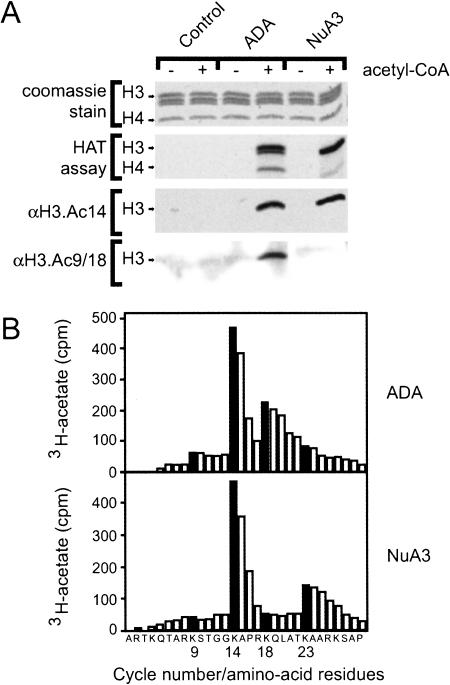
Figure 1
Figure 1
The NuA3 complex has overlapping site specificity with Gcn5p containing complexes for histone H3. (A) HAT assay fluorography and Western immunoblots of nucleosomes incubated alone (Control) or with purified ADA, or NuA3 complexes, in the presence (+) or absence (−) of radiolabeled acetyl-CoA. Western blots were probed with anti-H3.Ac14 or anti-H3.Ac9/18 antiserum. The positions of the individual histones are indicated. (B) HAT assays were performed using purified ADA or NuA3 HAT complexes and nucleosomes as substrate. Radiolabeled histone H3 was subsequently purified and subjected to microsequence analysis followed by direct determination of radioactivity at each position in the H3 polypeptide. The counts/min (cpm) for each cycle are plotted against the amino acid detected for that cycle. Potential acetylation sites are indicated.
Figure 2
Figure 2
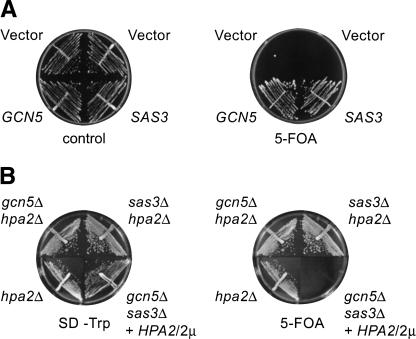
Deletion of SAS3 is synthetically lethal with gcn5Δ. (A) Yeast strain YJW134 (MATa his3Δ200 leu2Δ1 ura3-52 trp1-63 gcn5Δ::HIS3 sas3Δ::HIS3MX6, pJW214) was transformed with vector alone or plasmids encoding wild-type (GCN5, SAS3) Gcn5p or Sas3p, and the resulting transformants plated on either synthetic complete medium (control) or synthetic complete with 5-FOA. (B) Yeast strains LPY5686 (MATα ade2-1 his3 leu2 lys2Δ0 trp1Δ1 ura3 gcn5Δ::HIS3 hpa2Δ::KANMX), LPY5679 (MATα ade2-101 his3 leu2 lys2 trp1Δ1 ura3 sas3Δ::HIS3 hpa2Δ::KANMX), LPY5680 (MATα ade2-1 his3 leu2 lys2 trp1Δ1 ura3 hpa2Δ::KANMX), and LPY5529 (MATα ade2-101 his3Δ200 leu2 lys2Δ801 trp1Δ1 ura3-52 sas3Δ::HIS3 gcn5Δ, pLP640 pLP1399) were streaked on synthetic complete medium or synthetic complete with 5-FOA.
Figure 3
Figure 3
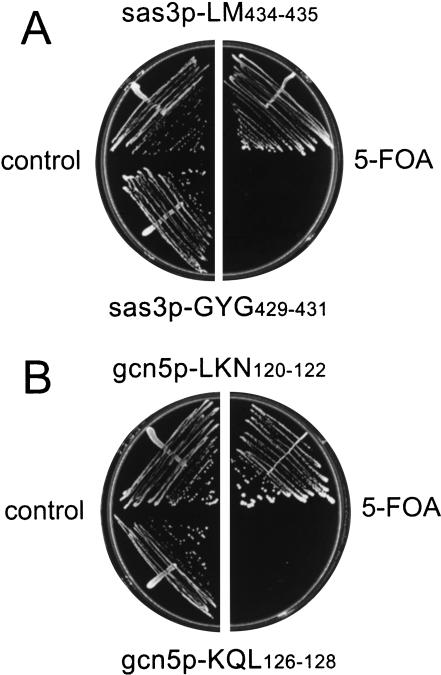
Synthetic lethality of the gcn5Δ sas3Δ strain is due to loss of HAT activity. Yeast strain YJW134 (MATa his3Δ200 leu2Δ1 ura3-52 trp1Δ63 gcn5Δ::HIS3 sas3Δ::HIS3MX6, pJW214) was transformed with plasmids encoding alanine substitution mutations in Sas3p (A, sas3p-LM434–435 and sas3p-GYG429–431) or Gcn5p (B, gcn5p-LKN120–122 and gcn5p-KQL126–128) and plated directly on either synthetic complete medium (control) or synthetic complete with 5-FOA.
Figure 4
Figure 4
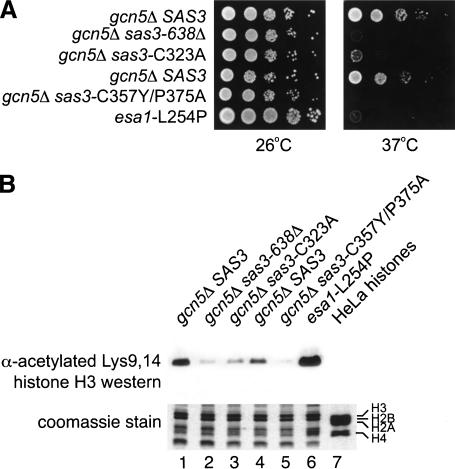
Sas3p is required for histone H3 acetylation in vivo. (A) gcn5Δ sas3 temperature sensitivity was observed upon plating gcn5Δ SAS3 [YJW136 (MATahis3Δ200 leu2Δ1 ura3-52 trp1Δ63 gcn5Δ::HIS3 sas3Δ::HIS3MX6, pLP0640)], gcn5Δ sas3-638Δ [YJW137 (MATahis3Δ200 leu2Δ1 ura352 trp1Δ63 gcn5Δ ::HIS3 sas3Δ::HIS3MX6, pLP1364)], gcn5Δ sas3-C323A [YJW138 (MATahis3Δ200 leu2Δ1 ura3-52 trp1Δ63 gcn5Δ::HIS3 sas3Δ::HIS3MX6, pLP1398)], gcn5Δ SAS3 [YJW134 (MATahis3Δ200 leu2Δ1 ura3-52 trp1Δ63 gcn5Δ::HIS3 sas3Δ::HIS3MX6, pJW214)], and gcn5Δ sas3-C357Y/P375A [YJW135 (MATahis3Δ200 leu2Δ1 ura3-52 trp1Δ63 gcn5Δ::HIS3 sas3Δ::HIS3MX6, pJW216)] on YPD and growing at 26 and 37°C for 3 d. (B) Histones were isolated from the wild-type and temperature-sensitive strains shown in A after growth for 12 h at 37°C, and resolved either on 18% SDS-PAGE and stained with Coomassie brilliant blue, or resolved on a 12% SDS-PAGE, transferred to nitrocellulose and probed with anti-acetylated histone H3 (Lys 9 and Lys 14) antiserum. Purified HeLa core histones were run in parallel.
Figure 5
Figure 5
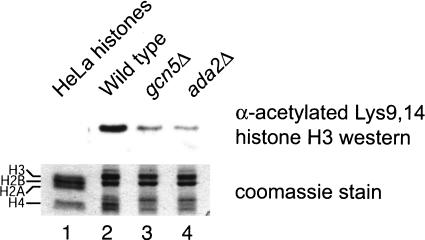
Gcn5p requires Ada2p for its catalytic function in vivo. Histones were isolated from PSY316 GCN5, PSY316 ada2Δ, or PSY316 gcn5Δ cells and resolved either on 18% SDS-PAGE and stained with Coomassie brilliant blue, or resolved on a 12% SDS-PAGE, transferred to nitrocellulose and probed with anti-acetylated histone H3 (Lys 9 and Lys 14) antiserum. Purified HeLa core histones were run in parallel.
Figure 6
Figure 6
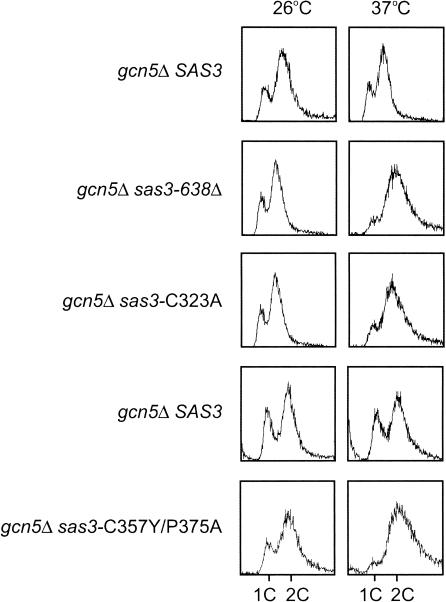
Flow cytometric analysis of gcn5Δ sas3 strains. Exponentially growing cultures of gcn5Δ strains containing either wild-type SAS3 [YJW136 (MATahis3Δ200 leu2Δ1 ura3-52 trp1Δ63 gcn5Δ::HIS3 sas3Δ::HIS3MX6, pLP0640) and YJW134 (MATahis3Δ200 leu2Δ1 ura3-52 trp1Δ63 gcn5Δ::HIS3 sas3Δ::HIS3MX6, pJW214)], or temperature-sensitive alleles of SAS3 [YJW137 (MATahis3Δ200 leu2Δ1 ura3-52 trp1Δ63 gcn5Δ::HIS3 sas3Δ::HIS3MX6, pLP1364), YJW138 (MATahis3Δ200 leu2Δ1 ura3-52 trp1Δ63 gcn5Δ::HIS3 sas3Δ::HIS3MX6, pLP1398), and YJW135 (MATahis3Δ200 leu2Δ1 ura3-52 trp1Δ63 gcn5Δ::HIS3 sas3Δ::HIS3MX6, pJW216)] were incubated at either permissive (26°C) or nonpermissive (37°C) temperatures, stained with propidium iodide and subjected to flow cytometry. The position of cells with a 1C or 2C DNA content is marked.

References

    1. Adams A, Gottschling DE, Kaiser CA, Stearns T. Methods in yeast genetics: A Cold Spring Harbor Laboratory course manual. Cold Spring Harbor, NY: Cold Spring Harbor Laboratory Press; 1997.
    1. Allard S, Utley R, Savard J, Clark A, Grant P, Brandl C, Pillus L, Workman J, Cο̂té J. NuA4, an essential transcription adaptor/histone H4 acetyltransferase complex containing Esa1p and the ATM-related cofactor Tra1p. EMBO J. 1999;18:5108–5119. - PMC - PubMed
    1. Angus-Hill ML, Dutnall RN, Tafrov ST, Sternglanz R, Ramakrishnan V. Crystal structure of the histone acetyltransferase Hpa2: A tetrameric member of the Gcn5-related N-acetyltransferase superfamily. J Mol Biol. 1999;294:1311–1325. - PubMed
    1. Ausubel FM. Current protocols in molecular biology. NY: Greene Pub. Associates and Wiley-Interscience, J. Wiley; 1987.
    1. Belotserkovskaya R, Sterner DE, Deng M, Sayre MH, Lieberman PM, Berger SL. Inhibition of TATA-binding protein function by SAGA subunits Spt3 and Spt8 at Gcn4-activated promoters. Mol Cell Biol. 2000;20:634–647. - PMC - PubMed

Publication types

MeSH terms