QTL analysis in a complex autopolyploid: genetic control of sugar content in sugarcane
- PMID: 11731498
- PMCID: PMC311218
- DOI: 10.1101/gr.198801
QTL analysis in a complex autopolyploid: genetic control of sugar content in sugarcane
Abstract
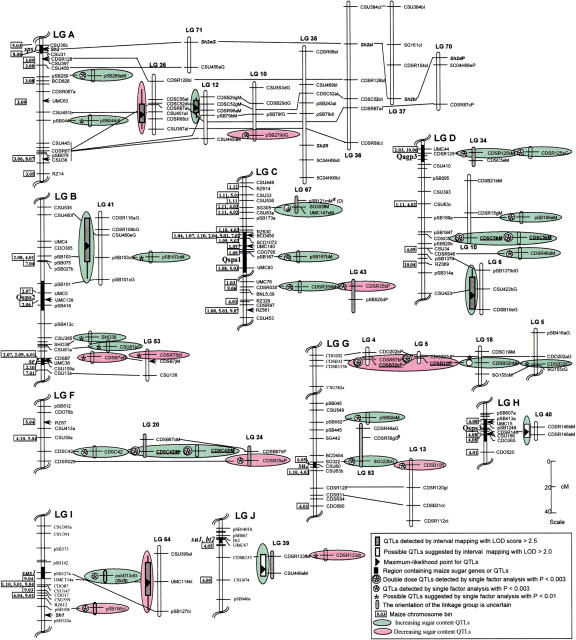
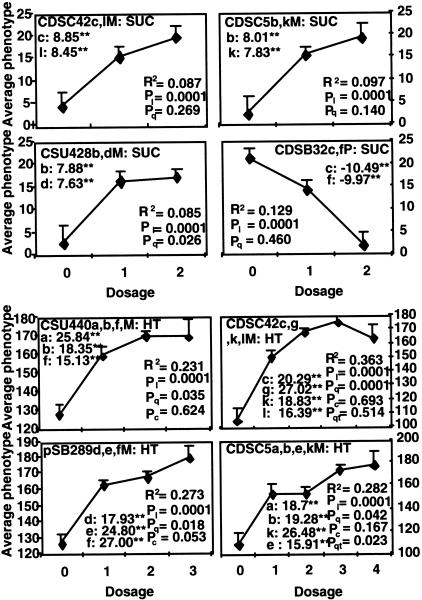
QTL mapping in autopolyploids is complicated by the possibility of segregation for three or more alleles at a locus and by a lack of preferential pairing, however the subset of polymorphic alleles that show simplex segregation ratios can be used to locate QTLs. In autopolyploid Saccharum, 36 significant associations between variation in sugar content and unlinked loci detected by 31 different probes were found in two interspecific F(1) populations. Most QTL alleles showed phenotypic effects consistent with the parental phenotypes, but occasional transgressive QTLs revealed opportunities to purge unfavorable alleles from cultivars or introgress valuable alleles from exotics. Several QTLs on homologous chromosomes appeared to correspond to one another-multiple doses of favorable 'alleles' at such chromosomal region(s) yielded diminishing returns-such negative epistasis may contribute to phenotypic buffering. Fewer sugar content QTLs were discovered from the highest-sugar genotype than from lower-sugar genotypes, perhaps suggesting that many favorable alleles have been fixed by prior selection, i.e. that the genes for which allelic variants (QTLs) persist in improved sugarcanes may be a biased subset of the population of genes controlling sugar content. Comparison of these data to mutations and QTLs previously mapped in maize hinted that seed and biomass crops may share a partly-overlapping basis for genetic variation in carbohydrate deposition. However, many QTLs do not correspond to known candidate genes, suggesting that other approaches will be necessary to isolate the genetic determinants of high sugar content of vegetative tissues.
Figures
References
-
- Ahn S, Anderson JA, Sorrells ME, Tanksley SD. Homoeologous relationships of rice, wheat, and maize chromosomes. Mol Gen Genet. 1993;241:483–490. - PubMed
-
- Baba T, Kimura K, Mizuno K, Etoh H, Ishida Y, Shida O, Arai Y. Sequence conservation of the catalytic regions of amylolytic enzymes in maize branching enzyme I. Biochem Biophys Res Commun. 1991;181:87–94. - PubMed
-
- Berding N, Moore PH, Smith GR. Advancing in breeding technology for sugarcane. In: Keating BA, Wilson JR, editors. Intensive sugarcane production: Meeting the challenges beyond 2000. Wallingford, UK: CAB International; 1997. pp. 189–220.
-
- Binh NQ, Michaud D, Yelle S, Krivitzky M, Lecharny A. Purification of maize sucrose synthase 1-specific polyclonal antibodies by affinity chromatography. Plant Physiol Biochem. 1995;33:419–422.
Publication types
MeSH terms
Substances
LinkOut - more resources
Full Text Sources
Other Literature Sources