


BRD4 bromodomain gene rearrangement in aggressive carcinoma with translocation t(15;19)
- PMID: 11733348
- PMCID: PMC1850578
- DOI: 10.1016/S0002-9440(10)63049-0
BRD4 bromodomain gene rearrangement in aggressive carcinoma with translocation t(15;19)
Abstract
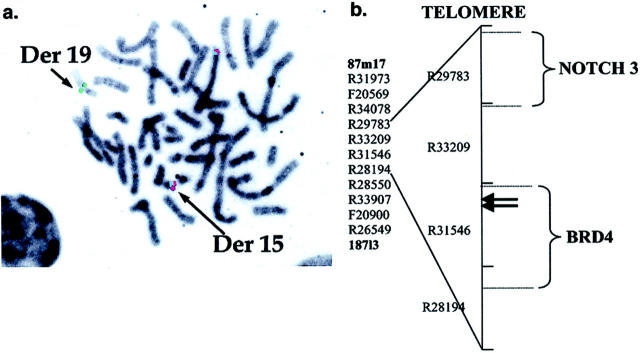
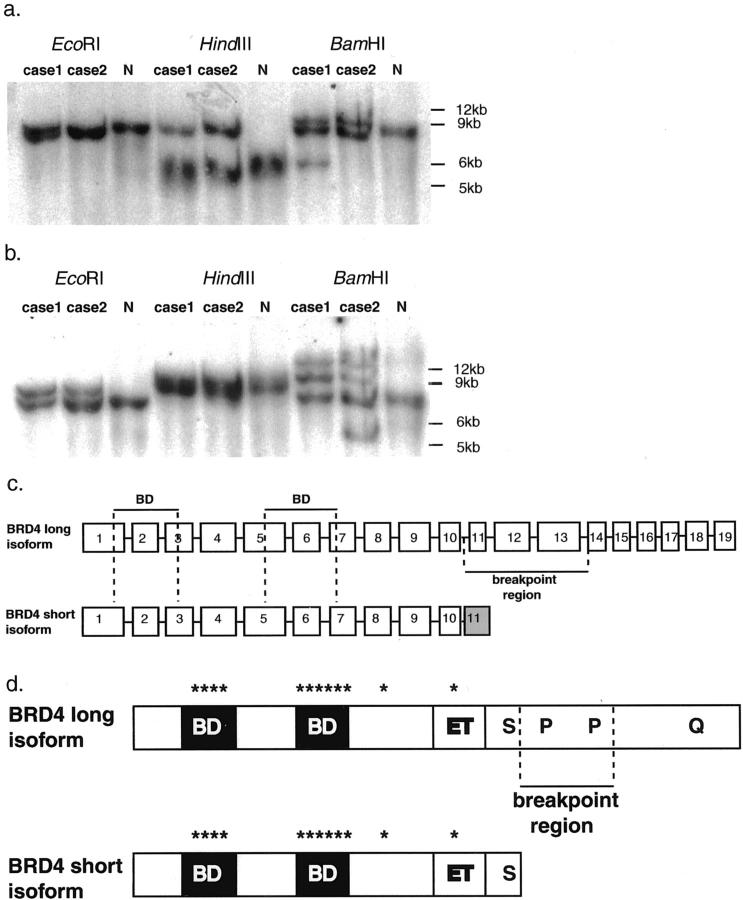
Translocation t(15;19)(q13;p13.1) defines a lethal midline carcinoma arising adjacent to respiratory tract in young people. To characterize molecular alterations responsible for the distinctly aggressive biological behavior of this cancer, we mapped the chromosome 15 and 19 translocation breakpoints by fluorescence in situ hybridization (FISH) and Southern blotting. To evaluate preliminarily the frequency, anatomical distribution, and histological features of t(15;19) cancer, we developed a FISH assay for paraffin sections. Our findings reveal a novel oncogenic mechanism in which the chromosome 19 translocation breakpoint interrupts the coding sequence of a bromodomain gene, BRD4. These studies implicate BRD4 as a potential partner in a t(15;19)-associated fusion oncogene. In addition, we localized the chromosome 15 breakpoint to a 9-kb region in each of two cases, thereby identifying several candidate oncogenes which might represent the BRD4 fusion partner. FISH evaluation of 13 pediatric carcinomas revealed t(15;19) in one of four sinonasal carcinomas, whereas this translocation was not detected in thymic (n = 3), mucoepidermoid (n = 3), laryngeal (n = 2), or nasopharyngeal (n = 1) carcinomas. Our studies shed light on the oncogenic mechanism underlying t(15;19) and provide further evidence that this highly lethal cancer arises from respiratory mucosa.
Figures

Comment in
-
Translocations in malignant tumors.Am J Pathol. 2001 Dec;159(6):1979-80. doi: 10.1016/S0002-9440(10)63047-7. Am J Pathol. 2001. PMID: 11733346 Free PMC article. No abstract available.
References
-
- Kroll TG, Sarraf P, Pecciarini L, Chen CJ, Mueller E, Spiegelman BM, Fletcher JA: PAX8-PPARγ1 fusion oncogene in human thyroid carcinoma. Science 2000, 289:1357-1360 - PubMed
-
- Sozzi G, Bongarzone I, Miozzo M, Borrello MG, Blutti MG, Pilotti S, Della Porta G, Pierotti MA: A t(10;17) translocation creates the RET/PTC2 chimeric transforming sequence in papillary thyroid carcinoma. Genes Chromosomes Cancer 1994, 9:244-250 - PubMed
-
- Nakata T, Kitamura Y, Shimizu K, Tanaka S, Fujimori M, Yokoyama S, Ito K, Emi M: Fusion of a novel gene, ELKS, to RET due to translocation t(10;12)(q11;p13) in a papillary thyroid carcinoma. Genes Chromosomes Cancer 1999, 25:97-103 - PubMed
-
- Corvi R, Berger N, Balczon R, Romeo G: RET/PCM-1: a novel fusion gene in papillary thyroid carcinoma. Oncogene 2000, 19:4236-4242 - PubMed
Publication types
MeSH terms
Substances
Associated data
- Actions
Grants and funding
LinkOut - more resources
Full Text Sources
Other Literature Sources
Medical
Molecular Biology Databases
Research Materials
