


doi: 10.1177/014107680109401202.
Is the National Health Service at the edge of chaos?
Affiliations
- PMID: 11733585
- PMCID: PMC1282291
- DOI: 10.1177/014107680109401202
Item in Clipboard
Is the National Health Service at the edge of chaos?
J R Soc Med.
2001 Dec.
Abstract
We used chaos and complexity theory to analyse waiting-list data (1998-2001) pertaining to over 20 000 National Health Service (NHS) patients from general surgical, orthopaedic and neurosurgical units across England. Plots of frequency versus quarter-to-quarter change in waiting times revealed a power relation which seems independent of surgical specialty and hospital location. One interpretation of these findings is that, for the period in question, the NHS was a system at the edge of chaos. This hypothesis might explain why waiting times have resisted attempts at shortening.
Figures
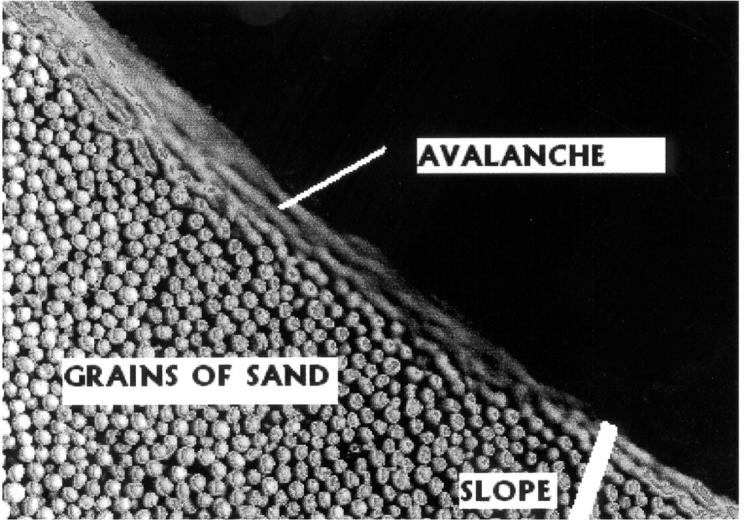
Resistance to change of a complex system at the edge of chaos
demonstrated by a pile of sand. Adding more sand to the pile causes
avalanches of different sizes, but the slope of the pile remains constant.
Avalanche size obeys a power relation (Ref.
1)
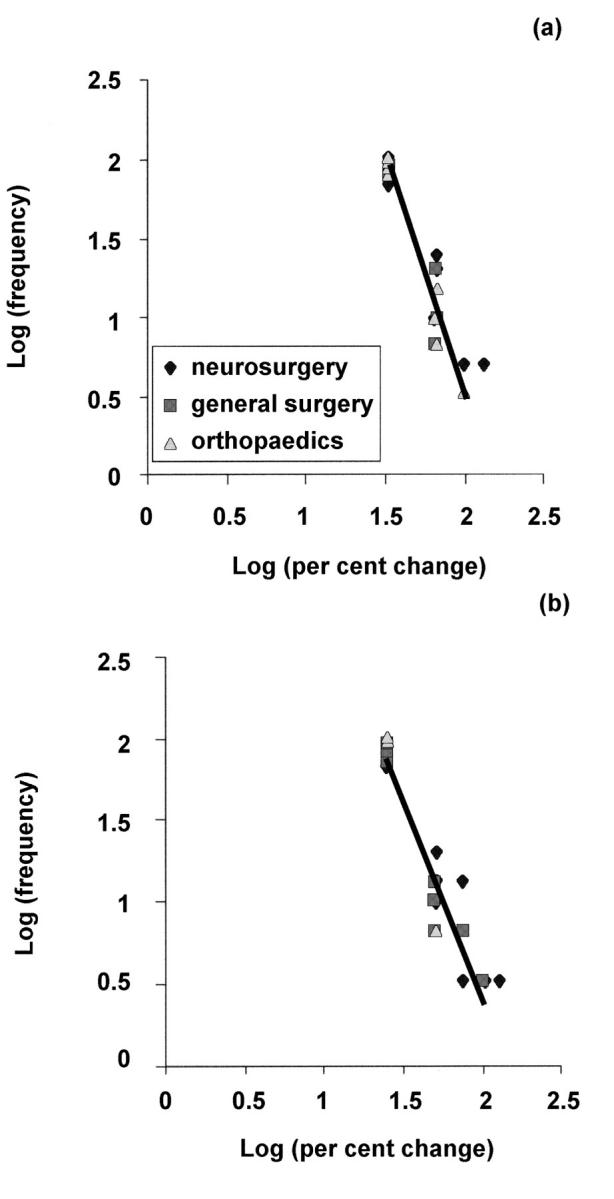
Plots of log (frequency) and log (per cent change) for (a)
outpatient and (b) inpatient waiting lists. The best-fit straight
line is also shown in each case. Note that many overlapping points appear as
single points
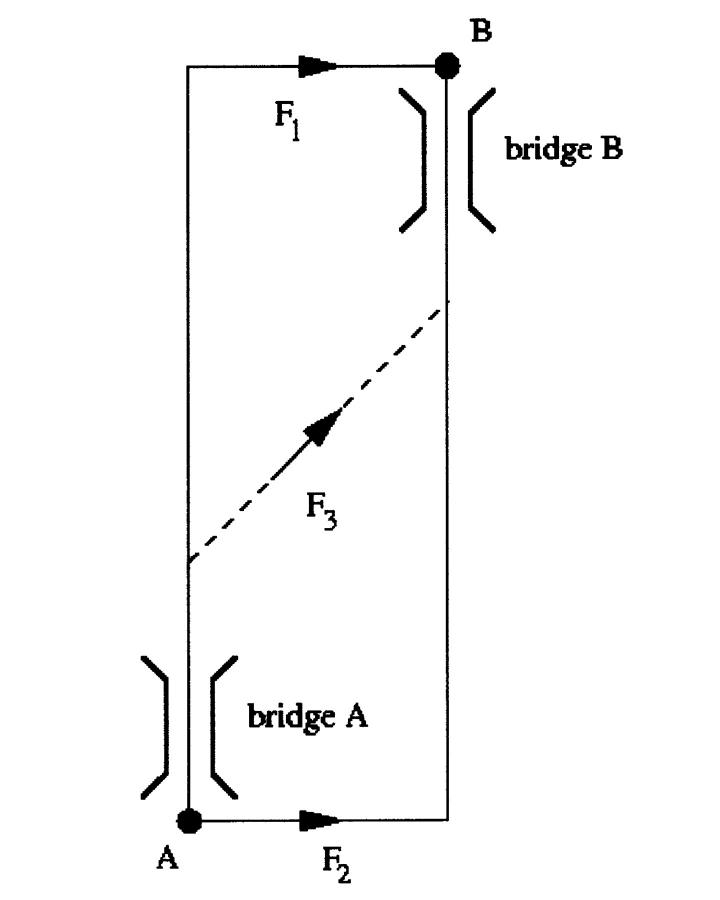
Analogy between the NHS and traffic jams. Cars travel from point A
to point B via route F1 or F2. Bridges A and B are
regions of congestion where the time taken to cross the bridge is directly
proportional to the number of cars trying to cross the bridge. Opening an
additional shorter route (F3) increases the average travel time
from point A to point B (Braess's paradox), because the cars that choose route
F3 contribute to congestion at both bridges A and B. The routes may
be analogous to doctors, the cars to patients and the journey times to waiting
times
Comment in
-
Do in-hospital waiting lists show self-regulation?J R Soc Med. 2002 Mar;95(3):164. doi: 10.1177/014107680209500324. J R Soc Med. 2002. PMID: 11872779 Free PMC article. No abstract available.
-
Edge of chaos.J R Soc Med. 2002 Mar;95(3):165. doi: 10.1258/jrsm.95.3.165-a. J R Soc Med. 2002. PMID: 11872780 Free PMC article. No abstract available.
-
Edge of chaos.J R Soc Med. 2002 Mar;95(3):165. doi: 10.1177/014107680209500325. J R Soc Med. 2002. PMID: 11872783 Free PMC article. No abstract available.
-
Self-regulation in hospital waiting lists.J R Soc Med. 2002 Apr;95(4):220. doi: 10.1258/jrsm.95.4.220-a. J R Soc Med. 2002. PMID: 11934925 Free PMC article. No abstract available.
-
Self-regulation in hospital waiting lists.J R Soc Med. 2002 Apr;95(4):220. doi: 10.1258/jrsm.95.4.220. J R Soc Med. 2002. PMID: 11934926 Free PMC article. No abstract available.
References
-
- Bak P. How Nature Works: The Science of Self-Organized Criticality. New York: Springer-Verlag, 1996
-
- Smethurst DP, Williams HC. Are hospital waiting lists self-regulating? Nature 2001;410: 652-3 - PubMed
-
- Department of Health. The NHS Plan: Proposal for a New Approach to the Consultant Contract. London: DoH, 2001
-
- Kaletsky A, Marris R. Europe holds lessons for our schools and hospitals. Times, 22 May 2001, p. 20
-
- Camm J. Consultant expansion to remain at just 4%. Hosp Doctor, 22 January 2001
MeSH terms
LinkOut - more resources
Full Text Sources
