. 2001:2:16.
doi: 10.1186/1471-2202-2-16. Epub 2001 Oct 19.

Generation of choline for acetylcholine synthesis by phospholipase D isoforms

Affiliations

Generation of choline for acetylcholine synthesis by phospholipase D isoforms

D Zhao et al. BMC Neurosci. 2001.

Abstract

Background: In cholinergic neurons, the hydrolysis of phosphatidylcholine (PC) by a phospholipase D (PLD)-type enzyme generates some of the precursor choline used for the synthesis of the neurotransmitter acetylcholine (ACh). We sought to determine the molecular identity of the relevant PLD using murine basal forebrain cholinergic SN56 cells in which the expression and activity of the two PLD isoforms, PLD1 and PLD2, were experimentally modified. ACh levels were examined in cells incubated in a choline-free medium, to ensure that their ACh was synthesized entirely from intracellular choline.

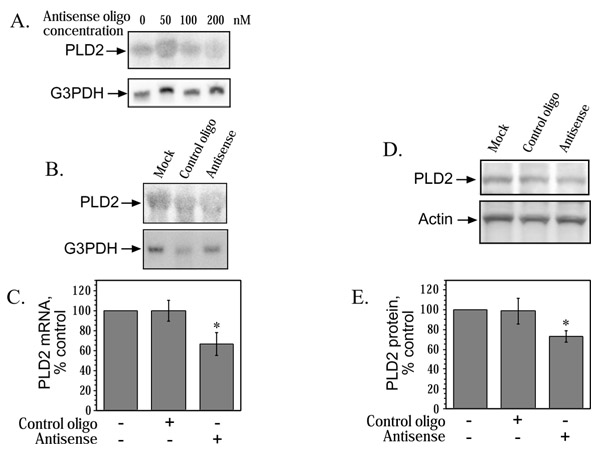
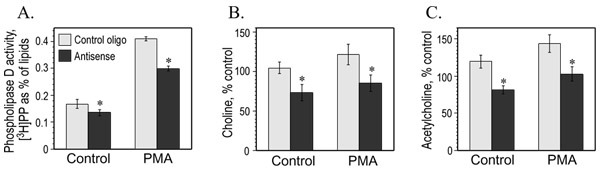
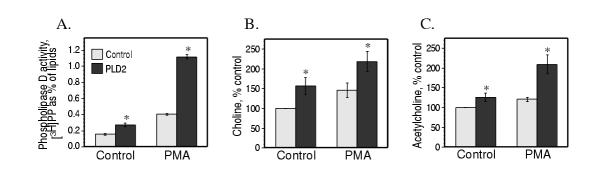
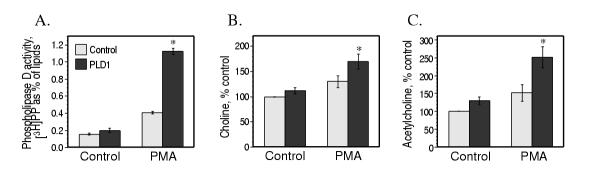
Results: PLD2, but not PLD1, mRNA and protein were detected in these cells and endogenous PLD activity and ACh synthesis were stimulated by phorbol 12-myristate 13-acetate (PMA). Introduction of a PLD2 antisense oligonucleotide into the cells reduced PLD2 mRNA and protein expression by approximately 30%. The PLD2 antisense oligomer similarly reduced basal- and PMA-stimulated PLD activity and ACh levels. Overexpression of mouse PLD2 by transient transfection increased basal- (by 74%) and PMA-stimulated (by 3.2-fold) PLD activity. Moreover, PLD2 transfection increased ACh levels by 26% in the absence of PMA and by 2.1-fold in the presence of PMA. Overexpression of human PLD1 by transient transfection increased PLD activity by 4.6-fold and ACh synthesis by 2.3-fold in the presence of PMA as compared to controls.

Conclusions: These data identify PLD2 as the endogenous enzyme that hydrolyzes PC to generate choline for ACh synthesis in cholinergic cells, and indicate that in a model system choline generated by PLD1 may also be used for this purpose.


Figures
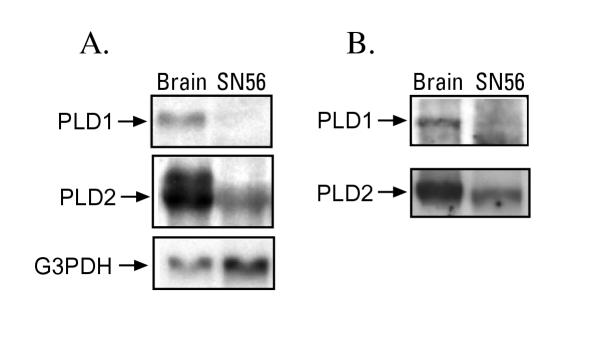
Figure 1
Figure 1
SN56 cells express PLD2 but not PLD1 mRNA and protein. Total RNA or protein lysates were prepared and subjected to Northern or Western blot analyses as described in the Experimental Procedures. A. Northern blot. Twenty μg of total RNA was subjected to electrophoresis on a 1.0% agarose gel and hybridized respectively with a mouse PLD2 probe, a human PLD1 probe and a mouse G3PDH probe. B. Western blot. A polyclonal anti-mouse PLD1 antibody and a polyclonal anti-human PLD2 antibody were used as primary antibodies. Rat brain total RNA (A) and protein lysates (B) were used as positive controls.
Figure 2
Figure 2
PLD2 antisense oligonucleotides reduce endogenous PLD2 mRNA expression and protein levels in SN56 cells. SN56 cells were transfected with either control or antisense oligonucleotides as described in the Experimental Procedures. Two days later PLD2 gene expression was assessed by Northern blot analysis (A-C) as described in Fig. 1. G3PDH was used for normalization (A-C). For Western blots 40 μg of lysate protein was subjected to SDS-PAGE. A polyclonal anti-human PLD2 antibody was used first to detect PLD2, the blot was stripped and rehybridized with a monoclonal anti-mouse actin antibody for normalization (D,E). A. Concentration-response curve to the antisense oligonucleotide. B. Comparison of the effects of the antisense and control oligonucleotides on PLD2 expression. The cells were transfected with 200 nM of either control or antisense oligomer as indicated. C. Quantification of results presented in B. Intensity of the hybridization bands was normalized to that of G3PDH. The antisense oligomer reduced PLD2 expression by 34%, *p < 0.05. Data shown are from 3–6 experiments and expressed as average ± SEM. D. The antisense oligomer reduced PLD2 protein expression as compared to mock-treated and control oligomer-transfected cells. E. The intensity of the PLD2 bands was quantified using NIH Image 1.62 and normalized to that of actin. The antisense oligomer reduced the PLD2 protein level by 28% compared to controls, *p < 0.05. The results are from 3 experiments and expressed as average ± SEM.
Figure 3
Figure 3
PLD2 antisense oligonucleotides down-regulate PLD2 activity, and acetylcholine and choline levels in SN56 cells. SN56 cells were transfected with either control or antisense oligonucleotides as described in the Experimental Procedures. After 48 hours the cells were preincubated for 20 minutes in choline-free medium and then incubated in fresh choline-free medium containing 50 μM neostigmine with or without 100 nM PMA for 45 minutes. PLD activity in the intact cells (A) and the intracellular choline (B) and acetylcholine (C) content were measured. The data were analyzed by two-way ANOVA and Fisher's post hoc test and are expressed as average ± SEM. The asterisks indicate a significant difference between the antisense and control transfectants (A-C). A. Effect of antisense oligonucleotides on PLD activity. The effect of PMA treatment is statistically significant in all groups. B. Effect of antisense oligonucleotides on intracellular choline level. C. Effect of antisense oligonucleotides on intracellular ACh level. The effect of PMA treatment is statistically significant in all groups.
Figure 4
Figure 4
Overexpression of PLD2 in SN56 cells increases enzyme activity, acetylcholine synthesis and choline content in the medium. The cells were transfected with the expression plasmid as described in the Experimental Procedures. After 48 hours the cells were treated as described in Fig. 3 and PLD activity in intact cells (A), choline content of the medium (B), and intracellular ACh content (C), were measured. The data were analyzed by two-way ANOVA and Fisher's post hoc test and are expressed as average ± SEM. The asterisks indicate a significant difference between the PLD2 and mock transfectants (A-C). A. Effect of PLD2 overexpression on PLD activity. The effect of PMA treatment is statistically significant in all groups. B. Effect of PLD2 overexpression on media choline level. The effect of PMA treatment is statistically significant in PLD2 transfectants. C. Effect of PLD2 overexpression on intracellular ACh level. The effect of PMA treatment is statistically significant in PLD2 transfectants.
Figure 5
Figure 5
Overexpression of PLD1 in SN56 cells increases enzyme activity, acetylcholine synthesis and choline content in the medium. The cells were transfected with the hPLD1 expression plasmid as described in the Experimental Procedures. After 48 hours the cells were treated as described in Fig. 3 and PLD activity in intact cells (A), choline content of the medium (B), and intracellular ACh content (C), were measured. The data were analyzed by two-way ANOVA and Fisher's post hoc test and are expressed as average ± SEM. The asterisks indicate a significant difference between the PLD1 and mock transfectants (A-C). A. Effect of PLD 1 overexpression on PLD activity. The effect of PMA treatment is statistically significant in all groups. B. Effect of PLD1 overexpression on media choline level. The effect of PMA treatment is statistically significant in PLD1 transfectants. C. Effect of PLD1 overexpression on intracellular ACh level. The effect of PMA treatment is statistically significant in PLD1 transfectants.

References

    1. Blusztajn JK, Wurtman RJ. Choline and cholinergic neurons. Science. 1983;221:614–620. - PubMed
    1. Apparsundaram S, Ferguson SM, George AL, Jr, Blakely RD. Molecular cloning of a human, hemicholinium-3-sensitive choline transporter. Biochem Biophys Res Commun. 2000;276:862–867. doi: 10.1006/bbrc.2000.3561. - DOI - PubMed
    1. Okuda T, Haga T, Kanai Y, Endou H, Ishihara T, Katsura I. Identification and characterization of the high-affinity choline transporter. Nat Neurosci. 2000;3:120–125. doi: 10.1038/72059. - DOI - PubMed
    1. Lee HC, Fellenz-Maloney MP, Liscovitch M, Blusztajn JK. Phospholipase D-catalyzed hydrolysis of phosphatidylcholine provides the choline precursor for acetylcholine synthesis in a human neuronal cell line. Proc Natl Acad Sci USA. 1993;90:10086–10090. - PMC - PubMed
    1. Hammond SM, Altshuller YM, Sung TC, Rudge SA, Rose K, Engebrecht J, Morris AJ, Frohman MA. Human ADP-ribosylation factor-activated phosphatidylcholine-specific phospholipase D defines a new and highly conserved gene family. J Biol Chem. 1995;270:29640–29643. doi: 10.1074/jbc.270.50.29640. - DOI - PubMed

Publication types

MeSH terms

Associated data

LinkOut - more resources