. 2001 Dec 4;98(25):14497-502.
doi: 10.1073/pnas.231494798.

Three retrotransposon families in the genome of Giardia lamblia: two telomeric, one dead

Affiliations

Three retrotransposon families in the genome of Giardia lamblia: two telomeric, one dead

I R Arkhipova et al. Proc Natl Acad Sci U S A. .

Abstract

Transposable elements inhabiting eukaryotic genomes are generally regarded either as selfish DNA, which is selectively neutral to the host organism, or as parasitic DNA, deleterious to the host. Thus far, the only agreed-upon example of beneficial eukaryotic transposons is provided by Drosophila telomere-associated retrotransposons, which transpose directly to the chromosome ends and thereby protect them from degradation. This article reports the transposon content of the genome of the protozoan Giardia lamblia, one of the earliest-branching eukaryotes. A total of three non-long terminal repeat retrotransposon families have been identified, two of which are located at the ends of chromosomes, and the third one contains exclusively dead copies with multiple internal deletions, nucleotide substitutions, and frame shifts. No other reverse transcriptase- or transposase-related sequences were found. Thus, the entire genome of this protozoan, which is not known to reproduce sexually, contains only retrotransposons that are either confined to telomeric regions and possibly beneficial, or inactivated and completely nonfunctional.


Figures
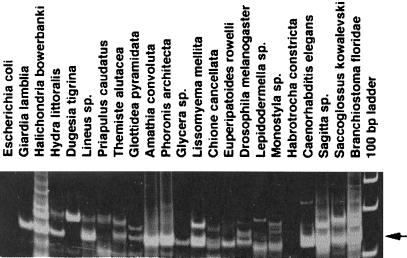
Figure 1
Figure 1
PCR amplification of total genomic DNA isolated from representatives of 20 animal phyla, plus G. lamblia and Escherichia coli, with nested primers specific for LINE-like RTases. An arrow corresponds to the position of prominent sequence-specific amplification products about 120 bp in length, typically representing members of the most abundant CR1 clade; larger products correspond to members of other clades such as L1, jockey, etc. (2). Amplification products are not visible in E. coli and in Habrotrocha constricta, a bdelloid rotifer (2).
Figure 2
Figure 2
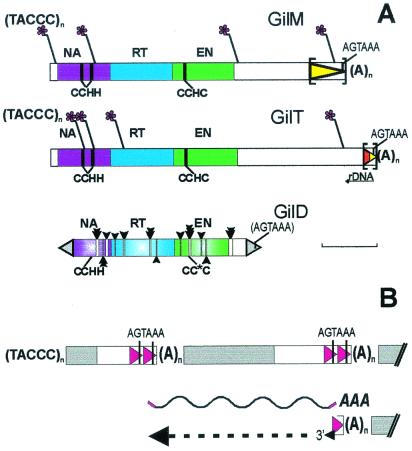
(A) Structure of three LINE-like retrotransposon families from G. lamblia. Asterisks designate sites of telomeric repeat addition to 5′-truncated copies of GilM and GilT. Oligo(A) tracts are designated by (A)n and are immediately followed by the intact 5′ end of another copy of the same element. Protein domains are designated as NA, nucleic acid binding (purple); RT, RTase (blue); EN, REL-endonuclease (green). Also shown are the Zn-finger motifs (CCHH and CCHC, vertical lines) and the polyadenylation signal (AGTAAA), which is included in parentheses in GilD because it can be identified only in a subset of copies. Noncoding regions are in white. The region in the 3′ UTR, which may also exist as a tandem duplication, is shown by a triangle in square brackets; the segment in GilT originally incorporated from rDNA is shown in red. The sites of deletion tracts in GilD are indicated by empty bars with vertical arrows, the number and size of arrows corresponding to the number and size of deletions at a particular site, and the adjacent inverted repeat is shown as a gray triangle. [Bar = 1 kb.] (B) Model of telomere formation by LINE elements based on features shared between telomere-associated retrotransposons of Giardia and Drosophila (ref. ; this study). Transcription from a nontruncated member of a tandem array can result in a full-length polyadenylated transcript (wavy line), which gets attached to the 3′ end of a chromosome serving as a primer for reverse transcription. Note that there is a potential to use annealing of the 3′ RNA end to a homologous segment at the DNA termini. Coding sequences are in blue; the 3′ segment may or may not be tandemly duplicated; telomeric repeats are not added in Drosophila. Not to scale. The telomere is on the left.
Figure 3
Figure 3
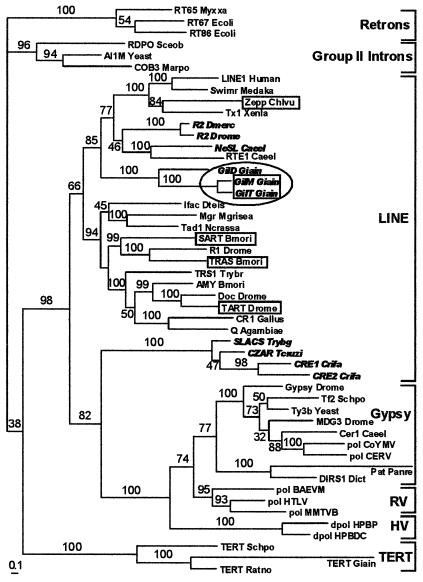
Phylogenetic analysis of RTase domains, including telomerase RTases (TERT), LINE-like retrotransposons, gypsy-like retrotransposons (including pararetroviruses), group II introns, bacterial retrons, retroviruses (RV), and hepadnaviruses (HV). The Giardia non-long terminal repeat retrotransposons identified in this study are enclosed in an oval. The tree was arbitrarily rooted with bacterial retrons, which have the simplest RTase domain structure. Telomere-associated LINE-like retrotransposons are boxed, and those containing the REL-ENDO domain appear in bold italic. Numbers above the branches are the clade credibility values or percentage of trees containing each bipartition. [Bar = 0.1 amino acid substitutions per site.]

Comment in

References

    1. Hickey D. Genetics. 1982;101:519–531. - PMC - PubMed
    1. Arkhipova I, Meselson M. Proc Natl Acad Sci USA. 2000;97:14473–14477. - PMC - PubMed
    1. Arkhipova I, Lyubomirskaya N, Ilyin Y. Drosophila Retrotransposons. Austin, TX: Landes; 1995.
    1. Capy P, Bazin C, Higuet D, Langin T. Dynamics and Evolution of Transposable Elements. Austin, TX: Landes; 1998.
    1. Mark Welch D, Meselson M. Science. 2000;288:1211–1215. - PubMed

Publication types

Associated data