


Red blood cell transfusion does not increase oxygen consumption in critically ill septic patients
- PMID: 11737926
- PMCID: PMC83858
- DOI: 10.1186/cc1070
Red blood cell transfusion does not increase oxygen consumption in critically ill septic patients
Abstract
Background: Red blood cell (RBC) transfusion is commonly used to increase oxygen transport in patients with sepsis. However it does not consistently increase oxygen uptake at either the whole-body level, as calculated by the Fick method, or within individual organs, as assessed by gastric intra-mucosal pH.
Aim: This study evaluates the hemodynamic and oxygen utilization effects of hemoglobin infusion on critically ill septic patients.
Methods: Fifteen septic patients undergoing mechanical ventilation whose hemoglobin was <10 g% were eligible. Ten patients (APACHE II: 25.5 +/- 7.6) received an infusion of 1 unit of packed RBC over 1 h while sedated and paralyzed. The remaining five control patients (APACHE II: 24.3 +/- 6.0) received a 5% albumin solution (500 ml) over 1 h. Hemodynamic data, gastric tonometry and calorimetry were obtained prior to and immediately after RBC transfusion or 5% albumin infusion.
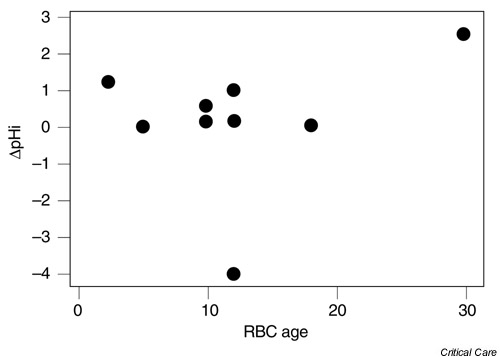
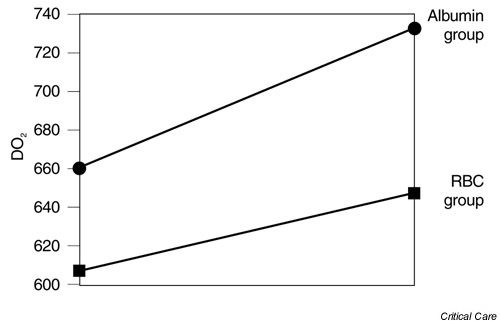
Results: Transfusion of RBC was associated with an improvement in left ventricular systolic work index (38.6 +/- 12.6 to 41.1 +/- 13.0 g/min/m2; P = 0.04). In the control group there was no significant change in the left ventricular systolic work index (37.2 +/- 14.3 to 42.2 +/- 18.9 g/min/m2). An increase in pulmonary vascular resistance index (203 +/- 58 to 238 +/- 49 dyne/cm5/m2; P = 0.04) was also observed, while no change was produced by colloid infusion (237 +/- 87.8 to 226.4 +/- 57.8 dyne/cm5/m2). Oxygen utilization did not increase either by Fick equation or by indirect calorimetry in either group. Gastric intramucosal pH increased only in the control group but did not reach statistical significance.
Conclusion: Hemoglobin increase does not improve either global or regional oxygen utilization in anemic septic patients. Furthermore, RBC transfusion may hamper right ventricular ejection by increasing the pulmonary vascular resistance index.
Figures
References
-
- Task Force of the American College of Critical Care Medicine, Society of Critical Care Medicine Practice parameters for hemodynamic support of sepsis in adult patients in sepsis. Crit Care Med. 1999;27:639–660. - PubMed
-
- Rashkin MC, Bosken C, Baughman RP. Oxygen delivery in critically ill patients: relationship to blood lactate and survival. Chest. 1985;87:580–584. - PubMed
-
- Weg JG. Oxygen transport in adult respiratory distress syndrome and other acute circulatory problems: relationship of oxygen delivery and oxygen consumption. Crit Care Med. 1991;19:650–657. - PubMed
-
- Ronco JJ, Phang PT, Walley KR, Wiggs B, Fenwick JC, Russel JA. Oxygen consumption is independent of changes in oxygen delivery in severe adult respiratory distress syndrome. Am Rev Respir Dis. 1991;143:1267–1273. - PubMed
-
- Bartlett RH, Dechert RE. Oxygen kinetics: pitfalls in clinical research. J Crit Care. 1990;5:77–80.
Publication types
MeSH terms
Substances
LinkOut - more resources
Full Text Sources
Medical
