Fetal and early life growth and body mass index from birth to early adulthood in 1958 British cohort: longitudinal study
- PMID: 11739217
- PMCID: PMC60670
- DOI: 10.1136/bmj.323.7325.1331
Fetal and early life growth and body mass index from birth to early adulthood in 1958 British cohort: longitudinal study
Abstract
Objectives: To determine the influence of birth weight on body mass index at different stages of later life; whether this relation persists after accounting for potential confounding factors; and the role of indicators of fetal growth (birth weight relative to parental size) and childhood growth.
Design: Longitudinal study of the 1958 British birth cohort.
Setting: England, Scotland, and Wales.
Participants: All singletons born 3-9 March 1958 (10 683 participants with data available at age 33).
Main outcome measures: Body mass index at ages 7, 11, 16, 23, and 33 years.
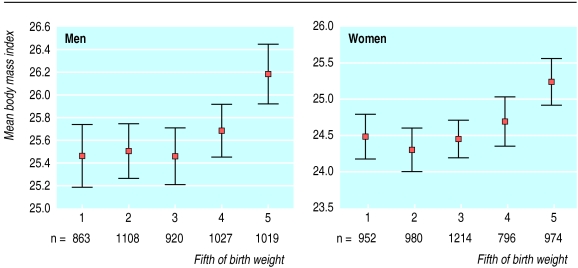
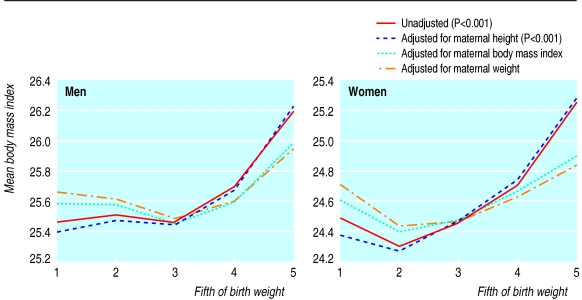
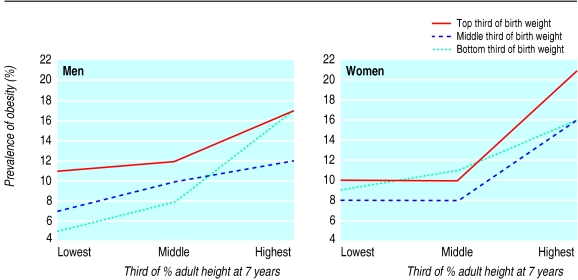
Results: The relation between birth weight and body mass index was positive and weak, becoming more J shaped with increasing age. When adjustments were made for maternal weight, there was no relation between birth weight and body mass index at age 33. Indicators of poor fetal growth based on the mother's body size were not predictive, but the risk of adult obesity was higher among participants who had grown to a greater proportion of their eventual adult height by age 7. In men only, the effect of childhood growth was strongest in those with lower birth weights and, to a lesser extent, those born to lighter mothers.
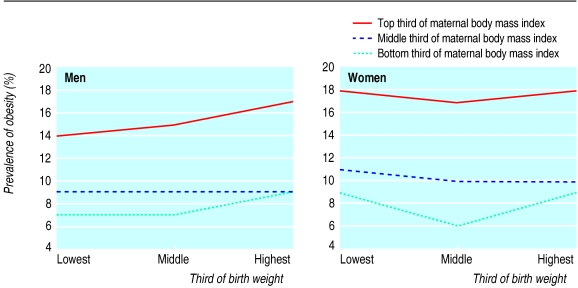
Conclusions: Maternal weight (or body mass index) largely explains the association between birth weight and adult body mass index, and it may be a more important risk factor for obesity in the child than birth weight. Birth weight and maternal weight seem to modify the effect of childhood linear growth on adult obesity in men. Intergenerational associations between the mother's and her offspring's body mass index seem to underlie the well documented association between birth weight and body mass index. Other measures of fetal growth are needed for a fuller understanding of the role of the intrauterine environment in the development of obesity.
Figures
Comment in
-
Adult obesity and growth in childhood.BMJ. 2001 Dec 8;323(7325):1320-1. doi: 10.1136/bmj.323.7325.1320. BMJ. 2001. PMID: 11739206 Free PMC article. No abstract available.
References
-
- Dietz WH. Critical periods in childhood for the development of obesity. Am J Clin Nutr. 1994;59:955–959. - PubMed
-
- Parsons TJ, Power C, Logan S, Summerbell CD. Childhood predictors of adult obesity: a systematic review. Intl J Obesity. 1999;23(suppl 8):S1–107. - PubMed
-
- Whitaker RC, Dietz WH. Role of the prenatal environment in the development of obesity. J Pediatr. 1998;132:768–776. - PubMed
-
- Seidman DS, Laor A, Gale R, Stevenson DK, Danon YL. A longitudinal study of birth weight and being overweight in late adolescence. Am J Dis Child. 1991;145:782–785. - PubMed
-
- Hulman S, Kushner H, Katz S, Falkner B. Can cardiovascular risk be predicted by newborn, childhood, and adolescent body size? An examination of longitudinal data in urban African Americans. J Pediatr. 1998;132:90–97. - PubMed