


doi: 10.1073/pnas.211556398.
Epub 2001 Dec 11.
Direct real-time observation of actin filament branching mediated by Arp2/3 complex using total internal reflection fluorescence microscopy
Affiliations
- PMID: 11742068
- PMCID: PMC64974
- DOI: 10.1073/pnas.211556398
Item in Clipboard
Direct real-time observation of actin filament branching mediated by Arp2/3 complex using total internal reflection fluorescence microscopy
Proc Natl Acad Sci U S A.
.
Abstract
Existing methods for studying actin filament dynamics have allowed analysis only of bulk samples or individual filaments after treatment with the drug phalloidin, which perturbs filament dynamics. Total internal reflection fluorescence microscopy with rhodamine-labeled actin allowed us to observe polymerization in real time, without phalloidin. Direct measurements of filament growth confirmed the rate constants measured by electron microscopy and established that rhodamine actin is a kinetically inactive tracer for imaging. In the presence of activated Arp2/3 complex, growing actin filaments form branches at random sites along their sides, rather than preferentially from their barbed ends.
Figures
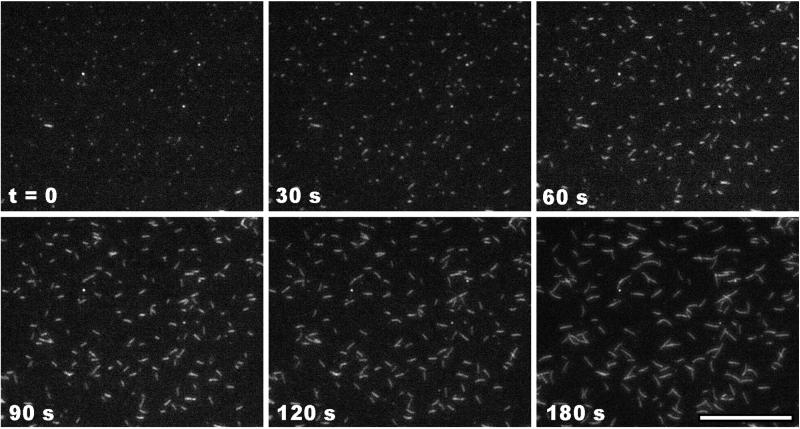
Elongation of actin filaments visualized by TIRFM. Actin monomers (1
μM, 40% rhodamine-labeled) were polymerized in fluorescence buffer
(50 mM KCl/1 mM MgCl2/10 mM imidazole, pH 7.0/1 mM
EGTA/100 μM CaCl2/200 μM ATP/3 mM
NaN3/3 mg/ml glucose/100 μg/ml glucose oxidase/20
μg/ml catalase/10 mM DTT) in a flow cell with the coverslip coated
with 100 μg/ml NEM-myosin for 1 min, and blocked with 1% BSA for 1
min. Exposures of 300 ms were collected every 3 s for 3 min. Shown
are frames representing the time course of elongation. (Scale bar
= 14 μm.)
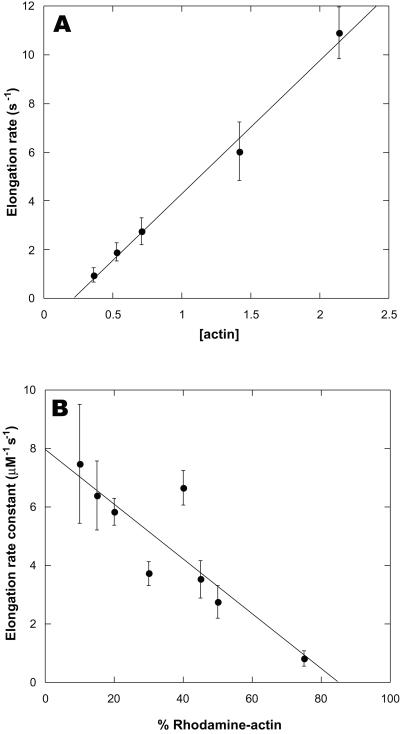
Dependence of barbed-end elongation rates on actin monomer
concentration. Actin filament elongation was observed as described in
Fig. 1. (A) Dependence on total actin concentration with
constant 40% rhodamine-actin. (B) Dependence on
fraction of rhodamine-labeled actin with 1 μM total actin. Values
shown are the mean ± SD of at least six randomly chosen growing
filaments per condition. Lines represent linear least-squares fits to
the mean values.
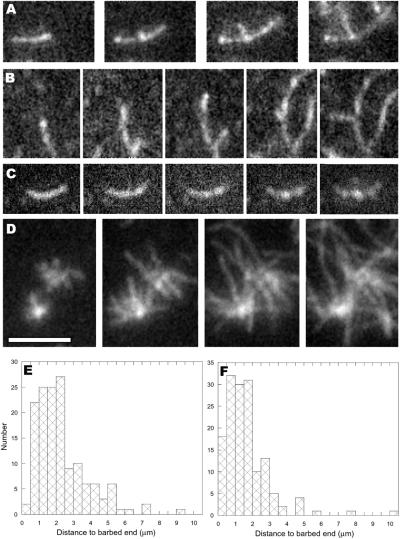
Actin filament branch formation. Filament elongation of 20% rhodamine
actin was visualized by TIRFM as described in Fig. 1. (A
and B) Actin monomers (1 μM) were visualized
polymerizing for 2 min before addition of 100 nM Arp2/3 complex, 300
nM Scar WA, and 2 μM actin monomers. Frames shown were subsequently
captured at 100, 130, 170, and 210 (A) or 105, 135, 165,
270, and 305 (B) s after addition. (C)
Actin monomers (2 μM) were polymerized for 3 min before growing
branches for 3 min in the presence of 60 nM Arp2/3 complex, 500 nM
Scar WA, 4 μM profilin, and 2 μM actin. Frames shown were collected
at 0, 36, 75, 132, and 180 s after addition of branching mixture.
(D) Unbound components were washed from the
branched structures in C and 2 μM monomeric actin was
added to the cell. Frames shown were collected 0, 32, 72, and 108
s after monomer addition. (E and F)
Histograms of the distances from branch points to mother filament
barbed ends for branches growing from the sides of filaments that had
grown before addition of Arp2/3 complex (E) or from
portions of filaments that had grown in the presence of Arp2/3
complex (F). (Scale bar = 4 μm.)
References
-
- Theriot J A, Mitchison T J. Nature (London) 1991;352:126–131. - PubMed
-
- Straub F B, Feuer G. Biochem Biophys Acta. 1949;4:455–470.
Publication types
MeSH terms
Substances
Grants and funding
LinkOut - more resources
Full Text Sources
Other Literature Sources
