. 2001 Dec 18;98(26):15119-24.
doi: 10.1073/pnas.261573998. Epub 2001 Dec 11.

A genome-wide analysis of immune responses in Drosophila

Affiliations

A genome-wide analysis of immune responses in Drosophila

P Irving et al. Proc Natl Acad Sci U S A. .

Abstract

Oligonucleotide DNA microarrays were used for a genome-wide analysis of immune-challenged Drosophila infected with Gram-positive or Gram-negative bacteria, or with fungi. Aside from the expression of an established set of immune defense genes, a significant number of previously unseen immune-induced genes were found. Genes of particular interest include corin- and Stubble-like genes, both of which have a type II transmembrane domain; easter- and snake-like genes, which may fulfil the roles of easter and snake in the Toll pathway; and a masquerade-like gene, potentially involved in enzyme regulation. The microarray data has also helped to greatly reduce the number of target genes in large gene groups, such as the proteases, helping to direct the choices for future mutant studies. Many of the up-regulated genes fit into the current conceptual framework of host defense, whereas others, including the substantial number of genes with unknown functions, offer new avenues for research.


Figures
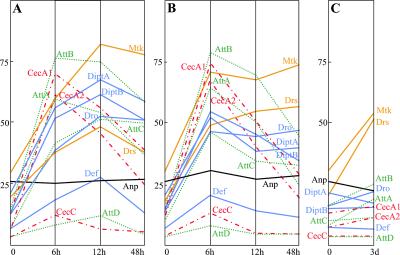
Figure 1
Figure 1
Absolute expression levels of antimicrobial peptide genes after microbial challenge. Expression of antimicrobial peptide genes in cn bw flies was assessed at 6, 12, and 48 h after inoculation with (A) E. coli and (B) M. luteus, and 3 days after natural infection with B. bassiana (C). Mtk and Drs (antifungal peptide genes), orange lines; Att gene family, green dotted lines; Cec gene family, red dash-dotted lines; Anp, black line; Dpt, Dro, and Def genes, blue lines.
Figure 3
Figure 3
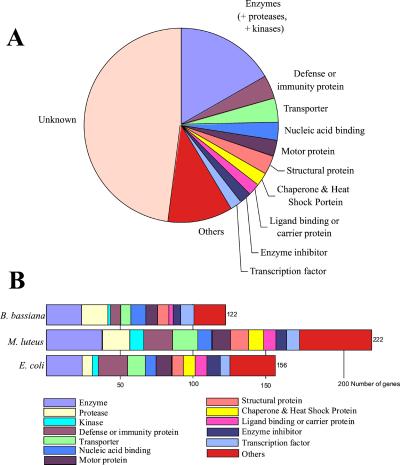
Drosophila genes up-regulated 2-fold or more during microbial challenge according to gene functional group. (A) Genes up-regulated 2-fold or more regardless of microbial challenge, including genes with unknown function. Genes were assigned to functional categories according to the protocol described in Table 2 (which is published as supporting information on the PNAS web site) with the additional fusion of enzymes, proteases, and kinases into one category and the regroupment of all categories containing six genes or less into “other.” (B) Number of genes whose expression was up-regulated 2-fold or more according to microbial challenge, excluding genes of unknown function. Genes were assigned to functional categories according to the protocol described in Table 2 with the regroupment of all categories containing six genes or less into “other.”
Figure 2
Figure 2
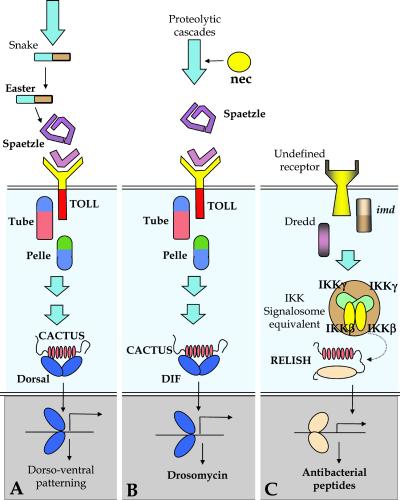
Distal components of the dorso-ventral, Toll, and Imd signaling pathways. (A) The distal part of the embryonic dorso-ventral patterning pathway, showing the end of the proteolytic cascade that leads to the cleavage of Spaetzle and intracellular signaling. (B) Established elements of the distal part of the Toll pathway, where a serpin, nec, regulated a proteolytic cascade leading to the cleavage of Spaetzle. This pathway reuses many of the components seen in embryonic dorso-ventral patterning, and it is induced by infection with Gram-positive bacteria and fungi. (C) Established elements of the Imd pathway, which is induced by Gram-negative bacteria. At present, none of components in the extracellular cascades are known for this pathway.

References

    1. Hoffmann J A, Kafatos F C, Janeway C A, Jr, Ezekowitz R A B. Science. 1999;284:1313–1318. - PubMed
    1. Borregaard N, Elsbach P, Ganz T, Garred P, Svejgaard A. Immunology. 2000;21:68–70. - PubMed
    1. Carton Y, Nappi A J. Immunogenetics. 2001;52:157–164. - PubMed
    1. Meister M, Hetru C, Hoffmann J A. Curr Top Microbiol Immunol. 2000;248:17–36. - PubMed
    1. Khush R S, Lemaitre B. Trends Genet. 2000;16:442–449. - PubMed

Publication types

LinkOut - more resources