. 2001 Dec 17;20(24):7052-9.
doi: 10.1093/emboj/20.24.7052.

Phosphorylation of Nedd4-2 by Sgk1 regulates epithelial Na(+) channel cell surface expression

Affiliations

Phosphorylation of Nedd4-2 by Sgk1 regulates epithelial Na(+) channel cell surface expression

C Debonneville et al. EMBO J. .

Abstract

The epithelial Na(+) channel (ENaC) plays an essential role in the regulation of whole body Na(+) balance and blood pressure. The cell surface expression of this channel, a complex of three subunits (alpha, beta and gamma ENaC), has been shown to be regulated by hormones such as aldosterone and vasopressin and by intracellular signaling, including ubiquitylation and/or phosphorylation. However, the molecular mechanisms involving phosphorylation in the regulation of ENaC are unclear. Here we show by expression studies in Xenopus laevis oocytes that the aldosterone-induced Sgk1 kinase interacts with the ubiquitin protein ligase Nedd4-2 in a PY motif-dependent manner and phosphorylates Nedd4-2 on Ser444 and, to a lesser extent, Ser338. Such phosphorylation reduces the interaction between Nedd4-2 and ENaC, leading to elevated ENaC cell surface expression. These data show that phosphorylation of an enzyme involved in the ubiquitylation cascade (Nedd4-2) controls cell surface density of ENaC and propose a paradigm for the control of ion channels. Moreover, they suggest a novel and complete signaling cascade for aldosterone-dependent regulation of ENaC.


Figures
None
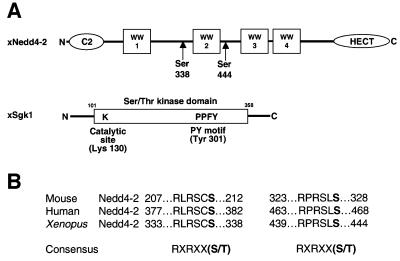
Fig. 1. Schematic view of Nedd4-2 and Sgk1. (A) Scheme of Xenopus Nedd4-2 with the consensus phosphorylation sites and Xenopus Sgk1 with the indication of the catalytic domain, the catalytically essential Lys130 and the PY motif. (B) Conserved consensus phosphorylation sites in mouse, human and Xenopus Nedd4-2.
None
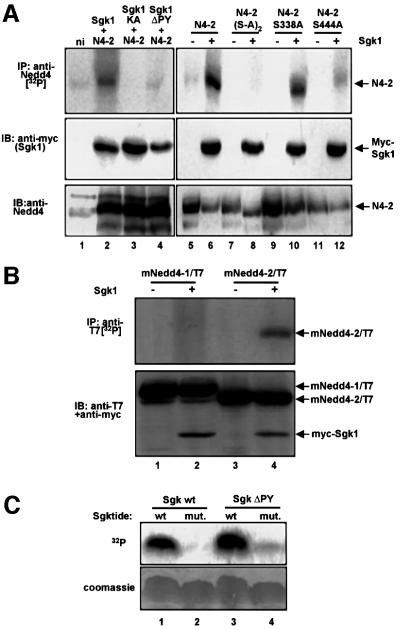
Fig. 2. Sgk1 phosphorylates Nedd4-2, but not Nedd4-1. (A) Oocytes expressing either wild-type Nedd4-2 (N4-2) or the phosphorylation mutants Nedd4-2-S338A-S444A [N4-2(S-A)2], Nedd4-2-S338A, Nedd4-2-S444A and myc-Sgk1 [wild-type, catalytically inactive (KA, K130A) or PY motif-mutated (ΔPY, Y301A)] were incubated with [32P]ortho–phosphate and treated as follows: top, immunoprecipitation from lysates with anti-Nedd4-2 antibodies and autoradiography; middle, western blot on lysates with anti-myc antibody (recognizing Sgk1); bottom, western blot on lysates with anti-Nedd4-2 antibodies. (B) Mouse Nedd4-1 (mNedd4-1/T7) or Nedd4-2 (mNedd4-2/T7), both epitope-tagged with a T7 epitope (Novagen), were expressed with or without Sgk1 (as indicated) and phosphorylation was followed as described in (A), except that the Nedd4 proteins were immunoprecipitated with anti-T7 antibody (top). Expression of mNedd4-1, mNedd4-2 and Sgk1 was followed by western blot analysis on lysates, using both anti-T7 (Nedd4-1 or Nedd4-2) and anti-myc (Sgk1) antibodies. (C) Phosphorylation of a synthetic peptide substrate (Sgktide) by Sgk1. Wild-type and mutant myc-Sgk1 (lacking a functional PY motif) were expressed in Xenopus oocytes and immunoprecipitated with anti-myc antibodies. The immunoprecipitated kinases were assayed in a kinase assay with Sgktide or a mutant peptide lacking the phosphorylation site as described in Materials and methods. Phosphorylated peptides were then analyzed by separation on a tricine acrylamide gel followed by autoradiography. Both wild-type and mutant Sgk1 were able to phosphorylate Sgktide, but not its mutant (top). Bottom, Coomassie Blue staining.
None
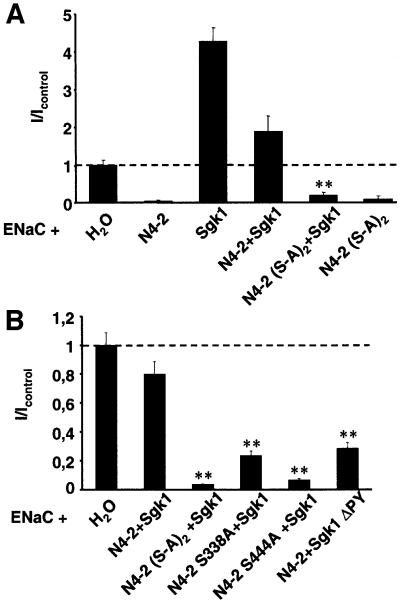
Fig. 3. Sgk1-dependent regulation of ENaC requires Nedd4-2 phosphorylation sites and the PY motifs on Sgk1. (A) Oocytes were injected with cRNA encoding Nedd4-2 or the Nedd4-2 phosphorylation mutant, Sgk1 cRNA and ENaC (as indicated). Amiloride-sensitive Na+ currents were measured and normalized to control oocytes (expressing only ENaC). n = 15 oocytes from three animals; **p <0.01 level of significance versus N4-2 + Sgk1. (B) Same as (A), but cRNA encoding either wild-type or mutant Sgk1 (Sgk1ΔPY), wild-type or phosphorylation site mutant Nedd4-2 and ENaC (as indicated) were injected, ** p <0.01 versus control. The observed variation of N4-2 + Sgk1 between (A) and (B) is due to batch-to-batch variation.
None
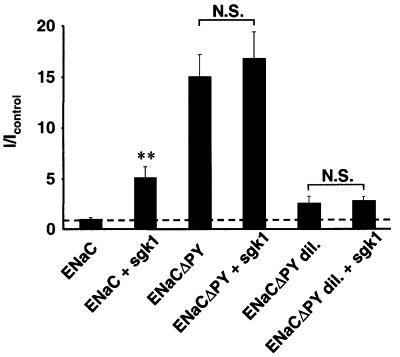
Fig. 4. The PY motifs of ENaC are required for stimulation of ENaC by Sgk1. Currents of oocytes expressing either wild-type ENaC or mutant ENaC lacking all PY motifs (ENaCΔPY), with and without Sgk1. ENaCΔPYdil containing 10 times less cRNA encoding ENaC was injected in order to get lower basal amiloride-sensitive currents. n = 18 oocytes from three animals; **p >0.01 versus ENaC.
None
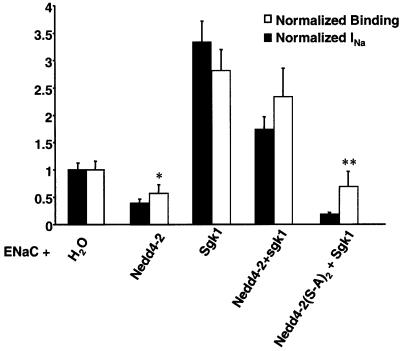
Fig. 5. Sgk1-dependent phosphorylation of Nedd4-2 controls ENaC cell surface expression. Oocytes were co-injected with cRNA encoding FLAG-tagged ENaC together with either H2O, wild-type or mutant Nedd4-2 lacking both phosphorylation sites [Nedd4(S-A)2] and Sgk1, as indicated. Amiloride-sensitive Na+ currents (filled bars) and binding of iodinated anti-FLAG antibodies (non-filled bars) to quantitate the number of channels at the cell surface were measured in the same oocytes, as described previously (Firsov et al., 1996; Abriel et al., 1999). Current and binding values were normalized to control values (ENaC + H2O). n = 18 oocytes from three animals; *p <0.05 versus control, **p <0.01 versus Nedd4-2 + Sgk1.
None
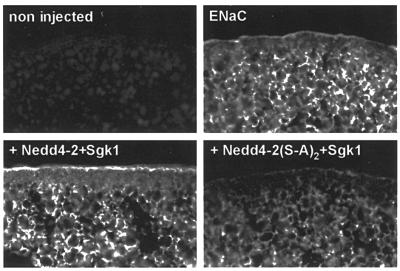
Fig. 6. Immunostaining of ENaC in oocytes expressing either wild-type or phosphorylation mutant Nedd4-2 and Sgk1. FLAG-tagged ENaC was followed by immunofluorescence with anti-FLAG antibodies on cryosections in either uninjected oocytes or oocytes expressing ENaC alone, ENaC plus wt-Nedd4-2 plus Sgk1 (+ Nedd4-2 + Sgk1) or ENaC plus Nedd4-2 S338A-S444A plus Sgk1 [+ Nedd4(S-A)2 + Sgk1].
None
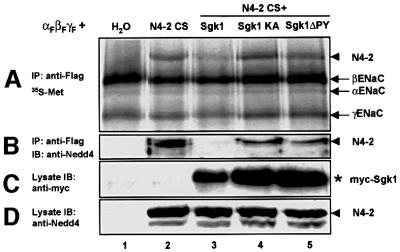
Fig. 7. Sgk1 interferes with ENaC–Nedd4-2 interaction. Oocytes were injected with cRNA encoding FLAG-tagged ENaC, Nedd4-2-CS and Sgk1, as indicated. After overnight incubation with [35S]methionine, membrane fractions were lysed and immunoprecipitations performed with anti-FLAG antibodies. (A) Immunoprecipitated material analyzed by SDS–PAGE autoradiography and (B) western blotting using an anti-Nedd4-2 antiserum. Lysates were analyzed by western blotting using (C) anti-c-myc (i.e. Sgk1) and (D) anti-Nedd4-2 antibodies.

References

    1. Abriel H., Loffing,J., Rebhun,J.F., Pratt,J.H., Horisberger,J.-D., Rotin,D. and Staub,O. (1999) Defective regulation of the epithelial Na+ channel (ENaC) by Nedd4 in Liddle’s syndrome. J. Clin. Invest., 103, 667–673. - PMC - PubMed
    1. Abriel H., Kamynina,E., Horisberger,J.-D. and Staub,O. (2000) Regulation of the cardiac voltage-gated Na+ channel (rH1) by the ubiquitin-protein ligase Nedd4. FEBS Lett., 466, 377–380. - PubMed
    1. Alvarez de la Rosa D., Zhang,P., Naray-Fejes-Toth,A., Fejes-Toth,G. and Canessa,C.M. (1999) The serum and glucocorticoid kinase sgk increases the abundance of epithelial sodium channels in the plasma membrane of Xenopus oocytes. J. Biol. Chem., 274, 37834–37839. - PubMed
    1. Blazer-Yost B.L., Paunescu,T.G., Helman,S.I., Lee,K.D. and Vlahos,C.J. (1999) Phosphoinositide 3-kinase is required for aldosterone-regulated sodium reabsorption. Am. J. Physiol., 277, C531–C536. - PubMed
    1. Bonifacino J.S. and Weissman,A.M. (1998) Ubiquitin and the control of protein fate in the secretory and endocytic pathways. Annu. Rev. Cell. Dev. Biol., 14, 19–57. - PMC - PubMed

Publication types

MeSH terms