


Tularemia outbreak investigation in Kosovo: case control and environmental studies
- PMID: 11749751
- PMCID: PMC2730257
- DOI: 10.3201/eid0801.010131
Tularemia outbreak investigation in Kosovo: case control and environmental studies
Abstract
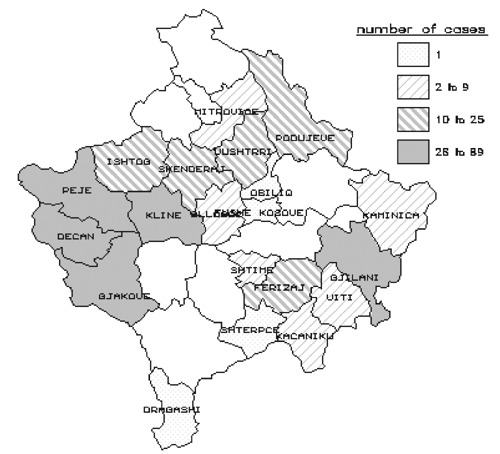
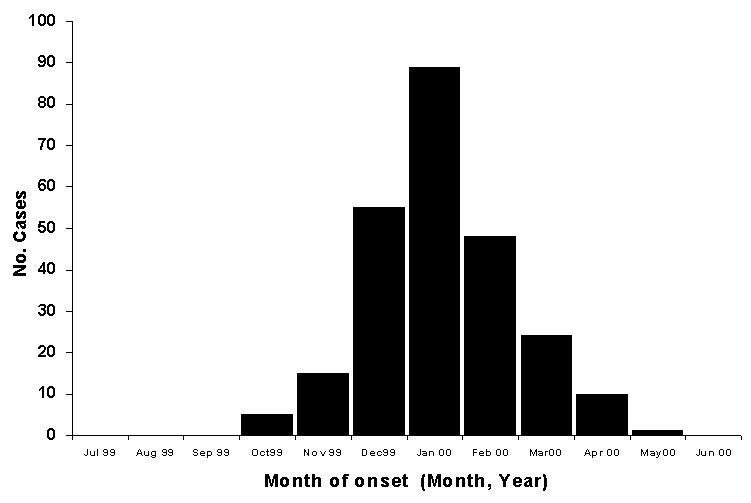
A large outbreak of tularemia occurred in Kosovo in the early postwar period, 1999-2000. Epidemiologic and environmental investigations were conducted to identify sources of infection, modes of transmission, and household risk factors. Case and control status was verified by enzyme-linked immunosorbent assay, Western blot, and microagglutination assay. A total of 327 serologically confirmed cases of tularemia pharyngitis and cervical lymphadenitis were identified in 21 of 29 Kosovo municipalities. Matched analysis of 46 case households and 76 control households suggested that infection was transmitted through contaminated food or water and that the source of infection was rodents. Environmental circumstances in war-torn Kosovo led to epizootic rodent tularemia and its spread to resettled rural populations living under circumstances of substandard housing, hygiene, and sanitation.
Figures

References
-
- World Health Organization. Tularemia, Kosovo [news]. Wkly Epidemiol Rec. 2000;75:133–4. - PubMed
-
- Gelman AC. The ecology of tularemia. In: May JM, editor. Studies in disease ecology. New York: Hafner Publishing Company; 1961. p. 89-108.
-
- Pearson AP. Tularemia. In: Palmer SR, Lord Soulsby, Simpson DIH, editors. Zoonoses: biology, clinical practice, and public health control. Oxford: Oxford University Press; 1998. p. 267-80.
-
- Hopla CE. The ecology of tularemia. Adv Vet Sci Comp Med. 1974;18:25–53. - PubMed
-
- Penn RL. Francisella tularensis (tularemia). In: Wintrobe MM, Thorn GW, Adams RD, Benett IL, Braunwald E, Isselbacher KJ, et al., editors. Harrison’s principles of internal medicine. New York: McGraw-Hill; 1994. p. 2060-7.
Publication types
MeSH terms
LinkOut - more resources
Full Text Sources
Other Literature Sources
Medical