


Case Reports
doi: 10.3201/eid0801.010108.
First case of human rabies in chile caused by an insectivorous bat virus variant
Affiliations
- PMID: 11749754
- PMCID: PMC2730271
- DOI: 10.3201/eid0801.010108
Item in Clipboard
Case Reports
First case of human rabies in chile caused by an insectivorous bat virus variant
Emerg Infect Dis.
2002 Jan.
Abstract
The first human rabies case in Chile since 1972 occurred in March 1996 in a patient without history of known exposure. Antigenic and genetic characterization of the rabies isolate indicated that its reservoir was the insectivorous bat Tadarida brasiliensis. This is the first human rabies case caused by an insectivorous bat rabies virus variant reported in Latin America.
Figures
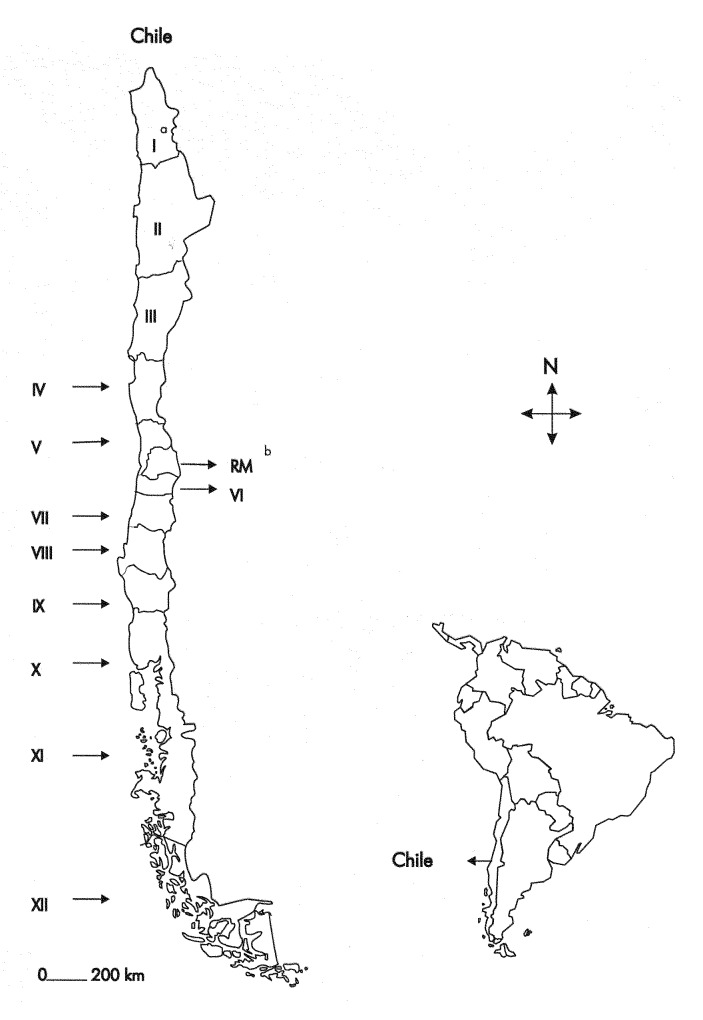
Map of South America showing the geographic position of Chile and map of Chile presenting the geographic distribution of the administrative regions of the country. aNumber of the corresponding administrative region. bMetropolitan region.
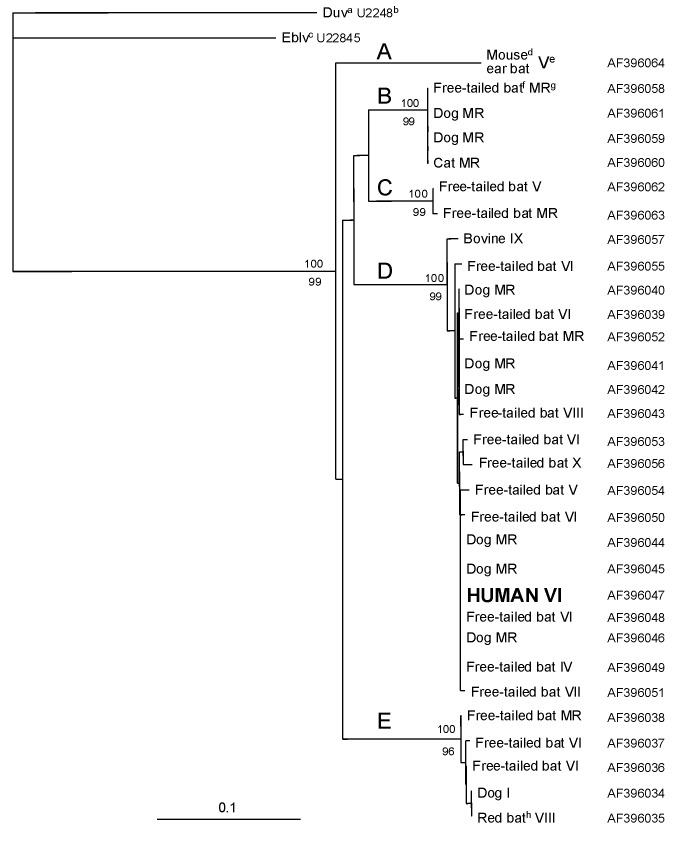
Neighbor-joining tree comparing the human rabies isolate with representatives of the rabies genetic variants obtained from insectivorous bats and domestic animals in Chile . Bootstrap values obtained from 100 resamplings of the data by using distance matrix (top) and parsimony methods (bottom) are shown at nodes corresponding to the lineages representing the rabies virus variants (A, B, C, D, and E) currently circulating in Chile. Only bootstrap values >50% are shown at the branching points. The bar at the left corner indicates 0.1 nucleotide substitutions per site. aDuvenhage virus, bGenBank accession number, cEuropean bat Lyssavirus, dMyotis chiloensis, eRoman numerals indicate the administrative region where the sample was obtained, fTadarida brasiliensis, gMetropolitan region, hLasiurus borealis.
References
-
- Carini A. Sur une grande Épizootie de rage. Annales de L’Institut Pasteur (Paris). 1911;25:843–6.
-
- Pawan JL. The transmission of rabies in Trinidad by the vampire bat. Ann Trop Med Parasitol. 1936;30:101–30.
-
- Baer GM, Smith JS. Rabies in nonhematophagous bats. In: Baer GM, editor. The natural history of rabies. 2nd ed. Boca Raton (FL): CRC Press; 1991. p. 341-66.
-
- Acha PN, Arambulo PV III. Rabies in the tropics, history and current status. In: Kuwert E, Merieux C, Koprowski H, Bögel K, editors. Rabies in the Tropics. Berlin: Springer-Verlag; 1985. p. 343-59.
-
- Favi M, Catalan R. Rabia en murciélagos en Chile. Avances en Ciencias Veterinarias. 1986;1:73–6.
Publication types
MeSH terms
LinkOut - more resources
Full Text Sources
Medical