


Molecular evolution of H6 influenza viruses from poultry in Southeastern China: prevalence of H6N1 influenza viruses possessing seven A/Hong Kong/156/97 (H5N1)-like genes in poultry
- PMID: 11752141
- PMCID: PMC136834
- DOI: 10.1128/jvi.76.2.507-516.2002
Molecular evolution of H6 influenza viruses from poultry in Southeastern China: prevalence of H6N1 influenza viruses possessing seven A/Hong Kong/156/97 (H5N1)-like genes in poultry
Abstract
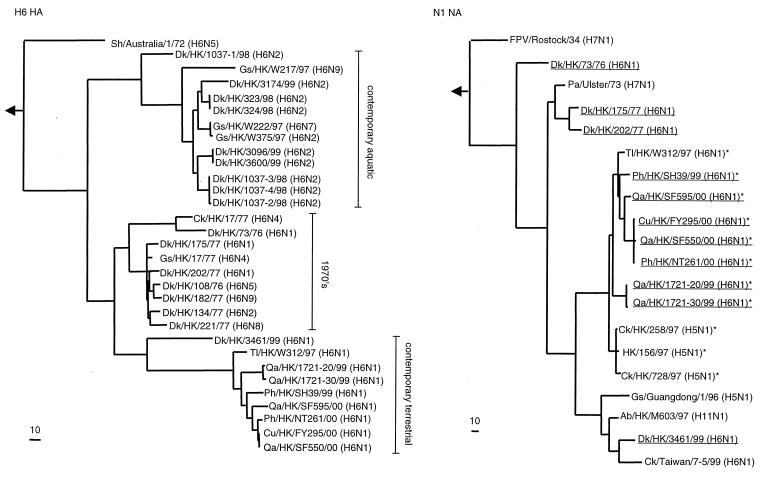
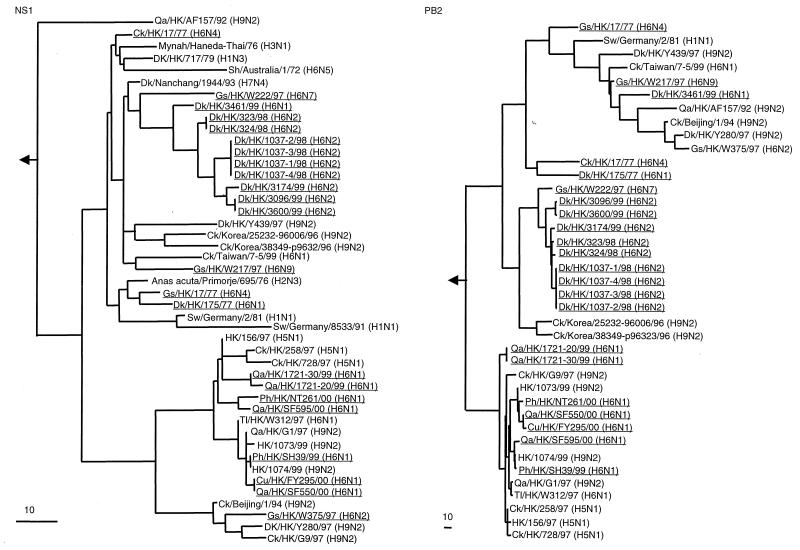
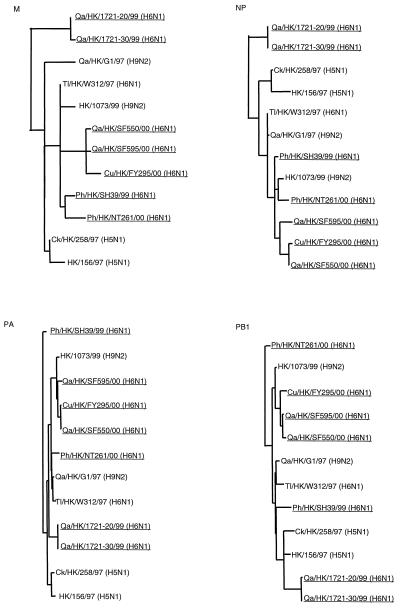
The A/teal/Hong Kong/W312/97 (H6N1) influenza virus and the human H5N1 and H9N2 influenza viruses possess similar genes encoding internal proteins, suggesting that H6N1 viruses could become novel human pathogens. The molecular epidemiology and evolution of H6 influenza viruses were characterized by antigenic and genetic analyses of 29 H6 influenza viruses isolated from 1975 to 1981 and 1997 to 2000. Two distinct groups were identified on the basis of their antigenic characteristics. Phylogenetic analysis revealed that all H6N1 viruses isolated from terrestrial poultry in 1999 and 2000 are closely related to A/teal/Hong Kong/W312/97 (H6N1), and the nucleotide sequences of these viruses and of A/Hong Kong/156/97 (H5N1) were more than 96% homologous. The hemagglutinin (HA) of the 1999 and 2000 terrestrial viruses does not have multiple basic amino acids at the site of cleavage of HA1 to HA2; however, a unique insertion of aspartic acid in HA1 between positions 144 and 145 (H3 numbering) was found. The neuraminidase of these terrestrial H6N1 viruses has a deletion of 19 amino acids characteristic of A/Hong Kong/156/97 (H5N1). Evolutionary analysis suggested that these H6N1 viruses coevolved with A/quail/Hong Kong/G1/97-like H9N2 viruses and became more adapted to terrestrial poultry. These terrestrial 1999 and 2000 A/teal/Hong Kong/W312/97 (H6N1)-like viruses, along with the H9N2 viruses, could have been involved in the genesis of the pathogenic H5N1 influenza viruses of 1997. The presence of H6N1 viruses in poultry markets in Hong Kong that possess seven of the eight genes of the A/Hong Kong/156/97 (H5N1) virus raises the following fundamental questions relevant to influenza pandemic preparedness: could the pathogenic H5N1 virus reemerge and could the H6N1 viruses directly cross the species barrier to mammals?
Figures
References
-
- Claas, E. C., A. D. Osterhaus, R. van Beek, J. C. de Jong, G. F. Rimmelzwaan, D. A. Senne, S. Krauss, K. F. Shortridge, and R. G. Webster. 1998. Human influenza A H5N1 virus related to a highly pathogenic avian influenza virus. Lancet 351:472–477. - PubMed
-
- Connor, R. J., Y. Kawaoka, R. G. Webster, and J. C. Paulson. 1994. Receptor specificity in human, avian, and equine H2 and H3 influenza virus isolates. Virology 205:17–23. - PubMed
-
- Downie, J. C., and W. G. Laver. 1973. Isolation of a type A influenza virus from an Australian pelagic bird. Virology 51:259–269. - PubMed
-
- Gardner, I. D., and K. F. Shortridge. 1979. Recombination as a mechanism in the evolution of influenza viruses: a two-year study of ducks in Hong Kong. Rev. Infect. Dis. 1:885–890. - PubMed
Publication types
MeSH terms
Substances
Associated data
- Actions
- Actions
- Actions
- Actions
- Actions
- Actions
- Actions
- Actions
- Actions
- Actions
- Actions
- Actions
- Actions
- Actions
- Actions
- Actions
- Actions
- Actions
- Actions
- Actions
- Actions
- Actions
- Actions
- Actions
- Actions
- Actions
- Actions
- Actions
- Actions
- Actions
- Actions
- Actions
- Actions
- Actions
- Actions
- Actions
- Actions
- Actions
- Actions
- Actions
- Actions
- Actions
- Actions
- Actions
- Actions
- Actions
- Actions
- Actions
- Actions
- Actions
- Actions
- Actions
- Actions
- Actions
- Actions
- Actions
- Actions
- Actions
- Actions
- Actions
- Actions
- Actions
- Actions
- Actions
- Actions
- Actions
- Actions
- Actions
- Actions
- Actions
- Actions
- Actions
- Actions
- Actions
- Actions
- Actions
- Actions
- Actions
- Actions
- Actions
- Actions
- Actions
- Actions
- Actions
- Actions
- Actions
- Actions
- Actions
- Actions
- Actions
- Actions
- Actions
- Actions
- Actions
- Actions
- Actions
- Actions
- Actions
- Actions
- Actions
- Actions
- Actions
- Actions
- Actions
- Actions
- Actions
- Actions
- Actions
- Actions
- Actions
- Actions
- Actions
- Actions
- Actions
- Actions
- Actions
- Actions
- Actions
- Actions
- Actions
Grants and funding
LinkOut - more resources
Full Text Sources
Other Literature Sources
Medical
Research Materials
Miscellaneous
