


PALS db: Putative Alternative Splicing database
- PMID: 11752289
- PMCID: PMC99163
- DOI: 10.1093/nar/30.1.186
PALS db: Putative Alternative Splicing database
Abstract
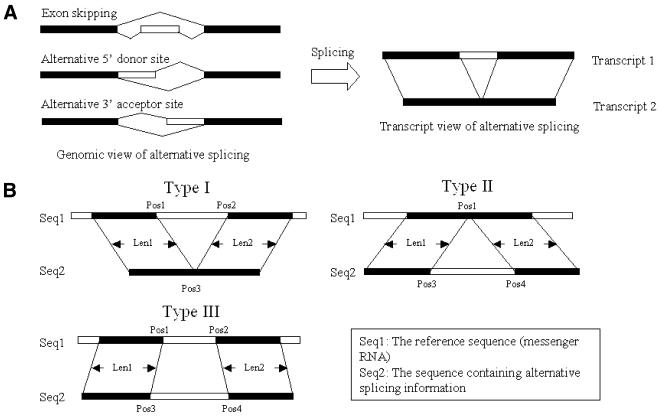
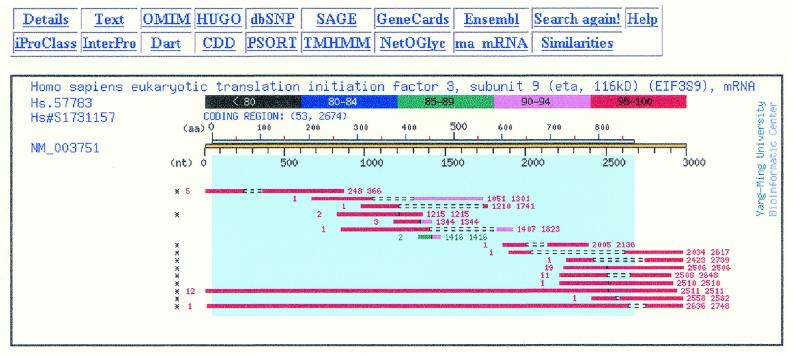
PALS db is a collection of Putative Alternative Splicing information from 19 936 human UniGene clusters and 16 615 mouse UniGene clusters. Alternative splicing (AS) sites were predicted by using the longest messenger RNA (mRNA) sequence in each UniGene cluster as the reference sequence. This sequence was aligned with related sequences in UniGene and dbEST to reveal the AS. This information was presented with six features: (i) literature aliases were used to improve the result of a gene name search; (ii) the quality of a prediction can be easily judged from the color-coded similarity and the scaled length of an alignment; (iii) we have clustered those EST sequences that support the same AS site together to enhance the users' confidence on a prediction; (iv) the users can also set up the alignment criteria interactively to recover false negatives; (v) tissue distribution can be displayed by placing the mouse cursor over an alignment; (vi) gene features will be analyzed at foreign sites by submitting the selected mRNA or its encoded protein as a query. Using these features, the users cannot only discover putative AS sites in silico, but also make new observations by combining AS information with tissue distributions or with gene features. PALS db is available at http://palsdb.ym.edu.tw/.
Figures
References
-
- Smith C.W. and Valcarcel,J. (2000) Alternative pre-mRNA splicing: the logic of combinatorial control. Trends Biochem. Sci., 25, 381–388. - PubMed
-
- Grabowski P.J. (1998) Splicing regulation in neurons: tinkering with cell-specific control. Cell, 92, 709–712. - PubMed
-
- Lahrtz F., Horstkorte,R., Cremer,H., Schachner,M. and Montag,D. (1997) VASE-encoded peptide modifies NCAM- and L1-mediated neurite outgrowth. J. Neurosci. Res., 50, 62–68. - PubMed
-
- Jiang Z.-H. and Wu,J.Y. (1999) Alternative splicing and programmed cell death. Proc. Soc. Exp. Biol. Med., 220, 64–72. - PubMed
-
- Yamamoto T., Nanba,E., Ninomiya,H., Higaki,K., Taniguchi,M., Zhang,H., Akaboshi,S., Watanabe,Y., Takeshima,T., Inui,K. et al. (1999) NPC1 gene mutations in Japanese patients with Niemann-Pick disease type C. Hum. Genet., 105, 10–16. - PubMed
Publication types
MeSH terms
Substances
LinkOut - more resources
Full Text Sources
Other Literature Sources
Research Materials
Miscellaneous
