


Glycopeptide antibiotic biosynthesis: enzymatic assembly of the dedicated amino acid monomer (S)-3,5-dihydroxyphenylglycine
- PMID: 11752437
- PMCID: PMC64956
- DOI: 10.1073/pnas.221582098
Glycopeptide antibiotic biosynthesis: enzymatic assembly of the dedicated amino acid monomer (S)-3,5-dihydroxyphenylglycine
Abstract
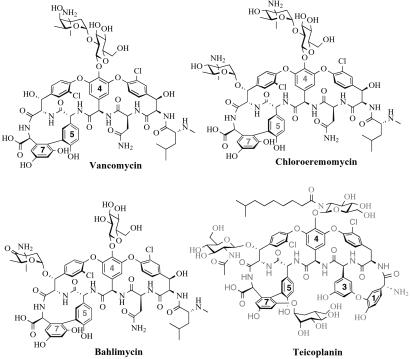
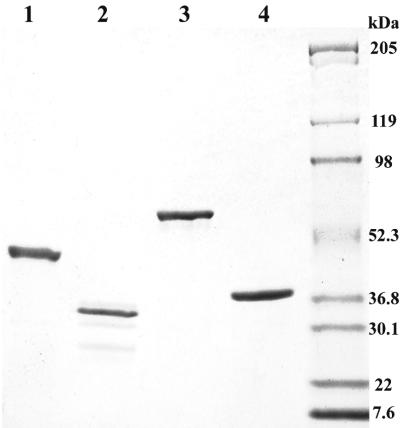
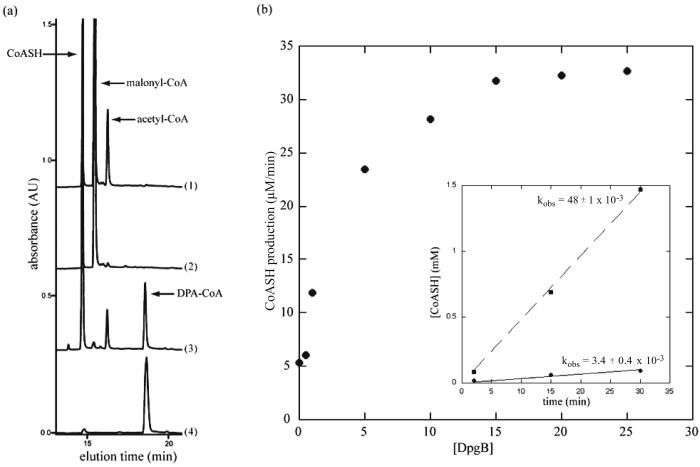
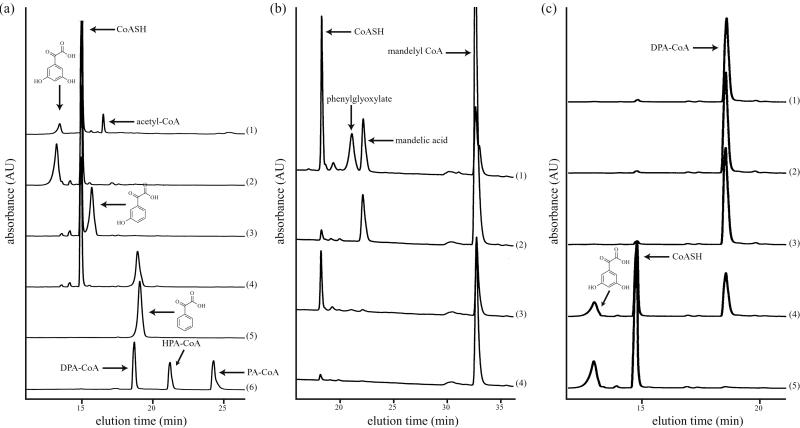
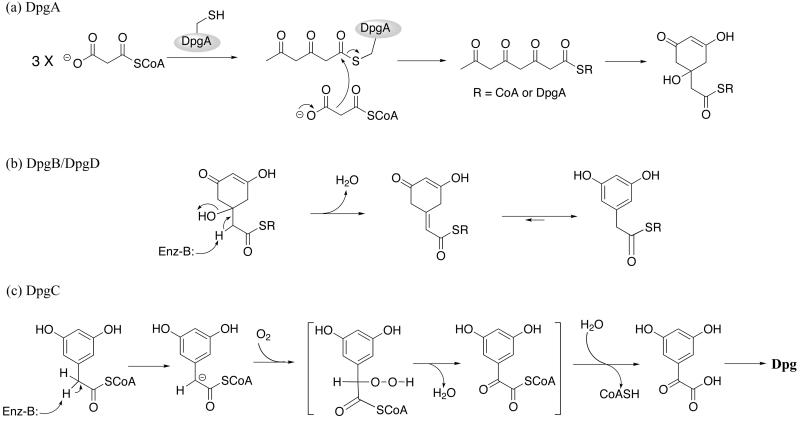
Four proteins, DpgA-D, required for the biosynthesis by actinomycetes of the nonproteinogenic amino acid monomer (S)-3,5-dihydroxyphenylglycine (Dpg), that is a crosslinking site in the maturation of vancomycin and teicoplanin antibiotic scaffolds, were expressed in Escherichia coli, purified in soluble form, and assayed for enzymatic activity. DpgA is a type III polyketide synthase, converting four molecules of malonyl-CoA to 3,5-dihydroxyphenylacetyl-CoA (DPA-CoA) and three free coenzyme A (CoASH) products. Almost no turnover was observed for DpgA until DpgB was added, producing a net k(cat) of 1-2 min(-1) at a 3:1 ratio of DpgB:DpgA. Addition of DpgD gave a further 2-fold rate increase. DpgC had the unusual catalytic capacity to convert DPA-CoA to 3,5-dihydroxyphenylglyoxylate, which is a transamination away from Dpg. DpgC performed a net CH(2) to C=O four-electron oxidation on the Calpha of DPA-CoA and hydrolyzed the thioester linkage with a k(cat) of 10 min(-1). Phenylacetyl-CoA was also processed, to phenylglyoxylate, but with about 500-fold lower k(cat)/K(M). DpgC showed no activity in anaerobic incubations, suggesting an oxygenase function, but had no detectable bound organic cofactors or metals. A weak enoyl-CoA hydratase activity was detected for both DpgB and DpgD.
Figures
References
-
- Moellering R C., Jr Am J Med. 1998;104:3S–6S. - PubMed
-
- Bardone M R, Paternoster M, Coronelli C. J Antibiot. 1978;31:170–177. - PubMed
-
- Reynolds P E. Eur J Clin Microbiol Infect Dis. 1989;8:943–950. - PubMed
-
- Williams D H, Williamson M P, Butcher D W, Hammond S J. J Am Chem Soc. 1983;105:1332–1339.
-
- Barna J C J, Williams D H, Williamson M P. J. Chem. Soc. Chem. Commun. 1985. 254–256.
Publication types
MeSH terms
Substances
Grants and funding
LinkOut - more resources
Full Text Sources
Other Literature Sources
Medical
Molecular Biology Databases
Miscellaneous
