. 2002 Jan 1;22(1):357-64.
doi: 10.1523/JNEUROSCI.22-01-00357.2002.

The suprachiasmatic nucleus is essential for circadian body temperature rhythms in hibernating ground squirrels

Affiliations

The suprachiasmatic nucleus is essential for circadian body temperature rhythms in hibernating ground squirrels

Norman F Ruby et al. J Neurosci. .

Abstract

Body temperature (T(b)) was recorded at 10 min intervals over 2.5 years in female golden-mantled ground squirrels that sustained complete ablation of the suprachiasmatic nucleus (SCNx). Animals housed at an ambient temperature (T(a)) of 6.5 degrees C were housed in a 12 hr light/dark cycle for 19 months followed by 11 months in constant light. The circadian rhythm of T(b) was permanently eliminated in euthermic and torpid SCNx squirrels, but not in those with partial destruction of the SCN or in neurologically intact control animals. Among control animals, some low-amplitude T(b) rhythms during torpor were driven by small (<0.1 degrees C) diurnal changes in T(a). During torpor bouts in which T(b) rhythms were unaffected by T(a), T(b) rhythm period ranged from 23.7 to 28.5 hr. Both SCNx and control squirrels were more likely to enter torpor at night and to arouse during the day in the presence of the light/dark cycle, whereas entry into and arousal from torpor occurred at random clock times in both SCNx and control animals housed in constant light. Absence of circadian rhythms 2.5 years after SCN ablation indicates that extra-SCN pacemakers are unable to mediate circadian organization in euthermic or torpid ground squirrels. The presence of diurnal rhythms of entry into and arousal from torpor in SCNx animals held under a light/dark cycle, and their absence in constant light, suggest that light can reach the retina of hibernating ground squirrels maintained in the laboratory and affect hibernation via an SCN-independent mechanism.


Figures
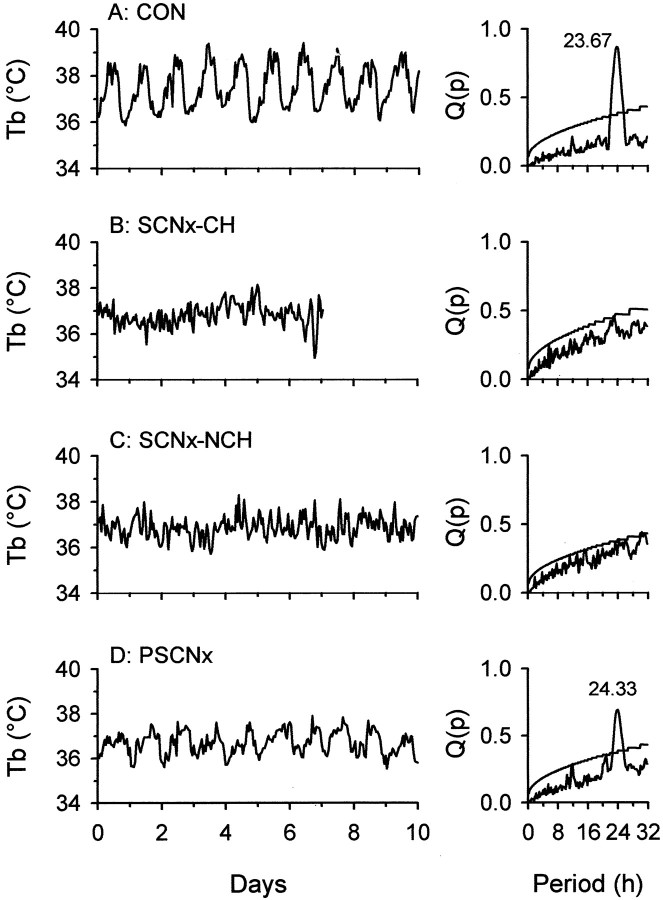
Fig. 1.
Fig. 1.
Representative Tb plots from control (A), SCNx-CH (B), SCNx-NCH (C), and PSCNx (D) squirrels. Periodogram results [Q(p)] for each animal are adjacent to their respective plots; tau is given for significant peaks (p < 0.001). Data inA, C, and D were obtained during the middle phase of each squirrel's annual nonhibernation season during housing in constant light. Because annual patterns of hibernation were eliminated in SCNx-CH animals,Tb data (B) were obtained for these squirrels during the single longest euthermic period during housing in constant light.
Fig. 2.
Fig. 2.
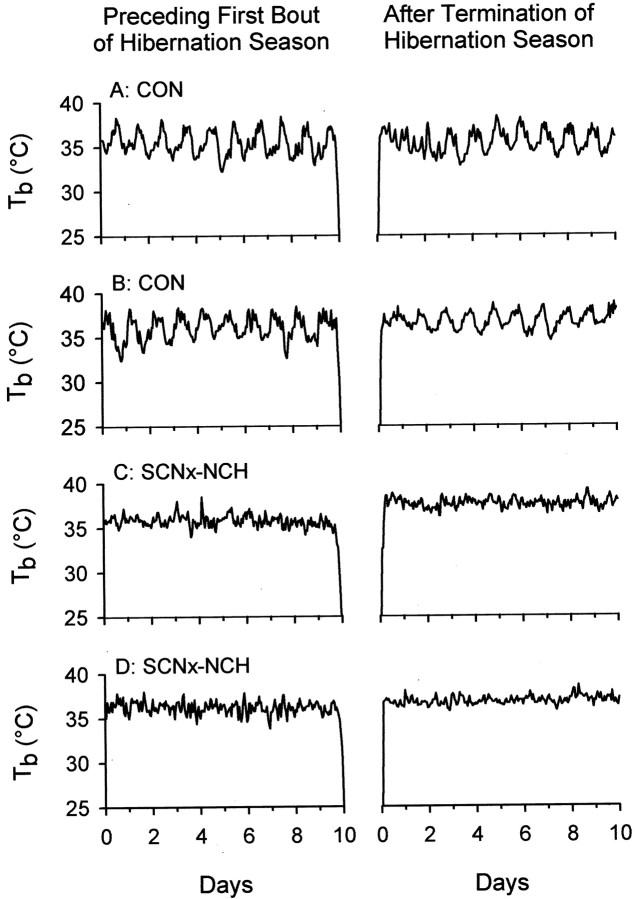
Representative Tb plots from different control (A, B) and SCNx-NCH (C, D) squirrels before (left panels) and after (right panels) a hibernation season in LL. CircadianTb rhythms were robust in all control animals in the days immediately preceding the onset of hibernation. Post-hibernation arrhythmicity was observed in two of six control animals and lasted for no more than 3 d (A, right panel). Tb rhythms were undetectable in SCNx-NCH squirrels before and after hibernation.
Fig. 3.
Fig. 3.
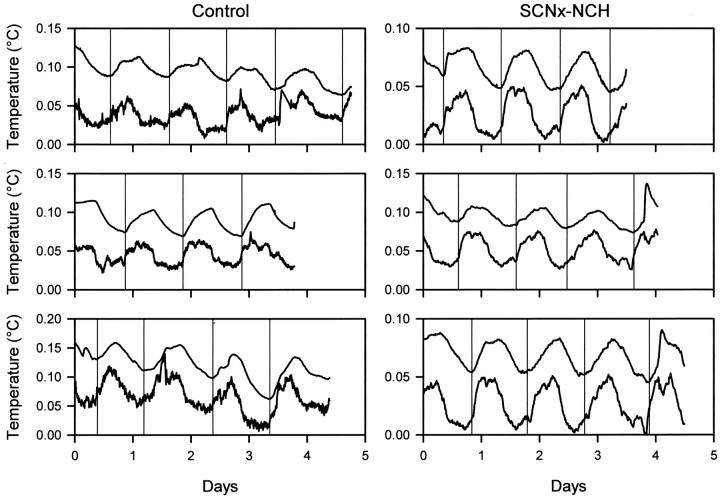
Representative plots of relativeTb and Ta values from control (left panels) and SCNx-NCH (right panels) squirrels during deep torpor bouts in which changes inTb closely parallel changes inTa. Tb is thetop, and Ta is thebottom line in each plot. Vertical reference lines indicate Tb nadirs. Data are plotted as relative values because the large difference betweenTb and Ta(2–3°C) and the very small rhythm amplitudes (<0.05°C in many cases) made rhythm synchrony difficult to visualize in the raw data. To facilitate visualization of phase relations betweenTb and Tarhythms, the interval between Tb andTa was reduced by subtracting a different constant from raw Tb andTa values for each torpor bout. This normalization procedure preserves the rhythm phases and amplitudes observed in the raw data. Note that rises inTa after the nadir always precede rises inTb.
Fig. 4.
Fig. 4.
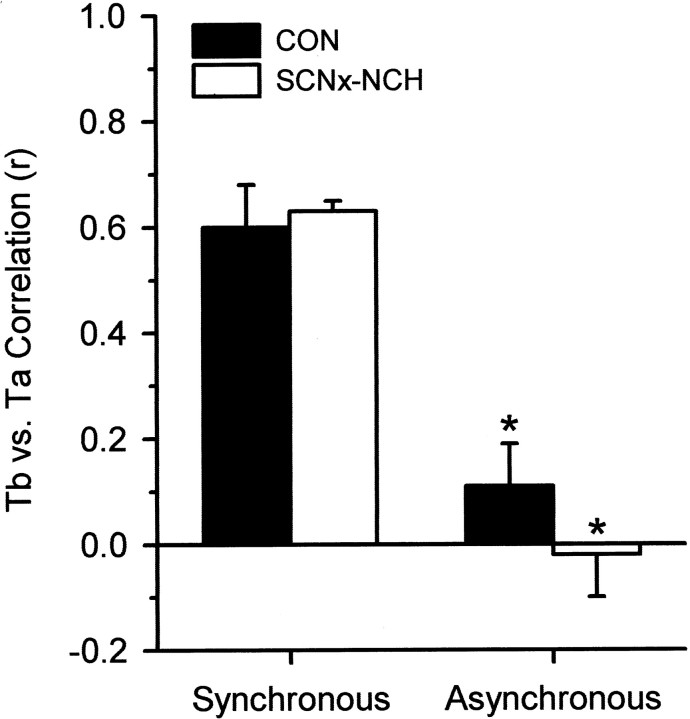
Mean (±SE) r values for correlations between Tb andTa for torpor bouts that were judged as synchronous or asynchronous based on visual inspection of the data. *p < 0.001 compared with synchronous bouts.
Fig. 5.
Fig. 5.
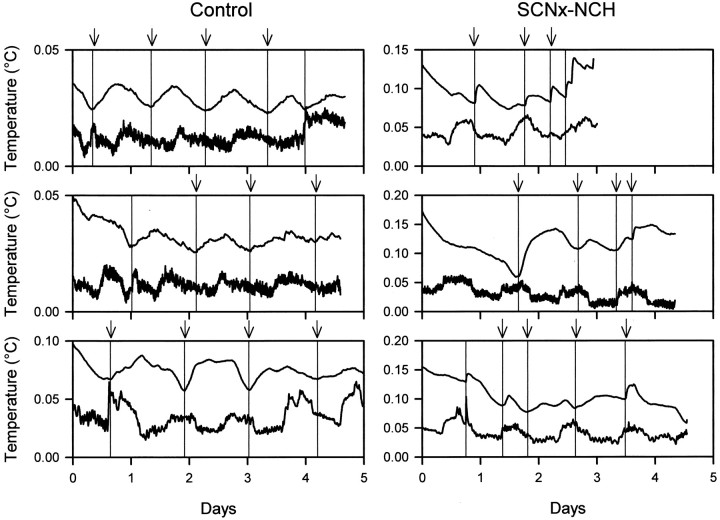
Representative Tb andTa plots from control (left panels) and SCNx-NCH (right panels) squirrels during deep torpor bouts in which Tb rhythms appear to be independent of changes in Ta. Conventions as in Figure 3. Note that rises inTb occur when Tais declining or stable (indicated by arrows). Absolute values were normalized as in Figure 3.
Fig. 6.
Fig. 6.
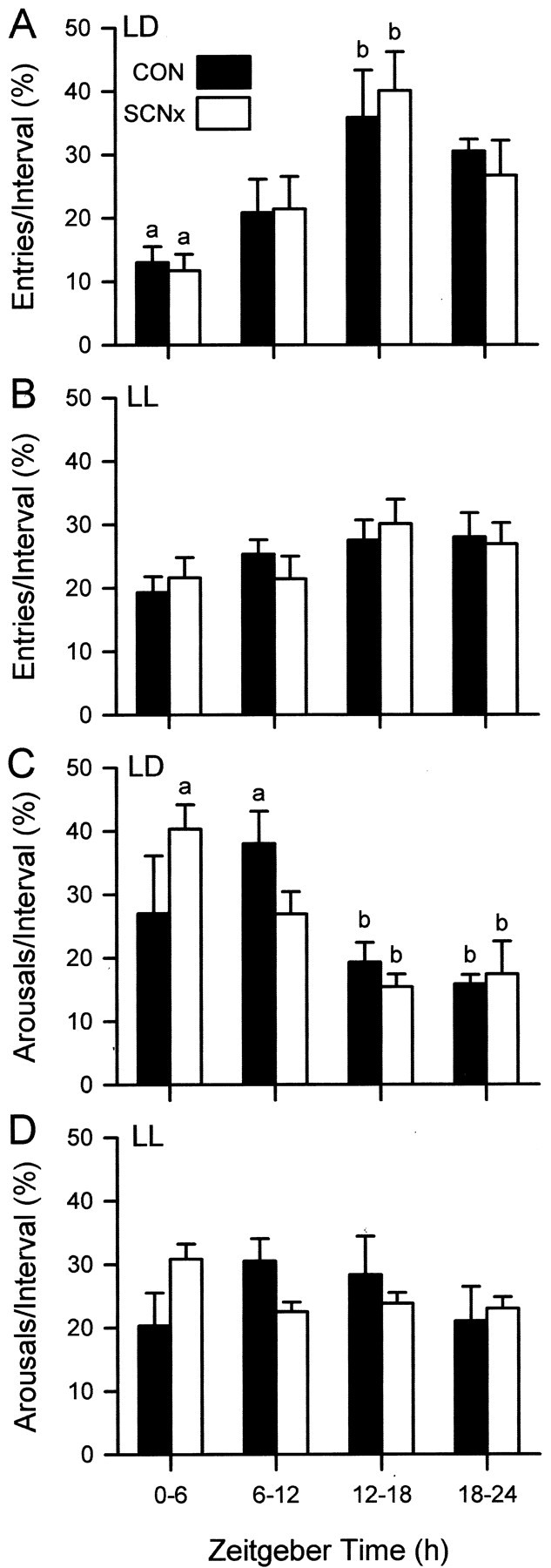
Time of day of entries in an LD cycle (A) and in LL (B) and of arousals from torpor in an LD cycle (C) and in LL (D) for control and SCNx squirrels. Bars with different letters differ significantly from each other (p < 0.05). There were no differences among control and SCNx animals in either lighting condition. Statistical comparisons were not made between LD and LL values. Zeitgeber time 0 = light onset (8:00 A.M. PST) in the 12 hr LD cycle.
Fig. 7.
Fig. 7.
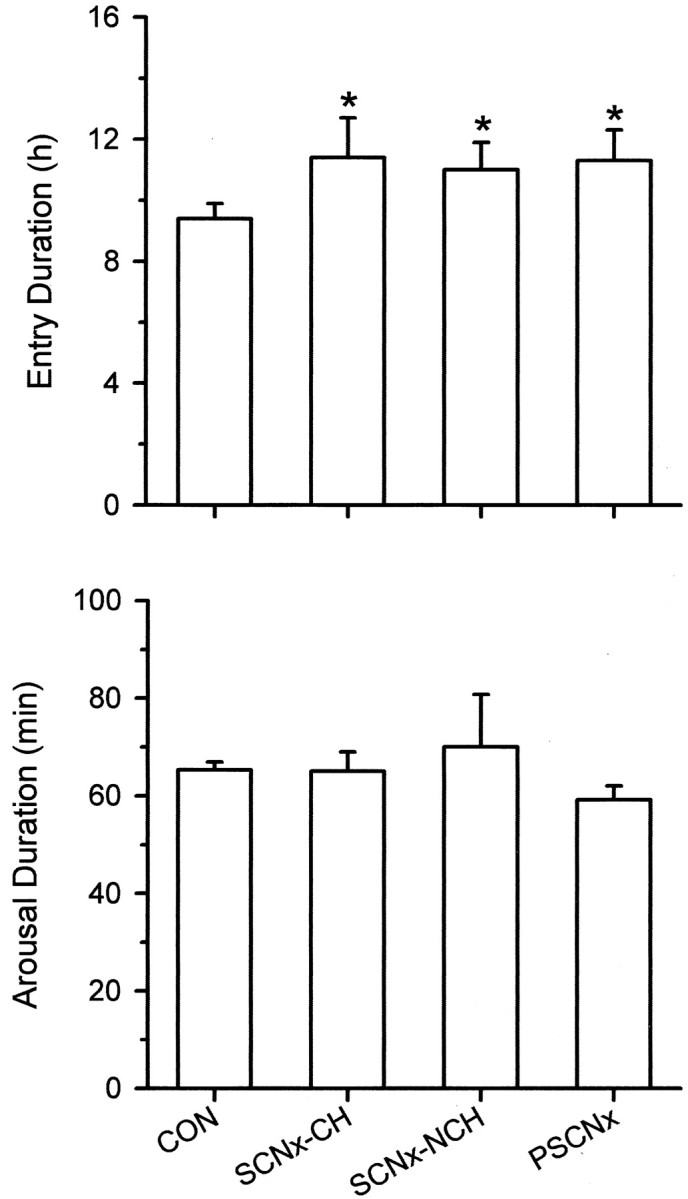
Torpor entry and arousal durations for all animals. Entries and arousals are defined as the time required forTb to change between 14 and 34°C. *p < 0.05 compared with control value.

References

    1. Aschoff J. Freerunning and entrained circadian rhythms. In: Aschoff J, editor. Handbook of behavioral neurobiology, Vol 4. Plenum; New York: 1981. pp. 81–93.
    1. Barnes BM, Ritter D. Patterns of body temperature change in hibernating Arctic ground squirrels. In: Carey C, Florant GL, Wunder BA, Horwitz B, editors. Life in the cold. Westview; Boulder, CO: 1993. pp. 119–130.
    1. Bittman EL, Bartness TJ, Goldman BD, DeVries GJ. Suprachiasmatic and paraventricular control of photoperiodism in Siberian hamsters. Am J Physiol. 1991;260:R90–R101. - PubMed
    1. Bronson MT. Altitudinal variations in the life history of the golden-mantled ground squirrel (Spermophilus lateralis). Ecology. 1979;60:272–279.
    1. Canguilhem B, Malan A, Masson-Pévet M, Nobelis P, Kirsch R, Pévet P, Le Minor J. Search for rhythmicity during hibernation in the European hamster. J Comp Physiol [B] 1994;163:690–698. - PubMed

Publication types

LinkOut - more resources